Euler's Eyes
2026-10-26
The names on theorems: Stigler's law
The names of theorems, formulas and numbers are a part of notation that almost nobody questions. We write “Pascal’s triangle”, “Pell’s equation”, “L’Hôpital’s rule” as if the name were a neutral label. It is not: the name records who was read, by whom and in what language.
A law that confirms itself
In 1980 the American statistician Stephen Stigler published a paper with a provocative law: no scientific discovery is named after its original discoverer. And, to round it off, he attributed the law to the sociologist Robert K. Merton, who had already studied the phenomenon. Stigler’s law of eponymy is therefore an example of itself. It exaggerates, but it is right with uncomfortable frequency.
The triangle of many names
The triangle of numbers in which each is the sum of the two above it bears the name of Blaise Pascal, who wrote a treatise on it in 1654. But it was already in the books of the Persian al-Karaji, around the year 1000, and of Omar Khayyam; it appears in the tenth-century Indian commentary of Halayudha; and in China the mathematician Yang Hui published it in 1261, attributing it to Jia Xian, who lived two centuries earlier. In China it is still called Yang Hui’s triangle; in Italy, Tartaglia’s triangle; in Iran, Khayyam’s triangle.
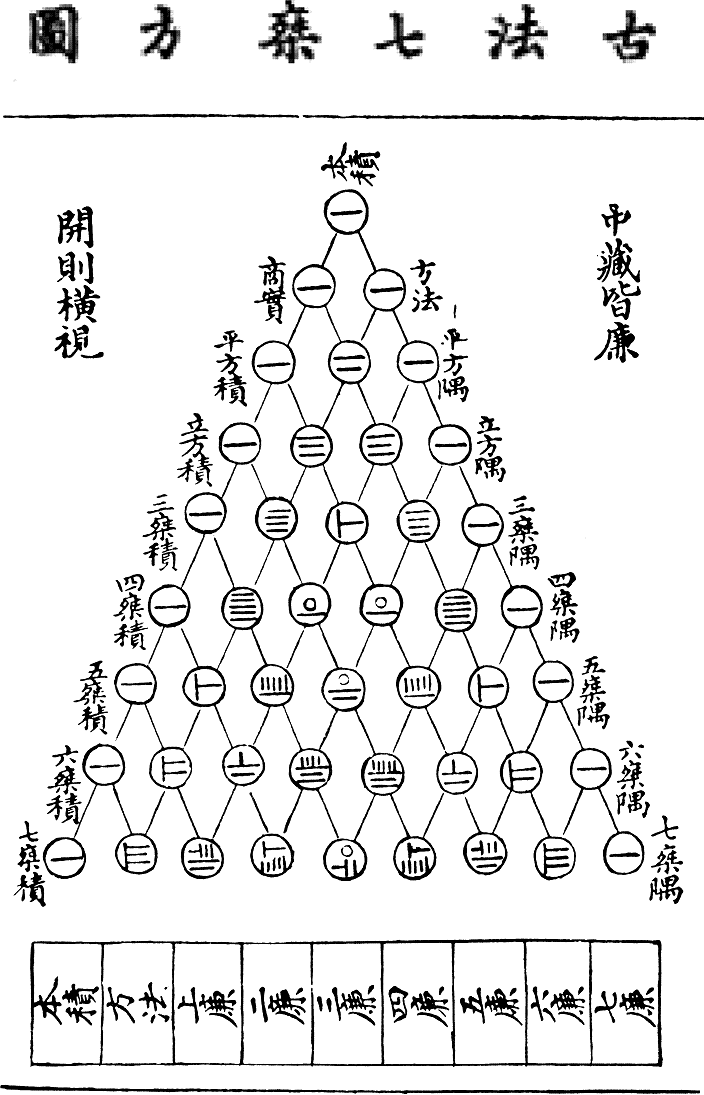
Zhu Shijie’s triangle, above, was drawn 350 years before Pascal, and notice that the numbers are written with the rods of the first text of the chapter. The name “Pascal’s” does not say who saw it first: it says that the mathematics that reached the world’s schools was European, and that Europeans read Pascal before they read Yang Hui.
Pell, who did nothing
The equation $x^2 - N y^2 = 1$, in which whole-number solutions are sought, is called Pell’s equation. The Englishman John Pell has almost nothing to do with it. The Indian Brahmagupta studied it in 628 and found a rule for combining solutions; Bhaskara II, around 1150, gave a method, the chakravala, that solves every case. In Europe, Fermat set it as a challenge in 1657 and William Brouncker solved it. It was Euler who, confusing Pell with Brouncker, gave it the wrong name, and the name stuck.
The rule that was bought
The rule that computes limits of the form $\frac{0}{0}$ by differentiating numerator and denominator bears the name of the marquis de L’Hôpital, who published it in 1696 in the first textbook of differential calculus. But the result was Johann Bernoulli’s, his private tutor. In 1694 the two had made a deal: L’Hôpital paid Bernoulli an annual pension and, in return, received his discoveries to use as he pleased. In this case, the notation records a contract.
Changing the names now would be impossible and perhaps not even desirable: the name is part of the sign, and changing it creates confusion. But knowing where the names come from changes what they teach. A triangle of many names is also a lesson that mathematics was made in many places.
Exercise: Zhu Shijie's last row
The last row of Zhu Shijie’s triangle gives the coefficients of $(a+b)^8$. Write it out and check the sum.
$1, 8, 28, 56, 70, 56, 28, 8, 1$. The sum is $256 = 2^8$, as in every row: setting $a = b = 1$, $(1+1)^8 = 2^8$. Look in the figure for the $70$ in the middle of the last row: the $7$ in the tens appears in the lying form of the rods, with one upright rod worth five and two lying rods.
Exercise: the smallest Pell solution
Find the smallest solution in positive integers of $x^2 - 2y^2 = 1$.
Trying $y = 1$: $x^2 = 3$, no good. $y = 2$: $x^2 = 9$, $x = 3$. The smallest solution is $(3, 2)$: $9 - 8 = 1$. Brahmagupta knew how to generate others from it: $(3 + 2\sqrt{2})^2 = 17 + 12\sqrt{2}$ gives $(17, 12)$, and indeed $289 - 288 = 1$.
Chapter index · ← The equals sign that gives orders: x = x + 1 and programming languages · Street mathematics and school mathematics: mathematics off the page →