Algebra is nothing but written geometry; geometry is nothing but drawn algebra.
— Sophie Germain, General Considerations on the State of the Sciences and Letters (1833)
Sophie Germain (1776–1831) was never allowed into a university, because she was a woman. She taught herself mathematics by candlelight, against her parents’ wishes. To be read by Lagrange and Gauss, the two greatest mathematicians of the day, she hid behind a man’s name, Monsieur Le Blanc. Even so, she made the biggest advance in more than a century on Fermat’s Last Theorem, and she was the first woman to win a major prize of the Paris Academy of Sciences, with a theory of vibrating plates.
In this trail we tell Sophie Germain’s life and redo, with the calculations in full, six of the subjects she worked on: the congruences she learned from Gauss, her theorem on Fermat, the primes that bear her name, an algebraic identity, Chladni’s sand figures and mean curvature.
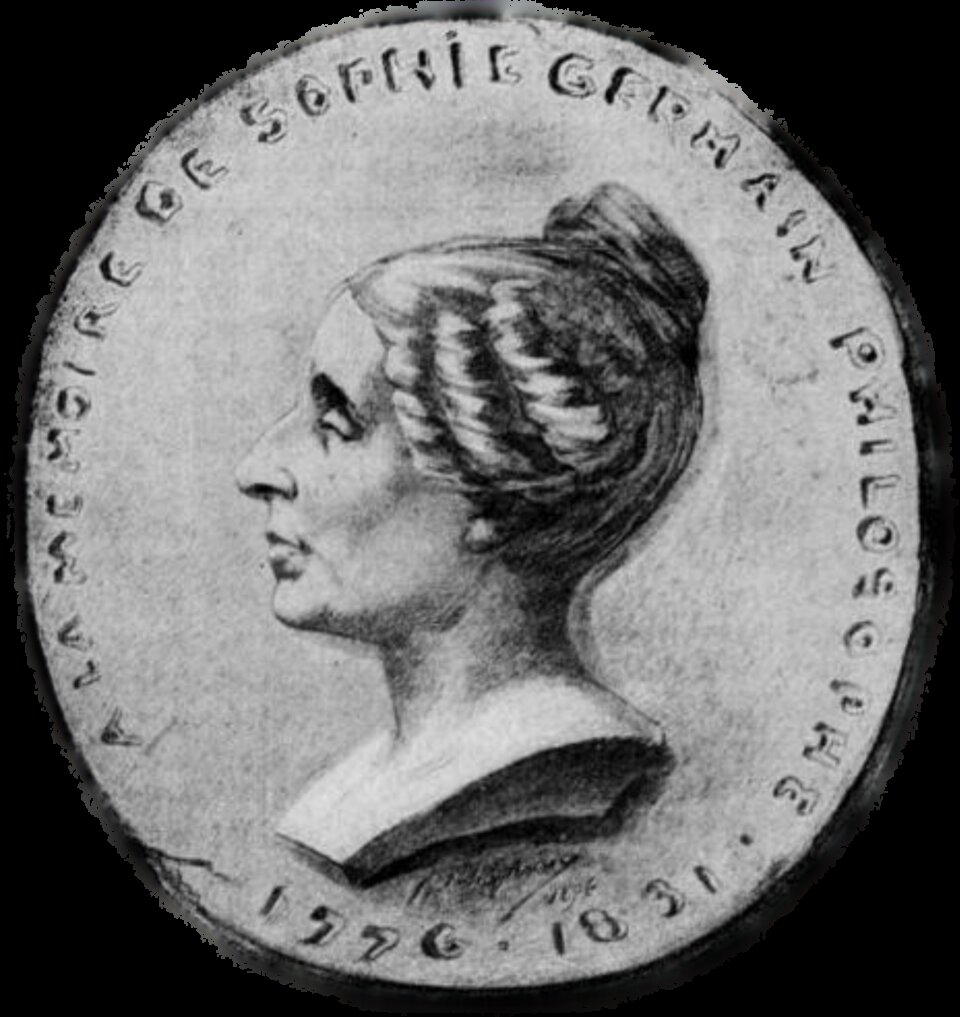
Who she was
Sophie Germain
- Nascimento
- 1 April 1776, Paris
- Morte
- 27 June 1831, Paris
- Origem
- France
- Áreas
- Number theory, elasticity and philosophy
Reading guide
Biography
Discovery and proof
- The letters of Monsieur Le Blanc: the arithmetic of remainders
- Sophie Germain’s theorem and Fermat’s Last Theorem
- Sophie Germain primes and cryptography
- The Sophie Germain identity: factoring what looks prime
- Chladni figures and the prize for vibrating plates
- Mean curvature: how much a surface bends