
Euler's Eyes
2026-10-27
Systems of rays and conical refraction
At the beginning of the nineteenth century optics was a collection of cases: the plane mirror, the curved mirror, the lens, the prism, each with its own formulas. Hamilton, still a student, asked himself whether there was not a single idea behind them all. The result was the Theory of Systems of Rays, read at the Royal Irish Academy in 1827 and extended over the following years.
One function to govern all rays
The starting point is a principle of Fermat: light goes from one point to another along the path that takes the least time, or, more precisely, a stationary time. Hamilton took that time as a function of the endpoints. For two points $A$ and $B$, let $V(A, B)$ be the “optical length” of the light’s path between them: the distance travelled in each medium, multiplied by the refractive index of that medium. He called $V$ the characteristic function.
The surprise is that this single function contains everything. The derivatives of $V$ with respect to the coordinates of $B$ give the direction of the ray arriving at $B$; the derivatives with respect to the coordinates of $A$ give the direction of the ray leaving $A$. To know $V$ is to know the whole system.
In a homogeneous medium of index $n$, for example, light travels in a straight line and
$$V(A, B) = n\,\lvert AB \rvert = n\sqrt{(x_B - x_A)^2 + (y_B - y_A)^2}.$$Differentiating with respect to $x_B$ and $y_B$,
$$\frac{\partial V}{\partial x_B} = n\,\frac{x_B - x_A}{\lvert AB \rvert}, \qquad \frac{\partial V}{\partial y_B} = n\,\frac{y_B - y_A}{\lvert AB \rvert},$$which is the unit vector in the direction of the ray, multiplied by $n$. The gradient of the characteristic function points in the direction of the light.
Snell from time
A ray leaves $A$, in the air, and reaches $B$, in the water, crossing the surface at a point at distance $x$. The time is proportional to
$$V(x) = n_1\sqrt{a^2 + x^2} + n_2\sqrt{b^2 + (d - x)^2},$$where $a$ and $b$ are the heights of $A$ and $B$ above and below the surface and $d$ the horizontal distance between them. The real path is the one for which $V'(x) = 0$:
$$n_1\,\frac{x}{\sqrt{a^2 + x^2}} = n_2\,\frac{d - x}{\sqrt{b^2 + (d - x)^2}} \quad\Longleftrightarrow\quad n_1 \sin\theta_1 = n_2 \sin\theta_2,$$Snell’s law, out of a derivative.
The prediction
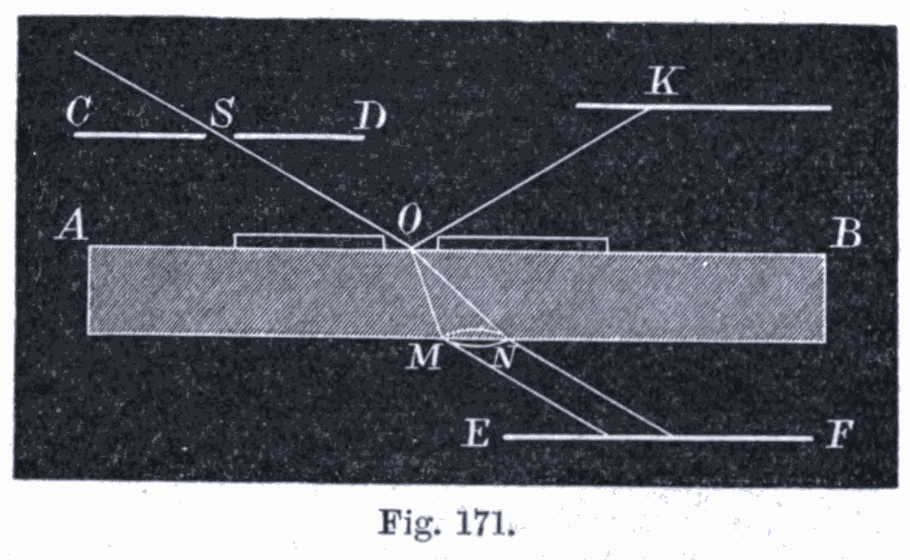
In 1832 Hamilton applied the theory to biaxial crystals, such as aragonite, in which the speed of light depends on direction in a complicated way described by Augustin Fresnel. Studying Fresnel’s wave surface, Hamilton saw that it has singular points, shaped like funnels. If a ray entered the crystal exactly in one of these special directions, it would come out not as one ray, nor as two, but as a cone of light, which would cast a ring on a screen.
Nobody had seen this. Hamilton asked his colleague Humphrey Lloyd, of Trinity College, to look for the effect. After about two months of work with a crystal of aragonite, Lloyd saw the ring. It was one of the first times mathematics had predicted an entirely new physical effect before any observation, and Hamilton, at 27, became famous throughout Europe.
Exercise: the gradient points along the ray
In glass of index $n = 1.5$, light goes from $A = (0, 0)$ to $B = (3, 4)$. Compute $\frac{\partial V}{\partial x_B}$ and $\frac{\partial V}{\partial y_B}$ and check that the vector has length $n$.
$\lvert AB \rvert = 5$, so $\frac{\partial V}{\partial x_B} = 1.5 \cdot \frac35 = 0.9$ and $\frac{\partial V}{\partial y_B} = 1.5 \cdot \frac45 = 1.2$. The length is $\sqrt{0.81 + 1.44} = \sqrt{2.25} = 1.5 = n$, and the direction is that of the line from $A$ to $B$.
Exercise: light entering water
A ray passes from air ($n_1 = 1$) into water ($n_2 = 1.33$) with an angle of incidence of $30°$. What is the angle of refraction?
$\sin\theta_2 = \frac{1 \cdot \sin 30°}{1.33} = \frac{0.5}{1.33} \approx 0.376$, so $\theta_2 \approx 22.1°$. The ray bends towards the vertical as it enters the medium in which light is slower.
Sources: William Rowan Hamilton, “Theory of Systems of Rays”, Transactions of the Royal Irish Academy (1828) and “Third Supplement” (1837) · Humphrey Lloyd, “On the phenomena presented by light in its passage along the axes of biaxal crystals”, Transactions of the Royal Irish Academy (1837) · Michael Berry, “Conical diffraction: Hamilton’s diabolical point at the heart of crystal optics”, Progress in Optics (2007).
All topics on William Rowan Hamilton · ← The life of William Rowan Hamilton · Complex numbers as couples →