
Euler's Eyes
2022-07-05
Geometry with sequences of numbers
Numbers using Geometry

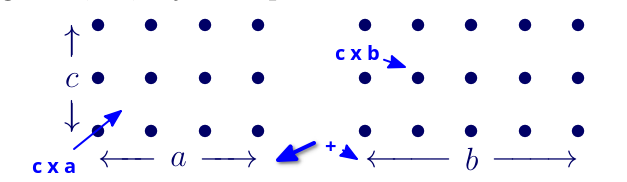
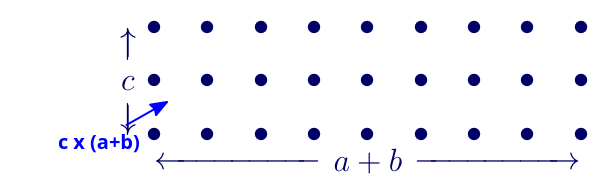
In Elements it shows numbers in geometric perspective. In previous posts, we saw the product of one natural number by another as the area of a rectangle or square.
| Property | Distributive |
|---|---|
|
|
An example of numbers associated with geometry, we can find triangular numbers.
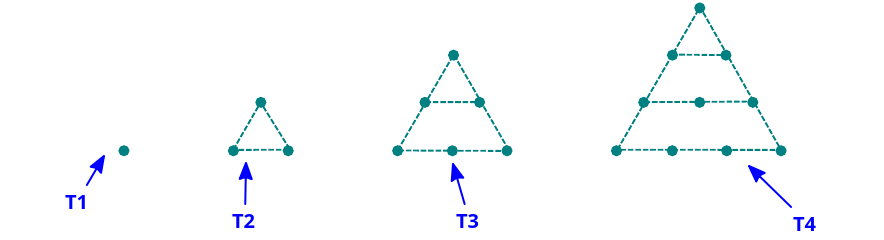
From the figure we note that triangular numbers are numbers arranged as:
$$T_1 = 1$$$$T_2 = 3$$
$$T_3 = 6$$
$$T_4 = 10$$
This is a basic example of a sequence of triangular numbers and they have a general formula, that is, we can define a pattern of the sequence. Mathematicians always think of shortcuts, to make life easier. For example:
In general we have:
Help us build the math website. Donate as much as you can.

Arithmetic progression

Now, do you believe that Carl Friedrich Gauss at 6 years of age deduced the triangular numbers? Today we know it as arithmetic progression.
Gauss was studying at a school in Germany, when a teacher, stressed by her students’ behavior, asked them to add the natural numbers from 1 to 100. When posing this problem, he imagined that the students would take about 2 hours or more. However, to his amazement, Gauss solved this problem in less than 1 minute at 6 years of age.
- How did you manage to calculate that boy?
- Easy teacher:
We arrange the numbers from 1 to 100 in ascending order and then in descending order as follows:
Now, teacher, we add the two terms:
As we add it twice we have:
$$T_{100} = \dfrac{100 \times 101}{2}$$In high school, we know how:
$$T_n = \dfrac{n(n+1)}{2}$$Just like with triangular numbers, we can define a recurrence sequence pattern based on the square.
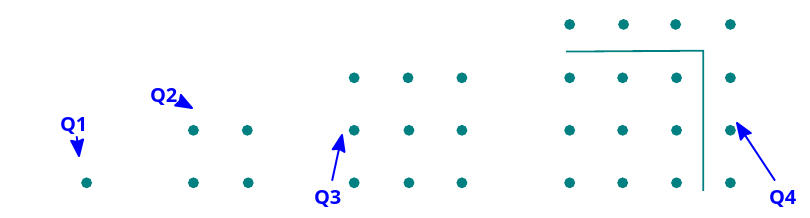
However, we will leave this as an exercise for you, defining a pattern of the recurrence sequence based on the square. 😃 😸