
Euler's Eyes
2026-10-10
History of Mathematics
Page 2 of 191
The language that Euler left us
Part of Euler’s influence is in things that seem to have always existed. He created or popularized:
- $f(x)$ to indicate a function of $x$;
- the letter $e$ for the base of natural logarithms, $e \approx 2{,}71828$;
- the letter $\pi$ for the ratio between the length of the circumference and the diameter (the symbol already existed, but it was Euler who spread it);
- $i$ for the imaginary unit, with $i^2 = -1$;
- $\Sigma$ to indicate a sum.
Euler’s Eyes was born from this idea: to look at mathematics through Euler’s eyes, through history and original words in Latin and Greek. Many notations lost their meaning along the way. Theroot square, for example, in Latin it is radix quadratum, the side of the square: the root of 4 is the side of a square of area 4.
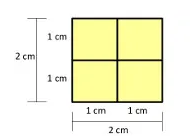
How radix quadratum became √ (click to advance)
radix quadratum 4 aequalis 2: “the side of the square of area 4 is equal to 2”.- Scribes abbreviate:
rad quad 4 aq 2. - They are more abbreviated:
ra qua 4 aq 2. - And more:
r q 4 aq 2. - Until r “swallows” the number and becomes the symbol we use today: $\sqrt{4} = 2$.
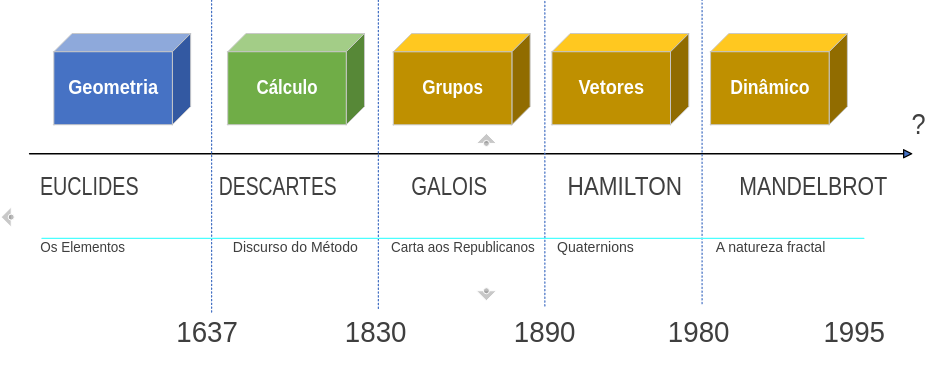
Euler lived in the midst of a great turning point. The way we tell it here on the site, mathematics went through five eras:
- 0–1637Drawing nature: Euclid’s geometry.
- 1637–1830Decoding nature: calculus, from Descartes to Euler.
- 1830–1890Imitate and engineer nature: Galois groups.
- 1890–1980Control nature: Hamilton’s vectors and quaternions.
- 1980–todayCreating nature: Mandelbrot’s fractal geometry.
All topics by Leonhard Euler · ← The life of Leonhard Euler · The Basel problem →