The theory of probabilities is at bottom nothing but common sense reduced to calculation.
— Pierre-Simon Laplace, Philosophical Essay on Probabilities (1814)
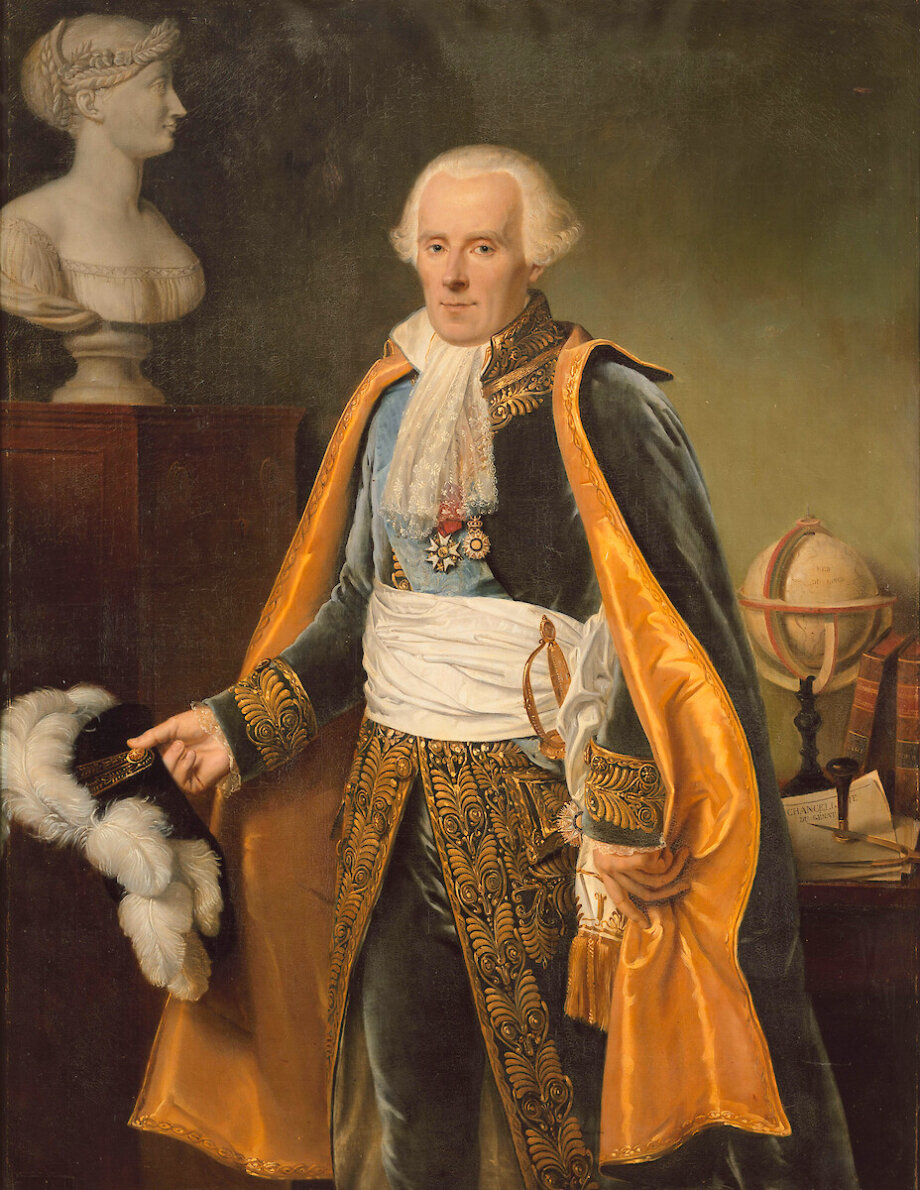
Pierre-Simon Laplace (1749–1827) was the “Newton of France”. The son of a cider merchant from Normandy, he arrived in Paris at nineteen with a letter of recommendation and left this life a marquis, having passed through the monarchy, the Revolution, Napoleon’s Empire and the return of the Bourbons without ever losing his place.
Newton had explained the motion of the planets but left a doubt behind: would their mutual attractions not end up disordering the Solar System? Laplace spent half a century showing that they would not. The five volumes of his Celestial Mechanics turned the sky into a predictable machine. And while computing orbits he realized he needed a theory of observational errors, and ended up writing the first great mathematical theory of probability.
Along the way he left an equation, a transform and a theorem that every engineer uses, and two ideas that sounded like science fiction: stars so dense that not even light escapes from them, and an intelligence able to foresee the whole future.
In this trail we tell Laplace’s life and redo, with the calculations in plain view, eleven of his ideas.
Who he was
Pierre-Simon Laplace
- Nascimento
- 23 March 1749, Beaumont-en-Auge, Normandy
- Morte
- 5 March 1827, Paris
- Origem
- France
- Áreas
- Celestial mechanics, probability, analysis, mathematical physics
Reading guide
Biography
Discoveries and proofs
- Jupiter, Saturn and the stability of the Solar System
- The nebular hypothesis
- The dark stars
- Laplace’s equation
- Laplace’s expansion of determinants
- Classical probability and the Gaussian integral
- The central limit theorem
- Will the Sun rise tomorrow? The rule of succession
- The Laplace transform
- The speed of sound
- Laplace’s demon