
Euler's Eyes
2026-10-11
Congruence and comparison
Copying an angle and dividing it in half are classic constructions. Dividing it into three equal parts, however, has challenged mathematicians for more than two thousand years.
Who discovered
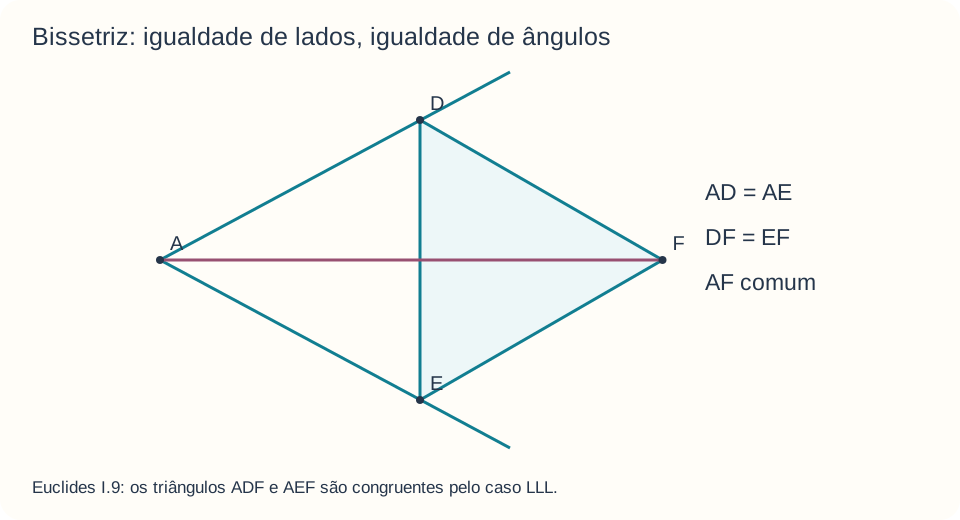
The two constructions are in The Elements of Euclid (c. 300 BC): the proposition I.9 divides an angle in half (a angle bisector) and the I.23 copies a given angle onto another straight line. The trisection of the angle with a ruler and compass — dividing any angle into three equal parts — was proven impossible in 1837 by the Frenchman Pierre Wantzel, then just over 20 years old.

The story
Trisection was one of the three classical Greek problems, alongside doubling the cube and squaring the circle. The Greeks were able to solve it using special curves or a ruler with marks — Archimedes gave a solution like this — but never just with a ruler without marks and a compass.
Wantzel transformed the problem into algebra: each construction with ruler and compass is equivalent to solving equations of degree 2, and trisecting an angle of 60° requires an equation of degree 3 that cannot be reduced to them. “Trisections” sent to magazines by amateurs still appear today; They all have some error.
In everyday life
- Carpenter’s suta. It is an “angle copyer”: it copies the slope of a roof or a staircase for the piece to be cut — the I.23 proposition in practice.
- Miter. To close a 90° corner on moldings and baseboards, each piece is cut at 45°: at angle bisector from the right angle.
- Folding. Folding a paper with one side over the other marks angle bisector without any instrument.
- Billiards. The ball leaves the table at the same angle at which it arrived.
Sources: Elements, proposition I.9 · Elements, proposition I.23 · Wantzel (MacTutor).
Theory and constructions
PostuladoCongruence of angles
The congruence of angles (symbol $\equiv$) is a primitive notion that satisfies:
- Reflective: $\widehat{ab} \equiv \widehat{ab}$.
- Symmetric: if $\widehat{ab} \equiv \widehat{cd}$, then $\widehat{cd} \equiv \widehat{ab}$.
- Transitive: if $\widehat{ab} \equiv \widehat{cd}$ and $\widehat{cd} \equiv \widehat{ef}$, then $\widehat{ab} \equiv \widehat{ef}$.
- Transport of angles: given an angle $A\hat{O}B$ and a ray $\overrightarrow{O^{\prime}A^{\prime}}$ of a plane, there exists in that plane, in each of the half-planes that the straight line $O^{\prime}A^{\prime}$ determines, a single ray $\overrightarrow{O^{\prime}B^{\prime}}$ that forms with $\overrightarrow{O^{\prime}A^{\prime}}$ an angle $A^{\prime}\hat{O^{\prime}}B^{\prime}$ congruent to $A\hat{O}B$.
Comparison. Given $\widehat{ab}$ and $\widehat{cd}$, we transport $\widehat{cd}$ to the origin half-plane on the line of $a$ that contains $b$, obtaining $\widehat{ad^{\prime}} \equiv \widehat{cd}$. If $d^{\prime}$ is internal to $\widehat{ab}$, we say $\widehat{ab} > \widehat{cd}$; if $d^{\prime}$ coincides with $b$, $\widehat{ab} \equiv \widehat{cd}$; if $d^{\prime}$ is external to $\widehat{ab}$, $\widehat{ab} < \widehat{cd}$.
Adding angles and angle bisector
DefiniçãoSum of angles
If the ray $\overrightarrow{Ob}$ is internal to the angle $a\hat{O}c$, then $a\hat{O}c$ is the sum of the angles $a\hat{O}b$ and $b\hat{O}c$:
$$a\hat{O}c = a\hat{O}b + b\hat{O}c.$$In general, given $\widehat{ab}$ and $\widehat{cd}$, if there are $\widehat{rs} \equiv \widehat{ab}$ and $\widehat{st} \equiv \widehat{cd}$ with $s$ internal to $\widehat{rt}$, we say $\widehat{rt} = \widehat{ab} + \widehat{cd}$. The angle that is the sum of $n$ angles congruent to $\widehat{ab}$, if it exists, is the multiple of $\widehat{ab}$ second $n$; and $\widehat{ab}$ is its submultiple.
Definiçãoangle bisector
A ray $\overrightarrow{Oc}$ internal to an angle $a\hat{O}b$ is angle bisector of that angle if, and only if, $a\hat{O}c \equiv c\hat{O}b$. angle bisector originates at the vertex and divides the angle into two congruent angles.
TeoremaUniqueness of angle bisector
An angle has a single angle bisector.
Demonstration (by absurdity)
- Suppose that $\overrightarrow{Ox}$ and $\overrightarrow{Oy}$, distinct, are angle bisectors of $a\hat{O}b$: $a\hat{O}x \equiv x\hat{O}b$ (1) and $a\hat{O}y \equiv y\hat{O}b$ (2).
- Case 1: $\overrightarrow{Ox}$ is internal to $a\hat{O}y$. Then $a\hat{O}y > a\hat{O}x$; and as $\overrightarrow{Oy}$ is internal to $x\hat{O}b$, $x\hat{O}b > y\hat{O}b$. Logo $a\hat{O}y > a\hat{O}x \equiv x\hat{O}b > y\hat{O}b$ — nonsense by (2).
- Case 2: $\overrightarrow{Oy}$ is internal to $a\hat{O}x$. Similarly, $a\hat{O}x > a\hat{O}y \equiv y\hat{O}b > x\hat{O}b$ — nonsense by (1).
- Therefore angle bisector is unique. Its existence will be proven in chapter 6, with construction using ruler and compass.