
Euler's Eyes
2026-10-28
Juries and the law of large numbers
In France in the 1830s, serious crimes were tried by a jury of twelve citizens, and the rule for convicting changed with the government. Until 1831 a majority of 7 votes to 5 was enough; in 1831 a majority of 8 to 4 became necessary; in 1835 the rule went back to 7 to 5. Which rule convicts more innocent people? Which lets more guilty ones go? Since Condorcet, in the eighteenth century, French mathematicians had believed that such questions could be answered by the calculus of probabilities.
The book of 1837
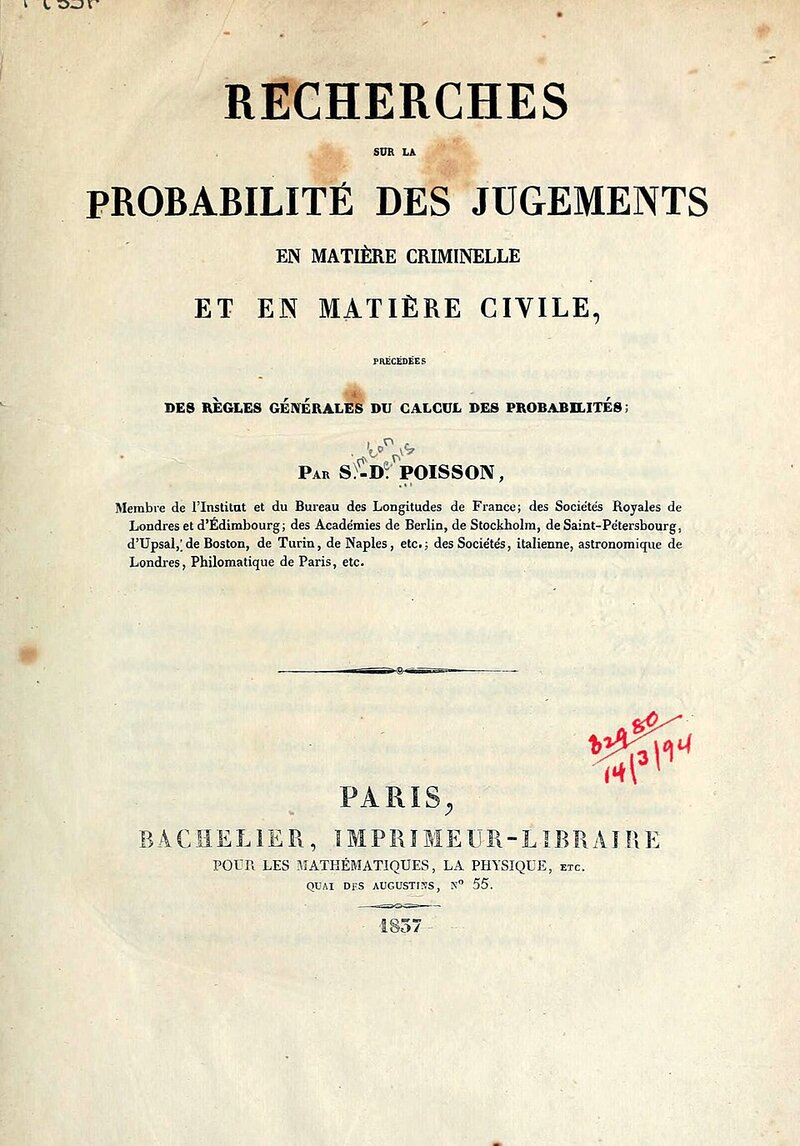
Poisson tackled the problem in a series of communications to the Academy and, in 1837, in the book Researches on the probability of judgements in criminal and civil matters. He had a new source: since 1825 the Ministry of Justice had published complete statistics of criminal trials every year, with the numbers of accused and convicted. With these proportions and a model of how jurors behave, Poisson tried to estimate the probability that a juror is right and the probability that an accused person is guilty.
A jury as a sum of votes
Suppose each juror, independently, is right with probability $p$. The probability that at least 7 of the 12 are right is
$$P(\text{correct majority}) = \sum_{k=7}^{12} \binom{12}{k} p^k (1 - p)^{12 - k}.$$With $p = 0.7$, this comes to about $0.88$: a jury is far more reliable than a single juror, as Condorcet had already observed. Requiring 8 votes to convict lowers the chance of convicting an innocent, but also that of convicting a guilty person: with $p = 0.7$, the probability of a correct majority of at least 8 falls to about $0.72$.
The law of large numbers
Poisson’s problem had a difficulty: jurors are not all alike, nor are cases. The probability of being right changes from one trial to another. Jakob Bernoulli’s theorem of 1713 said that, in many independent trials with the same probability $p$, the proportion of successes approaches $p$. Poisson proved a more general version: if the trials have different probabilities $p_1, p_2, \ldots, p_n$, the proportion of successes approaches the mean of the probabilities,
$$\frac{\text{successes}}{n} \approx \frac{p_1 + p_2 + \cdots + p_n}{n}.$$It was also Poisson who named the result. In a communication of 1835 and later in the book, he called it the law of large numbers, which he saw as a law of nature: things of every kind are subject to a universal law by which, when a very large number of events of the same nature is observed, the proportions remain almost constant. In the figure, each trial has its own probability, drawn at random; even so, the proportion of successes sticks to the mean of the probabilities:
How close?
A way of measuring the approximation came later, with Chebyshev, in 1867. If the trials are independent, the proportion of successes has variance $\frac{1}{n^2}\sum p_i(1 - p_i) \le \frac{1}{4n}$, and the probability that it strays from the mean of the $p_i$ by more than $\varepsilon$ is at most
$$\frac{1}{4n\varepsilon^2}.$$With $n = 10\,000$ trials and $\varepsilon = 0.01$, the guarantee is at most a 25% chance of an error larger than one percentage point. The inequality is crude; in practice the error is usually much smaller, as the central limit theorem and the figure show.
Exercise: a jury of three
A jury of 3 people decides by simple majority. If each juror is right with probability $p = 0.7$, independently, what is the probability that the jury is right?
At least 2 must be right: $\binom{3}{2}p^2(1 - p) + p^3 = 3 \cdot 0.49 \cdot 0.3 + 0.343 = 0.441 + 0.343 = 0.784$. Three jurors are right 78.4% of the time, more than the 70% of a single one.
Exercise: how many trials?
Using Chebyshev’s inequality, how many independent trials guarantee that the proportion of successes stays within $\varepsilon = 0.01$ of the mean of the probabilities with a chance of error of at most 5%?
We want $\frac{1}{4n\varepsilon^2} \le 0.05$, that is, $n \ge \frac{1}{4 \cdot 0.05 \cdot 0.0001} = 50\,000$. With the central limit theorem, about $\left(\frac{1.96}{2 \cdot 0.01}\right)^2 \approx 9\,600$ trials would suffice: the law of large numbers guarantees convergence, but other tools say how fast it happens.
Sources: Siméon Denis Poisson, Recherches sur la probabilité des jugements en matière criminelle et en matière civile (1837) · Stephen M. Stigler, The History of Statistics: The Measurement of Uncertainty before 1900 (1986), ch. 5 · Lorraine Daston, Classical Probability in the Enlightenment (1988) · Ian Hacking, The Taming of Chance (1990).
All topics on Siméon Denis Poisson · ← Poisson’s ratio · The Poisson distribution →