
Euler's Eyes
2026-10-14
The life of John Nash
Timeline
- 1928Born on 13 June in Bluefield, West Virginia, in the United States.
- 1945Enters the Carnegie Institute of Technology, in Pittsburgh, to study chemical engineering. Switches to mathematics.
- 1948Arrives at Princeton. Invents the game his colleagues call “Nash”, known today as Hex.
- 1950Defends the thesis “Non-cooperative games”, with the Nash equilibrium. Publishes “The bargaining problem”.
- 1951Becomes an instructor at MIT.
- 1956Publishes the isometric embedding theorem.
- 1957Marries Alicia Lardé, a physics student at MIT.
- 1958Publishes the result on the regularity of parabolic equations.
- 1959First psychiatric hospitalisation. Three decades of illness begin.
- 1994Receives the Nobel Prize in Economics, with John Harsanyi and Reinhard Selten.
- 2001Remarries Alicia. The film A Beautiful Mind is released.
- 2015Receives the Abel Prize, with Louis Nirenberg. Dies in a car crash on 23 May, together with Alicia.
- He grows up in a railway and coal town. He reads Men of Mathematics and proves Fermat’s little theorem by himself.
- At the Carnegie Institute of Technology he swaps chemical engineering for mathematics and has the bargaining idea.
- He invents Hex and defends his 28-page thesis with the Nash equilibrium.
- A professor at MIT. He proves the embedding theorem and the result on parabolic equations. In 1959 his illness begins.
- He wanders the corridors as “the phantom of Fine Hall” and recovers at the end of the 1980s.
- He receives the Nobel Prize in Economics, with John Harsanyi and Reinhard Selten.
- He receives the Abel Prize, with Louis Nirenberg. On the way home, on 23 May, he and Alicia die in a taxi crash in New Jersey.
- 1928–1945 · Bluefield
- 1945–1948 · Pittsburgh
- 1948–1951 · Princeton
- 1951–1959 · MIT
- 1970–2015 · Princeton
- 1994 · Stockholm
- 2015 · Oslo
A boy from Bluefield
John Forbes Nash Jr. was born in Bluefield, a small railway and coal town in West Virginia. His father was an electrical engineer at the power company; his mother had taught English and Latin before marrying. At school the boy was shy, solitary and did not stand out. At home he did chemistry and electricity experiments.
At high school he read Men of Mathematics, by E. T. Bell, with biographies of the great mathematicians. He was struck by the chapter on Fermat and managed to prove Fermat’s little theorem by himself. He would later recall this episode in the autobiographical note he wrote for the Nobel Prize.
Carnegie and the one-line letter
In 1945 he entered the Carnegie Institute of Technology, in Pittsburgh, on a scholarship, to study chemical engineering. He moved to chemistry and soon to mathematics. His teachers quickly recognised his talent. In a course on international economics, the only economics course he ever took, he had the idea that would become the bargaining solution.
In 1948 he received offers from Harvard and Princeton and chose Princeton, which gave him a larger fellowship. The recommendation letter from his teacher Richard Duffin had a single line: “This man is a genius.”
Princeton: the game and the thesis
At Princeton Nash hardly went to lectures. He thought books hampered originality and preferred to discover things by himself. He spent his afternoons in the common room of Fine Hall, the mathematics building, playing chess and Go. There he invented a board game with hexagonal cells, which his colleagues began to call “Nash” and which today is called Hex. A Dane, Piet Hein, had invented the same game in 1942, but Nash did not know.
At the end of 1949, aged 21, Nash went to see John von Neumann, the biggest name in game theory, to show him an idea: in any game with a finite number of players and strategies, there is a combination of strategies in which nobody gains by changing alone. Von Neumann, according to the biographer Sylvia Nasar, replied: “That’s trivial, you know. That’s just a fixed point theorem.” Nash published the idea in a one-page note in the Proceedings of the National Academy of Sciences and, in May 1950, defended his 28-page thesis, “Non-cooperative games”. It was the Nash equilibrium.
MIT: the bets
In 1951 Nash went to MIT. Arrogant and brilliant, he liked to provoke his colleagues. One of them, Warren Ambrose, a geometry specialist, challenged him: if he was so good, why didn’t he solve the problem of embedding an abstract surface in Euclidean space without changing lengths? Nash accepted. In 1956 he published the isometric embedding theorem, which specialists had considered out of reach.
Soon afterwards he attacked another famous problem, on the regularity of solutions of differential equations. He solved it in 1957, but found that the Italian Ennio De Giorgi had reached the same result, by another route, a few months earlier. Many believe that, but for this, Nash would have received the Fields Medal in 1958.
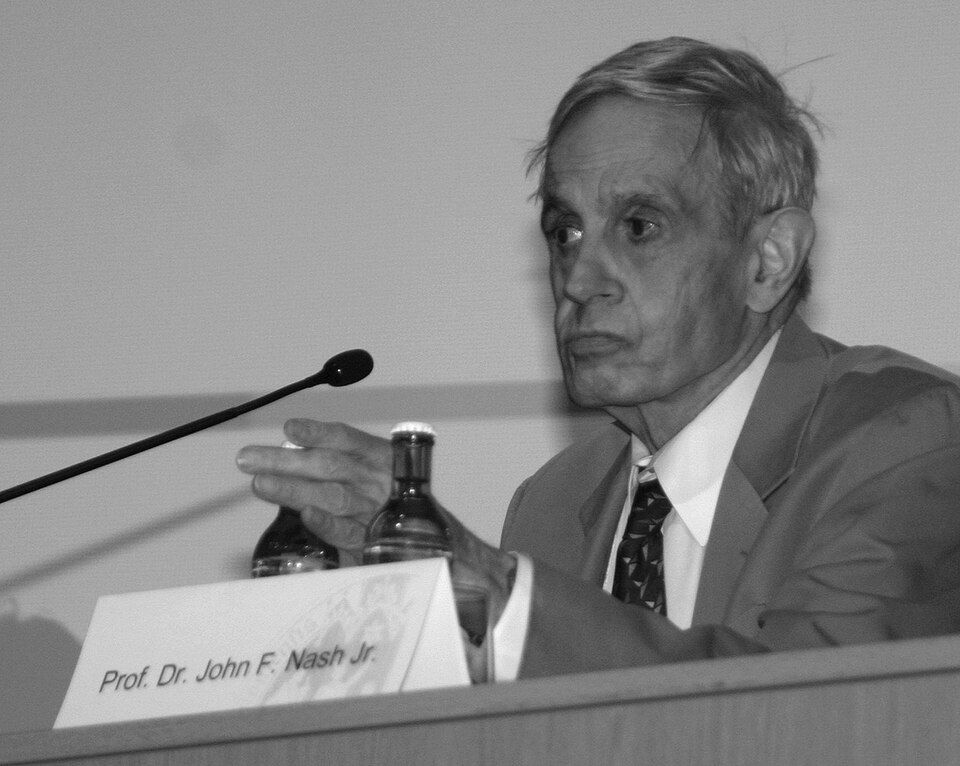
The illness
In 1957 Nash married Alicia Lardé, a Salvadoran physics student who had been his student at MIT. At the beginning of 1959, with Alicia pregnant, Nash began to have delusions: he said he was receiving coded messages from extraterrestrials through the newspapers, and he turned down a post at the University of Chicago because, he explained, he was going to be emperor of Antarctica. He was hospitalised with a diagnosis of paranoid schizophrenia.
Three decades of hospitalisations, treatments and periods of improvement followed. Nash lost his job at MIT, travelled around Europe trying to renounce his American citizenship and, from the 1970s, began to wander the corridors of Princeton. Students called him “the phantom of Fine Hall”: a thin, silent man who wrote strange formulas and numerology on the blackboards. Alicia divorced him in 1963, but in 1970 she took him back into her home, as a lodger, and never stopped caring for him.
The return
At the end of the 1980s Nash improved. He himself wrote that he gradually began to reject intellectually the lines of thinking influenced by his delusions. In 1994 he received the Nobel Prize in Economics, shared with John Harsanyi and Reinhard Selten, for the analysis of equilibria in the theory of non-cooperative games.
In 1998 the journalist Sylvia Nasar published the biography A Beautiful Mind, and in 2001 the film based on it won four Oscars, including best picture. That same year, Nash and Alicia married again. In 2015 he received, with Louis Nirenberg, the Abel Prize, the most important prize in mathematics, for contributions to partial differential equations. On 23 May 2015, on their way back from Oslo, where he had received the prize, Nash and Alicia died in a taxi crash on a New Jersey highway. He was 86; she was 82.
Sources: John Nash’s autobiographical note, Nobel Foundation · Sylvia Nasar, A Beautiful Mind (Simon & Schuster, 1998) · 2015 Abel Prize.
All topics on John Nash · The game of Hex: why the first player wins →