
Euler's Eyes
2026-10-14
The legacy of Albert Einstein
Imagination is more important than knowledge. Knowledge is limited; imagination encircles the world.
— Albert Einstein, interview in the Saturday Evening Post (1929)
Einstein is the only scientist whose face everyone recognises. But his legacy is not on the posters: it is in devices we use without thinking and in questions physicists are still trying to answer. Several of his predictions were only confirmed decades after his death.
The laser
In 1917, studying how matter absorbs and emits light, Einstein realised that, besides absorbing and emitting photons spontaneously, an excited atom can be stimulated by a photon to emit another, identical one, in the same direction. It was a theoretical observation. Forty years later it became the laser, the acronym for “light amplification by stimulated emission of radiation”. Barcode readers, optical fibres, eye surgery and lecture pointers are all applications of stimulated emission.
A new state of matter
In 1924 the Indian physicist Satyendra Nath Bose sent Einstein a paper with a new way of counting photons. Einstein translated it into German, had it published and extended the idea to atoms. He predicted that, very close to absolute zero, a gas of certain atoms would condense into a single state, as if all the atoms became one. The Bose–Einstein condensate was produced in the laboratory in 1995, and its makers won the 2001 Nobel Prize.
The universe and the biggest blunder
In 1917 Einstein applied general relativity to the whole universe. The equations said the universe could not stand still: it had to expand or contract. Since everyone believed in a static universe, Einstein added a term to the equations, the cosmological constant $\Lambda$, just to keep it still. In 1929 Edwin Hubble showed that galaxies are moving away from one another: the universe is expanding. According to the physicist George Gamow, Einstein said the constant had been “the biggest blunder” of his life.
The story has a twist. In 1998 it was discovered that the expansion of the universe is accelerating, and the simplest explanation is precisely a cosmological constant. The “blunder” came back into the equations.
Waves in spacetime
In 1916 Einstein predicted that accelerating masses would produce gravitational waves, ripples in spacetime itself travelling at the speed of light, but he thought they would be too weak ever to be measured. On 14 September 2015, almost a hundred years later, the LIGO detectors in the United States recorded one: it came from the merger of two black holes 1.3 billion light-years away. The wave stretched and squeezed the detectors’ 4 km arms by less than a thousandth of the size of a proton.
Black holes
Einstein’s equations allow regions where spacetime curves so much that not even light escapes. Einstein himself doubted that nature produced them. Today we know there is a black hole of 4 million solar masses at the centre of our galaxy, and in 2019 the Event Horizon Telescope released the first image of the shadow of one, in the galaxy M87.
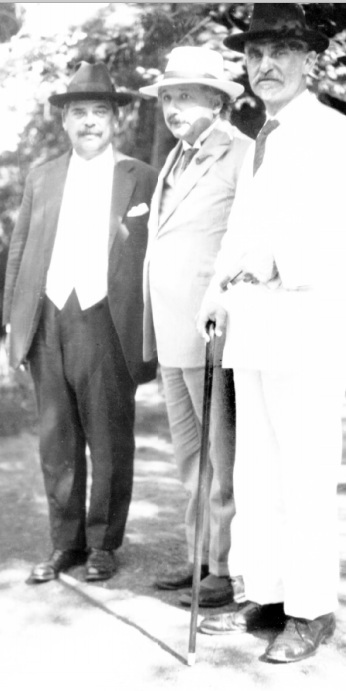
Einstein and Brazil
The 1925 visit left its mark. Einstein was received by the Brazilian Academy of Sciences and by the scientist Henrique Morize, director of the National Observatory, who had taken part in the Sobral eclipse. Newspapers published caricatures and columns; one of them, playing on the word relativity, ran a cartoon called “Irrelativity”. Sobral today has the Eclipse Museum, built on the spot where the telescopes were set up, and the 2019 centenary was celebrated with a week of scientific events in the town.
What remained
- Quantum physics. Photons, the photoelectric effect, stimulated emission and Bose–Einstein statistics.
- Atoms. Brownian motion gave the first direct measurement of Avogadro’s number and settled the debate over the existence of atoms.
- Space and time. Special relativity united space and time and showed that mass is energy.
- Gravitation. General relativity turned gravity into geometry and created modern cosmology.
- Technology. GPS, lasers, photoelectric cells, nuclear energy and PET scans.
To remember
- Albert Einstein lived from 1879 to 1955. In 1905, while working in a patent office, he published four papers that changed physics.
- Light exchanges energy in packets of energy $hf$; the maximum energy of the photoelectrons is $hf-\phi$.
- In Brownian motion, the typical distance grows as the square root of time: $\langle x^2\rangle=2Dt$.
- A clock moving with speed $v$ runs slow by the factor $\gamma=1/\sqrt{1-v^2/c^2}$, as Pythagoras’s theorem shows in the light clock.
- Mass is energy: $E=mc^2$. One gram is equivalent to $9\times10^{13}$ J.
- Gravity is the curvature of spacetime. Light grazing the Sun is bent by $1.75''$, as the Sobral photographs confirmed in 1919.
Sources: Walter Isaacson, Einstein: His Life and Universe (Simon & Schuster, 2007) · Abraham Pais, Subtle is the Lord: The Science and the Life of Albert Einstein (Oxford, 1982) · LIGO, first detection of gravitational waves.
All topics on Albert Einstein · ← General relativity: from the lift to the Sobral eclipse · Image credits →