
Euler's Eyes
2026-10-14
Crumpling without stretching: the embedding theorem
Take a sheet of paper. You can roll it into a cylinder without tearing or stretching it: distances measured on the sheet, with a flexible ruler, stay the same. But you cannot wrap a ball with it without making folds. The sheet and the sphere have different intrinsic geometries, and Gauss proved in 1827 that this difference, the curvature, does not change when the surface is bent without stretching.
In the nineteenth century Bernhard Riemann had an even bolder idea: to describe a surface, or a space of any dimension, by its internal measurements alone, without drawing it anywhere. All it takes is a rule, the metric, that says how to measure the length of any curve. This is how general relativity describes spacetime: from inside, without a larger space around it.
The question
But can every abstract Riemannian space be drawn inside an ordinary Euclidean space, perhaps of many dimensions, so that lengths measured inside it coincide with lengths measured in the drawing? This “drawing without distortion” is called an isometric embedding. The question was half a century old, and geometers considered it extremely hard.
Around 1953, at MIT, the geometer Warren Ambrose, irritated by his young colleague’s arrogance, challenged Nash: if he was so good, let him solve that. Nash took the bet.
An example: the cylinder
Let us see what an isometric embedding means in a simple case. A strip of the plane has coordinates $(u,v)$ and the ordinary metric, $ds^2=du^2+dv^2$: a tiny piece of curve with displacements $du$ and $dv$ has length $\sqrt{du^2+dv^2}$. Roll the strip into a cylinder of radius $R$:
$$F(u,v)=\left(R\cos\frac uR,\ R\sin\frac uR,\ v\right).$$The derivatives are
$$F_u=\left(-\sin\frac uR,\ \cos\frac uR,\ 0\right),\qquad F_v=(0,0,1),$$and the dot products,
$$F_u\cdot F_u=1,\qquad F_v\cdot F_v=1,\qquad F_u\cdot F_v=0.$$So on the cylinder $ds^2=du^2+dv^2$, exactly as on the strip. The rolling is isometric: an ant walking on the surface would notice no difference. But note: two points close together across the cylinder may be far apart walking along the surface. The embedding preserves the lengths of curves on the surface, not straight-line distances through space.
The flat torus
Now a hard case. Take a square of paper and glue the top side to the bottom one: it becomes a cylinder. Now glue the two ends of the cylinder: it becomes a doughnut, a torus. If you do this with real paper, it will crumple: the ordinary doughnut has positive curvature on the outside and negative on the inside. The torus made from a flat square, with the square’s measurements, is called the flat torus, and a classical theorem says that it cannot be drawn smoothly in three-dimensional space without distortion. It fits, without distortion, in four dimensions, but not in three.
What Nash proved
In 1954 Nash published an astonishing result: if the embedding only needs to be smooth once, that is, to have a well-defined tangent at each point but not necessarily a curvature, any surface can be placed isometrically in three-dimensional space. The Dutchman Nicolaas Kuiper completed the argument in 1955. By the Nash-Kuiper theorem, even the flat torus fits in ordinary space. The price is an extremely strange surface, full of corrugations upon corrugations, at ever smaller scales, like a fractal.
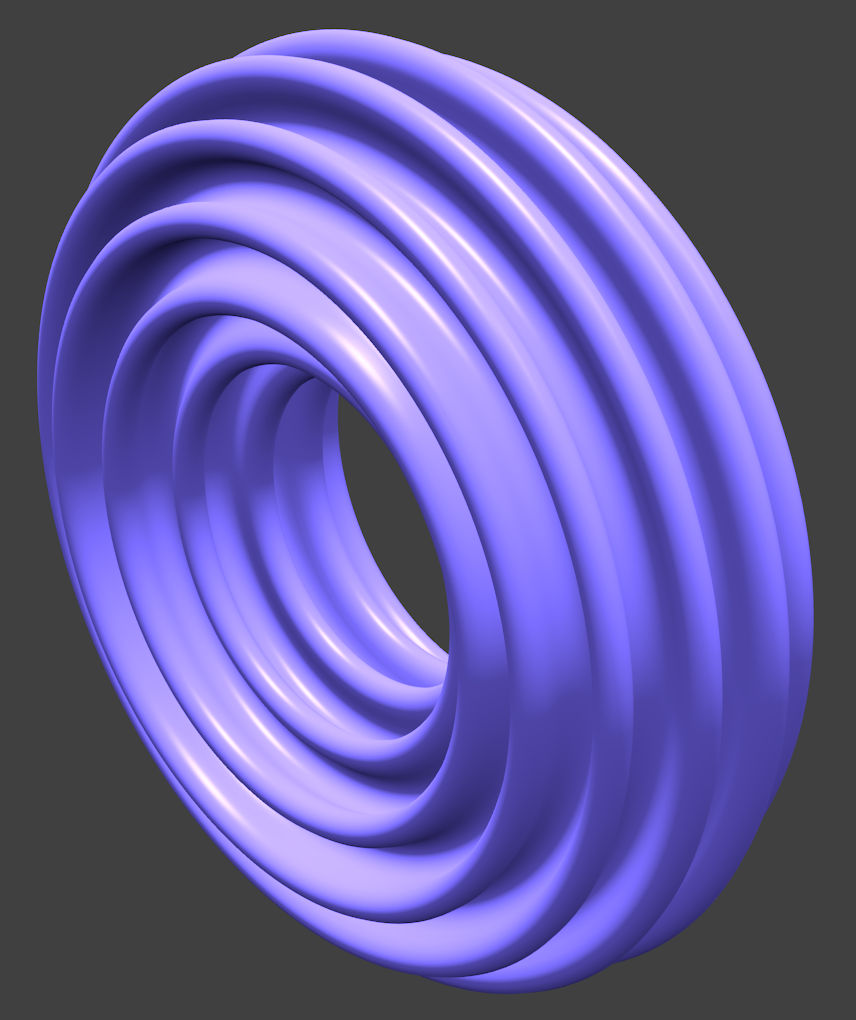
In 1956 Nash published the case Ambrose had proposed, that of fully smooth embeddings: every Riemannian manifold can be placed isometrically in a Euclidean space of high enough dimension. For this he invented a new technique for solving equations, a method of successive approximations that corrects, at each step, the loss of smoothness of the previous step. The technique, later refined by Jürgen Moser, became known as the Nash-Moser method and is used today in problems of celestial mechanics and of differential equations that have nothing to do with geometry.
Exercise: on the cylinder of radius R = 1, what is the length of the path on the surface between the points (1, 0, 0) and (−1, 0, 0)? And the straight-line distance?
The points correspond to $u=0$ and $u=\pi$ with the same $v$. Walking on the surface, the length is that on the strip: $\pi\approx3.14$. In a straight line through space, crossing the cylinder, the distance is $2$. The embedding preserves the first, not the second.
Exercise: a cone can also be made from paper without stretching. What fraction of a disc of radius 1 is needed to make a cone with base radius 1/2 and slant height 1?
The slant height of the cone is the radius of the disc, 1. The rim of the base has length $2\pi\cdot\frac12=\pi$, which must be the arc of the sector cut from the disc. The whole disc has rim $2\pi$, so the sector is half the disc: a rolled-up semicircle becomes the cone. Since the paper was not stretched, the cone is an isometric embedding of a piece of the plane.
Sources: John Nash, “C¹ isometric imbeddings”, Annals of Mathematics 60 (1954) and “The imbedding problem for Riemannian manifolds”, Annals of Mathematics 63 (1956) · Vincent Borrelli et al., “Flat tori in three-dimensional space and convex integration”, PNAS 109 (2012) · 2015 Abel Prize citation.
All topics on John Nash · ← The Nash bargaining solution · The heat equation and the regularity of De Giorgi and Nash →