
Euler's Eyes
2024-07-11
Pythagoras Theorem
The Pythagorean Theorem is one of the best-known and fundamental propositions in mathematics, establishing an elegant relationship between the sides of a right-angled triangle. The history of this theorem is as fascinating as its mathematical application, as it spans cultures and eras, revealing how mathematical knowledge is accumulated and shared across generations.

Traditionally attributed to the Greek philosopher and mathematician Pythagoras, who lived between approximately 570 BC and 495 BC, the theorem states that in a right-angled triangle, the square of the hypotenuse (the side opposite the right angle) is equal to the sum of the squares of the other two sides, known as legs.
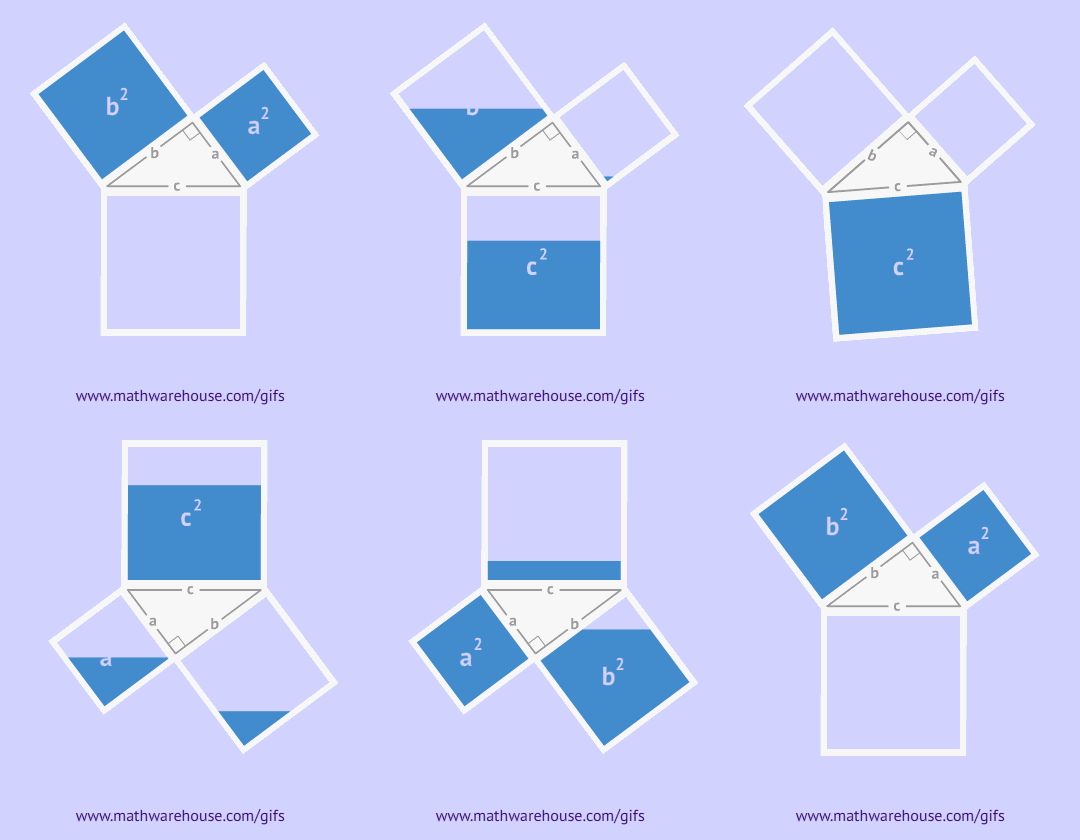
However, the history of the Pythagorean Theorem is complex and nuanced. There is evidence that the theorem was already known and used by mathematicians in Babylon, India and Egypt, thousands of years before Pythagoras. These ancient civilizations applied the theorem for practical purposes, such as surveying and architecture, long before it was formalized in Ancient Greece.
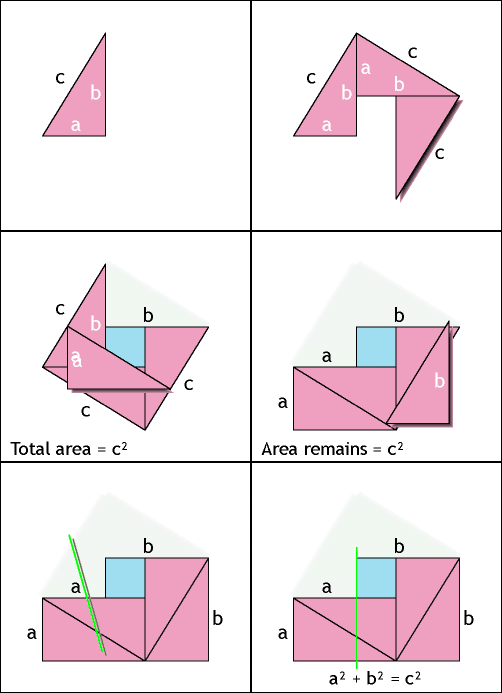
Pythagoras, in turn, is often credited with the first formal demonstration of the theorem that bears his name, although there are no direct written records of his proof. The Pythagorean school, founded by him, was responsible for a series of mathematical and philosophical discoveries, and it is possible that the proof of the theorem was a collective effort by this community of thinkers.

Euclidean geometry, named after Euclid of Alexandria, is the exploration of geometric space that is intuitively familiar to us. It deals with flat, solid figures that are studied in a system of dimensions that extend infinitely in all directions, like lines and planes. Within this system, the Pythagorean Theorem serves as an essential tool for solving problems and proving concepts related to distances and areas.
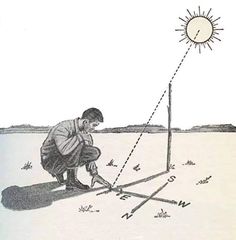
The application of the Pythagorean Theorem goes beyond the limits of pure mathematics. It is used in several areas, such as physics, engineering, architecture and even art. For example, in navigation, it helps calculate the shortest route between two points, while in construction, it allows workers to check that corners are at right angles to ensure structural accuracy.

There are numerous proofs of the Pythagorean Theorem, some of which are purely visual, while others use algebraic methods. One of the best-known demonstrations involves arranging four identical triangles within a square, revealing that the sum of the areas of the smaller squares (the legs) is equal to the area of the larger square (the hypotenuse).
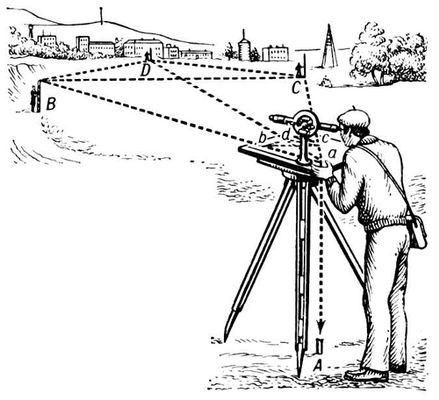
Euclidean distance, a concept derived from the Pythagorean Theorem, is used to calculate the shortest distance between two points in a space of any dimension. This principle is fundamental in data analysis and computer graphics, where measurement accuracy is crucial.
Pythagoras Theorem
In the introduction to this book, we started with the concepts of sides of a square. Our radix quadratum.
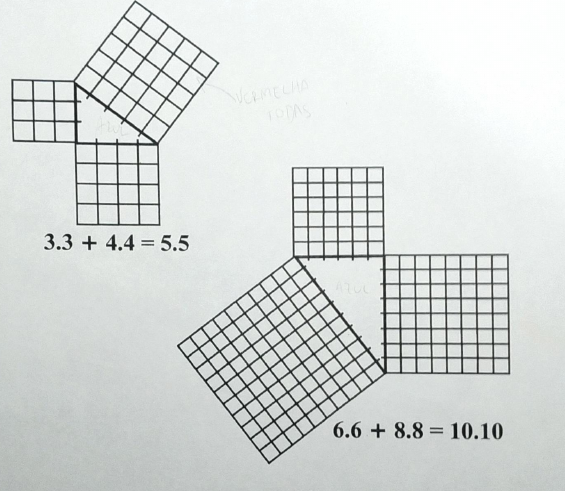
From the figure, we notice that we have area of squares, which in current mathematics is side $\times$ side.
Example 1:
$$\text{Area 1} = 3\times 3 = 9$$$$\text{Area 2} = 4\times 4 = 16$$
$$\text{Area 3} = 5\times 5 = 25$$
$$\text{Area 1} + \text{Area 1} = \text{Area 3}$$
Example 2:
$$\text{Area 1} = 6\times 6 = 36$$$$\text{Area 2} = 8\times 8 = 64$$
$$\text{Area 3} = 10\times 10 = 100$$
$$\text{Area 1} + \text{Area 1} = \text{Area 3}$$
When we generalize the concept, we have the Pythagorean Theorem.
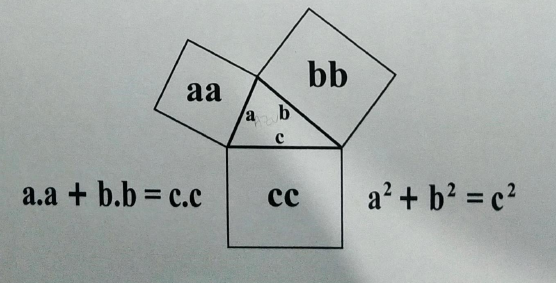
The square (quadratum) sideways (latus) a plus (et) the square (quadratum) sideways (latus) b
is equal (aequalis) to the square (quadratum) of side (latus) c.
equilateral triangle
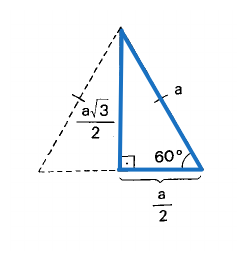
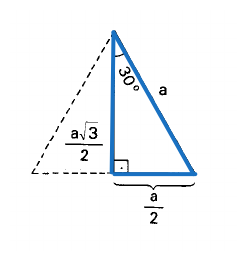
equilateral triangle can be derived from the words equi (iguais) lateralo (lados) and can be obtained from a right-angled triangle. The right triangle is half (½) of a equilateral triangle.
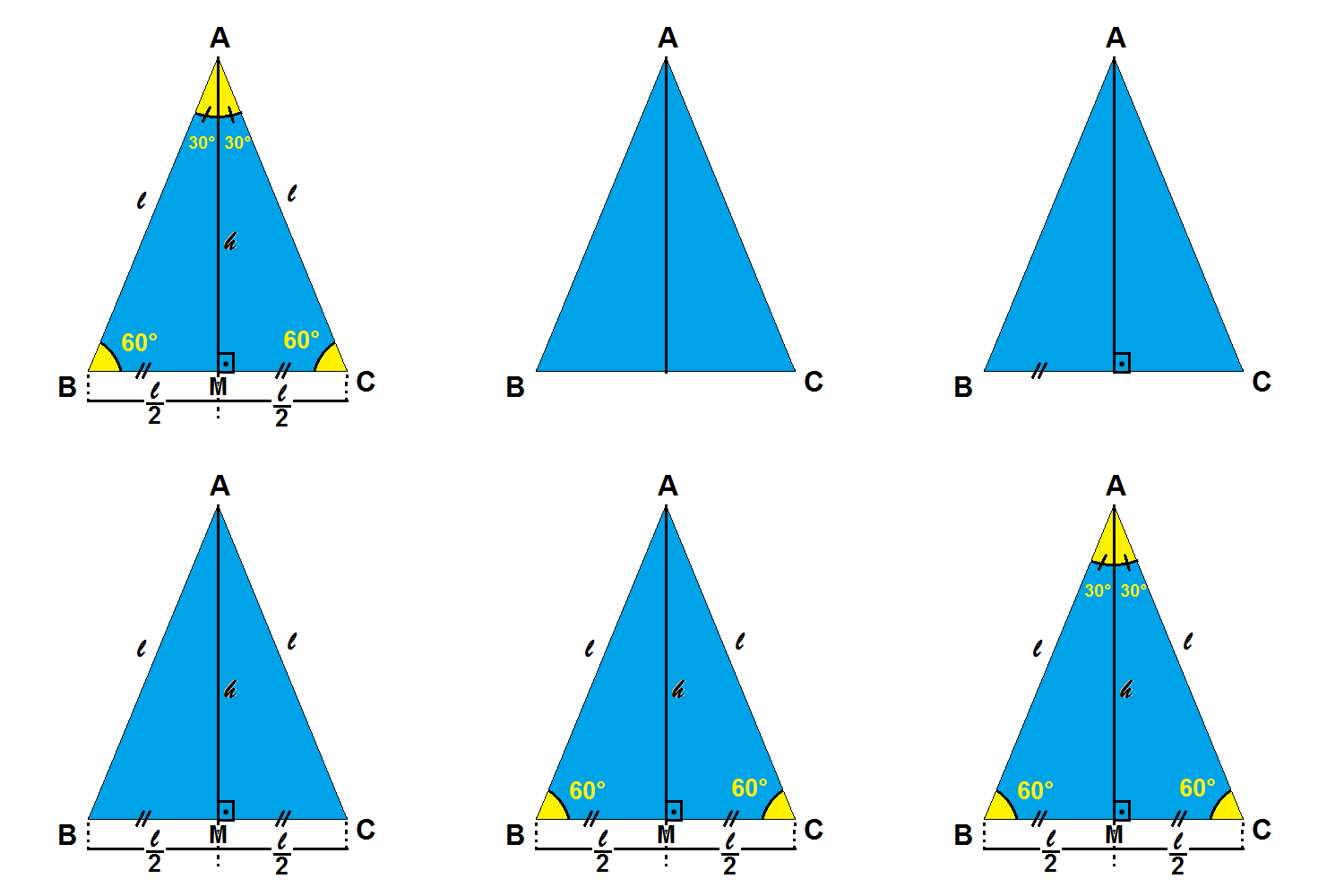
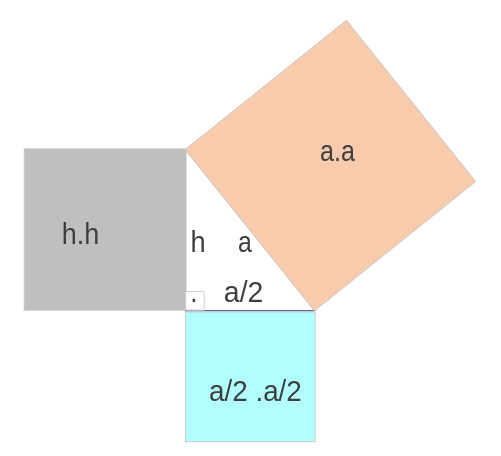
From the right triangle we notice that the hypotenuse in the following example has distance a, one of the legs has distance h and the other leg a/2. As shown in the following figure:
When we unfold the right triangle, we obtain the following equilateral triangle (3 equal sides).

Example 1:
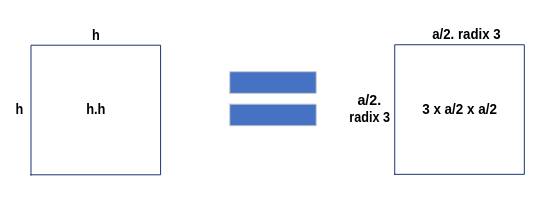
With this, we obtain:
$$h= \frac{a}{2}~.~\text{radix}~ 3$$or
$$h= \frac{a}{2}~.~\sqrt{3}$$Diagonal of the square
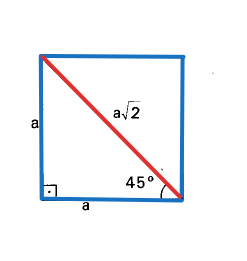
Given a square of side $a$, let’s deduce the diagonal $d$.
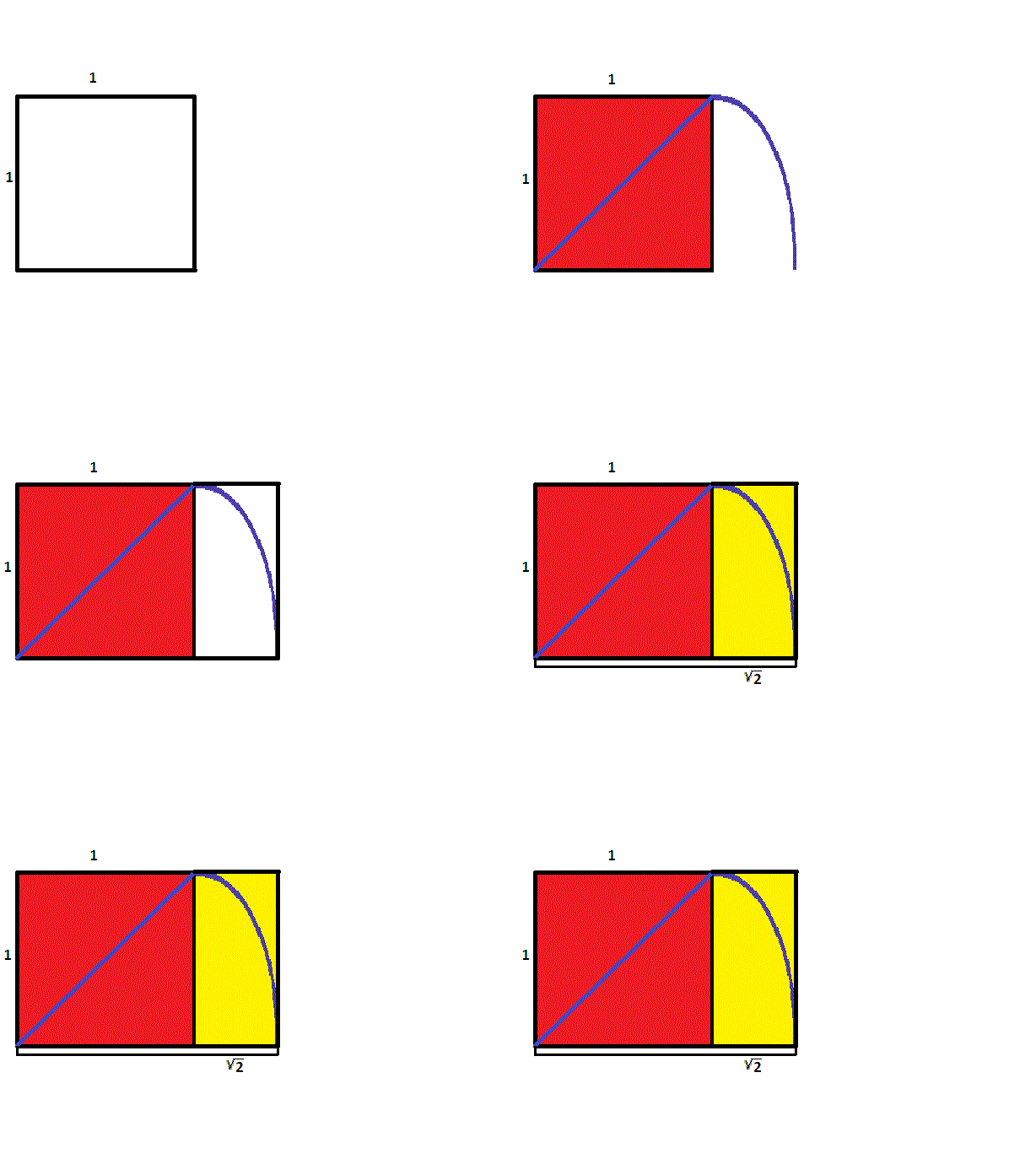
Let $ABCD$ be the square of side $a$.
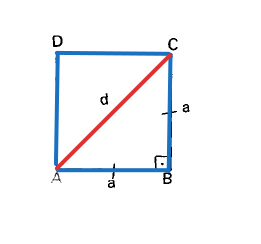
From the Pythagorean theorem in the triangle $ABC$ we have:
$$d^2 = a^2 + a^2$$$$d^2 = 2a^2 $$
$$d = a\sqrt{2} $$
Precursors of Sine, Cosine and Tangent in Right Triangles
The history of trigonometry dates back to ancient Egypt and Babylon, but it was in Ancient Greece that it began to take shape as we know it today. Greek mathematicians such as Hipparchus and Ptolemy began creating trigonometric tables, which were used to understand celestial movements and navigation.
Sine, cosine and tangent, as they are defined in right triangles, have their roots in the work of Indian mathematicians. The mathematician Aryabhata is often credited with developing the sine function in the 5th century, while cosine and tangent were formalized later. These functions were originally designed to solve astronomy problems and were later adapted to mathematics.

In a right-angled triangle, the sine of an angle is defined as the ratio of the length of the side opposite that angle to the length of the hypotenuse. The cosine is the ratio between the adjacent side and the hypotenuse, and the tangent is the ratio between the opposite side and the adjacent side. These definitions are fundamental to trigonometry and are still used today to solve a variety of practical and theoretical problems.
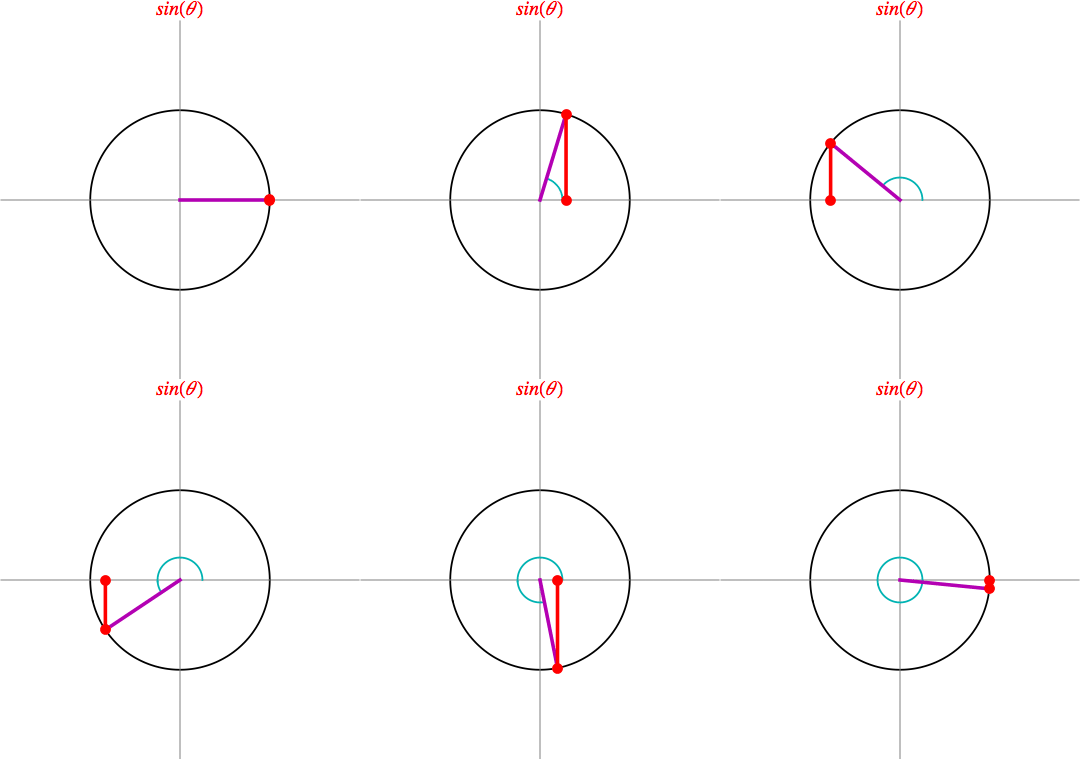
Over the centuries, trigonometry evolved and expanded, incorporating new functions and theorems. However, sine, cosine and tangent remain the basic and most used functions, being essential for students and professionals in areas such as engineering, physics, architecture and many others.
Trigonometry in the right triangle is a powerful tool that allows you to calculate inaccessible distances and measure angles without the need for a protractor. For example, you can use the tangent to determine the height of a building or the width of a river, applying trigonometric ratios to real situations.
The Origin of the Name “Sine”
Trigonometry, a fascinating area of mathematics, is full of terms with interesting stories behind their names, and “sine” is one of them. The word “sine” has a curious origin that dates back to translations between various languages and cultures.
The term’s journey begins with Hindu mathematicians, who referred to half the chord of a circle as “jiva”. This term was later shortened to “jya”. When the Arabs came into contact with Hindu mathematical works, they transliterated “jya” as “jb”, as in Arabic often only the consonants are written, leaving the vowels to be inferred by the reader.
The next step in the term’s journey occurred when Arabic texts were translated into Latin. Translator Robert of Chester in the 12th century interpreted “jb” as “jaib”, which means “bay” or “cove” in Arabic. When translating into Latin, he used the word “sinus”, which shares a similar meaning with “jaib”. Thus, the term “sinus” entered the European mathematical lexicon and eventually evolved into the “sine” we know today in Portuguese.
Sine, cosine and tangent of notable angles
Let $\alpha$ be the measure of one of the acute angles of a right triangle.
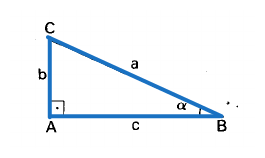
Sine of angle $\alpha$:
$$\sin \alpha = \frac{\text{cateto oposto}}{\text{hipotenusa}} = \frac{b}{a}$$
Cosine of angle $\alpha$:
$$\cos \alpha = \frac{\text{cateto adjascente}}{\text{hipotenusa}} = \frac{c}{a}$$
tangent of angle $\alpha$:
$$\tan \alpha = \frac{\text{cateto oposto}}{\text{cateto adjascente}} = \frac{b}{c}$$
Application for notable angles
| Angle | Sine | Cosine | Tangent | geometric figure |
|---|---|---|---|---|
| $45^\circ$ | $$\sin 45^\circ= \frac{a}{a\sqrt{2}}=\frac{\sqrt{2}}{2 }\quad$$ | $$\cos 45^\circ= \frac{a}{a\sqrt{2}}=\frac{\sqrt{2}}{2}\quad$$ | $$\tan 45^\circ = \frac{a}{a} = 1\quad$$ |
|
| $60^\circ$ | $$\sin 60^\circ= \frac{\frac{a\sqrt{3}}{2}}{a}=\frac{\sqrt{3}}{2 }\quad$$ | $$\cos 60^\circ= \frac{\frac{a}{2}}{a}=\frac{1}{2}\quad$$ | $$\tan 60^\circ = \frac{\frac{a\sqrt{3}}{2}}{\frac{a}{2}} = \sqrt{3}\quad$$ |
|
| $30^\circ$ | $$\sin 30^\circ= \frac{\frac{a}{2}}{a}=\frac{1}{2}\quad$$ | $$\cos 30^\circ= \frac{\frac{a\sqrt{3}}{2}}{a}=\frac{\sqrt{3}}{2}\quad$$ | $$\tan 30^\circ = \frac{\frac{a}{2}}{\frac{a\sqrt{3}}{2}} = \frac{\sqrt{3}}{3}\quad$$ |
|
Considerations
In short, the Pythagorean Theorem is a jewel of Euclidean geometry, a tool that continues to prove its value and versatility in a wide range of scientific and practical fields. It is a testament to the power of mathematics to describe the world around us with simplicity and precision.
For those who wish to explore more about this fascinating topic, there are a wealth of resources available that offer deeper insight into the theorem and its applications. Here a small contribution was made to the Pythagorean theorem, wait for the next posts.