
Euler's Eyes
2026-11-03
EJU 2021 (1st session) – Mathematics Course 2 solved
Source: JASSO – Mathematics paper in English, in Japanese and official answer key. Files on the page for the 1st session of 2021.
Course 2 is the advanced mathematics paper of the EJU. Each letter $\boxed{\text{A}}$, $\boxed{\text{B}}$, … is a digit from 0 to 9 or the minus sign. In some blanks the answer is the number of a choice, from ⓪ to ⑨. The statements below are summarized from the official English version.
Answer key
| Question | Topic | Answers |
|---|---|---|
| I | Same as Question I of Course 1 | A=6, BC=24, DE=33, F=2, G=8, H=2, I=1, JK=27; LM=13, NO=19, PQR=427, STUV=1981, WX=31 |
| II Q1 | Vectors in the regular tetrahedron | AB=12, C=0, D=2, E=5, F=7, G=5, HI=12, JK=12, LM=56 |
| II Q2 | Rotation in the complex plane | N=2, OP=74, QR=74, S=2, T=1, UV=12, WXY=525 |
| III | Minimum of an exponential function | A=2, B=3, CD=12, EF=45, G=3, H=3, I=5, J=2, KL=50, M=3, NO=54, P=5, QR=50, ST=50, U=0, V=5, WX=21, Y=1 |
| IV | Areas between $\sin^2x$ and $k\cos2x$ | A=2, B=1, C=1, D=2, E=1, F=1, G=2, H=2, I=1, J=2, K=1, L=2, M=1, N=1, O=2, P=1, Q=4, R=4 |
Question I
Question I of Course 2 is identical to that of Course 1 (two quadratic functions and a card game). The full solution is in the Course 1 post.
Answers: A=6, BC=24, DE=33, F=2, G=8, H=2, I=1, JK=27; LM=13, NO=19, PQR=427, STUV=1981, WX=31.
Question II
Q1: vectors in a regular tetrahedron
Statement. In blanks $\boxed{\text{C}}$ to $\boxed{\text{G}}$, choose the correct option from ⓪ to ⑨ below; in the others, write the number.
Let $OABC$ be a regular tetrahedron with edge 1. For $0 < x < 1$, let $P$ be the point dividing $AB$ in the ratio $x : (1 - x)$ and $Q$ the point dividing $BC$ in the ratio $x : (1 - x)$. Let $\vec a = \vec{OA}$, $\vec b = \vec{OB}$ and $\vec c = \vec{OC}$. We want the possible values of $\cos\angle POQ$.
The vectors satisfy $\vec a\cdot\vec b = \vec b\cdot\vec c = \vec c\cdot\vec a = \dfrac{\boxed{\text{A}}}{\boxed{\text{B}}}$. Writing $\vec{OP} = \boxed{\text{C}}$ and $\vec{OQ} = \boxed{\text{D}}$, we have $|\vec{OP}| = |\vec{OQ}| = \sqrt{\boxed{\text{E}}}$ and $\vec{OP}\cdot\vec{OQ} = \boxed{\text{F}}$. So
$$\cos\angle POQ = \frac{1}{\boxed{\text{G}}} - \frac{\boxed{\text{H}}}{\boxed{\text{I}}},$$and finally $\dfrac{\boxed{\text{J}}}{\boxed{\text{K}}} < \cos\angle POQ \le \dfrac{\boxed{\text{L}}}{\boxed{\text{M}}}$.
Options: ⓪ $(1 - x)\vec a + x\vec b$; ① $x\vec a + (1 - x)\vec b$; ② $(1 - x)\vec b + x\vec c$; ③ $x\vec b + (1 - x)\vec c$; ④ $x^2 + x + 1$; ⑤ $x^2 - x + 1$; ⑥ $x^2 - x - 1$; ⑦ $\frac12(-x^2 + x + 1)$; ⑧ $\frac12(-x^2 - x + 1)$; ⑨ $\frac12(-x^2 + x - 1)$.
Solution.
1. The dot products. The faces are equilateral triangles with side 1, so the angle between two edges from $O$ is $60^\circ$ and $\vec a\cdot\vec b = \cos60^\circ = \frac12$.
2. The points. $AP : PB = x : (1 - x)$ gives $\vec{OP} = (1 - x)\vec a + x\vec b$ (⓪). Likewise, $\vec{OQ} = (1 - x)\vec b + x\vec c$ (②).
3. The lengths.
$$|\vec{OP}|^2 = (1 - x)^2 + x^2 + 2x(1 - x)\cdot\frac12 = x^2 - x + 1 \quad (\text{⑤}),$$and the same for $|\vec{OQ}|^2$.
4. The dot product. Expanding, with $\vec b\cdot\vec b = 1$ and the other products equal to $\frac12$:
$$\vec{OP}\cdot\vec{OQ} = \frac12(1 - x)^2 + \frac12x(1 - x) + x(1 - x) + \frac12x^2 = \frac12(-x^2 + x + 1) \quad (\text{⑦}).$$5. The cosine. With $u = x^2 - x + 1$, the numerator is $\frac12(2 - u)$, so
$$\cos\angle POQ = \frac{2 - u}{2u} = \frac1u - \frac12.$$6. The range. $u = \left(x - \frac12\right)^2 + \frac34$ ranges over $\left[\frac34, 1\right)$ for $0 < x < 1$ (minimum at $x = \frac12$; $u \to 1$ at the ends without reaching it). So $\frac1u \in \left(1, \frac43\right]$ and
$$\frac12 < \cos\angle POQ \le \frac56.$$Answers: A=1, B=2, C=0, D=2, E=5, F=7, G=5, H=1, I=2, J=1, K=2, L=5, M=6.
Q2: rotation in the complex plane
Statement. Triangle $ABC$ in the complex plane has vertices $A(\alpha)$, $B(\beta)$ and $C(\gamma)$ with
$$\frac{\gamma - \alpha}{\beta - \alpha} = 1 - i.$$(Arguments $\theta$ are taken in $0 \le \theta < 2\pi$.)
- In polar form, $\dfrac{\gamma - \alpha}{\beta - \alpha} = \sqrt{\boxed{\text{N}}}\left(\cos\dfrac{\boxed{\text{O}}}{\boxed{\text{P}}}\pi + i\sin\dfrac{\boxed{\text{O}}}{\boxed{\text{P}}}\pi\right)$. So $C$ is obtained by rotating $B$ by $\dfrac{\boxed{\text{Q}}}{\boxed{\text{R}}}\pi$ about $A$ and multiplying the distance to $A$ by $\sqrt{\boxed{\text{S}}}$. Hence the modulus and argument of $w = \dfrac{\gamma - \beta}{\alpha - \beta}$ are $|w| = \boxed{\text{T}}$ and $\arg w = \dfrac{\boxed{\text{U}}}{\boxed{\text{V}}}\pi$.
- If $\alpha + \beta + \gamma = 0$, then $|\alpha| : |\beta| : |\gamma| = \sqrt{\boxed{\text{W}}} : \sqrt{\boxed{\text{X}}} : \sqrt{\boxed{\text{Y}}}$.
Solution.
1. Polar form. $|1 - i| = \sqrt2$, and $1 - i$ lies in the fourth quadrant with argument $\frac{7\pi}{4}$. So $\gamma - \alpha = \sqrt2\left(\cos\frac{7\pi}{4} + i\sin\frac{7\pi}{4}\right)(\beta - \alpha)$: rotate $B$ by $\frac74\pi$ about $A$ and multiply the distance by $\sqrt2$.
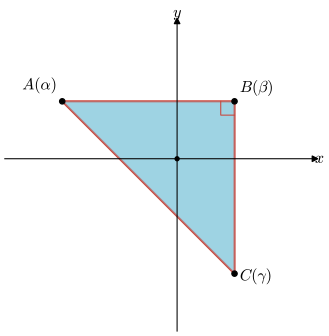
2. The number $w$. Since only differences matter, choose $\alpha = 0$ and $\beta = 1$. Then $\gamma = 1 - i$ and $w = \frac{(1 - i) - 1}{0 - 1} = i$: $|w| = 1$ and $\arg w = \frac\pi2$. The triangle is an isosceles right triangle with the right angle at $B$.
3. With $\alpha + \beta + \gamma = 0$. Let $d = \beta - \alpha$. Then $\gamma = \alpha + (1 - i)d$, and
$$\alpha + \beta + \gamma = 3\alpha + (2 - i)d = 0 \implies \alpha = -\frac{(2 - i)d}{3}.$$So $\beta = \alpha + d = \frac{(1 + i)d}{3}$ and $\gamma = \alpha + (1 - i)d = \frac{(1 - 2i)d}{3}$. The moduli are proportional to $|2 - i| = \sqrt5$, $|1 + i| = \sqrt2$ and $|1 - 2i| = \sqrt5$.
Answers: N=2, O=7, P=4, Q=7, R=4, S=2, T=1, U=1, V=2, W=5, X=2, Y=5.
Question III: the minimum of an exponential function
Statement. We want the minimum value of
$$f(x) = 8^x + 8^{-x} - 3\left(4^{1+x} + 4^{1-x} - 2^{4+x} - 2^{4-x}\right) - 24$$and the values of $x$ at which it occurs.
Let $2^x + 2^{-x} = t$. Since $4^x + 4^{-x} = t^2 - \boxed{\text{A}}$ and $8^x + 8^{-x} = t^3 - \boxed{\text{B}}\,t$, we have $f(x) = t^3 - \boxed{\text{CD}}\,t^2 + \boxed{\text{EF}}\,t$. Calling the right-hand side $g(t)$, $g'(t) = \boxed{\text{G}}\left(t - \boxed{\text{H}}\right)\left(t - \boxed{\text{I}}\right)$, with $\boxed{\text{H}} < \boxed{\text{I}}$. Since $2^x + 2^{-x} = t$, $t \ge \boxed{\text{J}}$. At $t = \boxed{\text{J}}$, $g = \boxed{\text{KL}}$. For $t > \boxed{\text{J}}$, $g$ has a local maximum at $t = \boxed{\text{M}}$, with value $\boxed{\text{NO}}$, and a local minimum at $t = \boxed{\text{P}}$, with value $\boxed{\text{QR}}$. So the minimum of $f$ is $\boxed{\text{ST}}$, at $x = \boxed{\text{U}}$ and at $x = \log_2\left(\boxed{\text{V}} \pm \sqrt{\boxed{\text{WX}}}\right) - \boxed{\text{Y}}$.
Solution.
1. The powers of $t$. $t^2 = 4^x + 2 + 4^{-x}$, so $4^x + 4^{-x} = t^2 - 2$. And $t^3 = 8^x + 3(2^x + 2^{-x}) + 8^{-x}$, so $8^x + 8^{-x} = t^3 - 3t$.
2. The function in $t$. $4^{1+x} + 4^{1-x} = 4(t^2 - 2)$ and $2^{4+x} + 2^{4-x} = 16t$. So
$$f = t^3 - 3t - 3\left(4t^2 - 8 - 16t\right) - 24 = t^3 - 12t^2 + 45t.$$3. The derivative. $g'(t) = 3t^2 - 24t + 45 = 3(t - 3)(t - 5)$.
4. The domain of $t$. By AM–GM, $2^x + 2^{-x} \ge 2$, with equality only at $x = 0$.
5. The values. $g(2) = 8 - 48 + 90 = 50$; $g(3) = 27 - 108 + 135 = 54$ (local maximum); $g(5) = 125 - 300 + 225 = 50$ (local minimum). For $t \ge 2$, $g$ rises from 50 to 54, falls to 50 and then grows without bound: the minimum is $50$, at $t = 2$ and at $t = 5$.
6. The values of $x$. $t = 2$ gives $x = 0$. $t = 5$ gives $2^x + 2^{-x} = 5$, that is, $(2^x)^2 - 5\cdot2^x + 1 = 0$, $2^x = \frac{5 \pm \sqrt{21}}{2}$ (both positive), and
$$x = \log_2\left(5 \pm \sqrt{21}\right) - 1.$$Answers: A=2, B=3, CD=12, EF=45, G=3, H=3, I=5, J=2, KL=50, M=3, NO=54, P=5, QR=50, ST=50, U=0, V=5, WX=21, Y=1.
Question IV: areas between sin²x and k·cos 2x
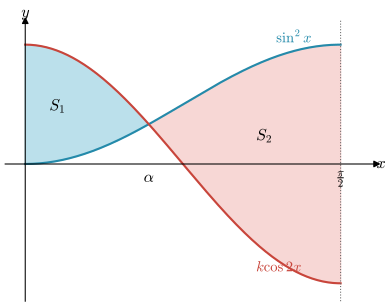
Statement. Let $k > 0$ and consider the curves $C_1: y = \sin^2x$ and $C_2: y = k\cos2x$, with $0 \le x \le \frac\pi2$. Let $S_1$ be the area of the region bounded by $C_1$, $C_2$ and the $y$-axis, and $S_2$ the area of the region bounded by $C_1$, $C_2$ and the line $x = \frac\pi2$. We want to show that $S_2 - S_1$ does not depend on $k$.
Let $\alpha$ be the solution of $\sin^2x = k\cos2x$. Then
$$\sin\alpha = \sqrt{\frac{k}{\boxed{\text{A}}\,k + \boxed{\text{B}}}}, \qquad \cos\alpha = \sqrt{\frac{k + \boxed{\text{C}}}{\boxed{\text{D}}\,k + \boxed{\text{E}}}}.$$Hence
$$S_1 = \frac{\boxed{\text{F}}}{\boxed{\text{G}}}\int_0^\alpha\left\{\left(\boxed{\text{H}}\,k + \boxed{\text{I}}\right)\cos\boxed{\text{J}}\,x - 1\right\}dx = \frac{\boxed{\text{K}}}{\boxed{\text{L}}}\left\{\sqrt{k\left(k + \boxed{\text{M}}\right)} - \alpha\right\},$$$$S_2 = \frac{\boxed{\text{N}}}{\boxed{\text{O}}}\left\{\sqrt{k\left(k + \boxed{\text{P}}\right)} - \alpha\right\} + \frac{\pi}{\boxed{\text{Q}}},$$and $S_2 - S_1 = \dfrac{\pi}{\boxed{\text{R}}}$, which does not depend on $k$.
Solution.
1. The meeting point. $\sin^2x = k(1 - 2\sin^2x)$ gives $\sin^2\alpha = \frac{k}{2k + 1}$ and $\cos^2\alpha = 1 - \sin^2\alpha = \frac{k + 1}{2k + 1}$.
2. $S_1$. On $[0, \alpha]$, $C_2$ is on top ($k\cos 0 = k > 0 = \sin^2 0$). With $\sin^2x = \frac{1 - \cos2x}{2}$,
$$k\cos2x - \sin^2x = \frac12\left\{(2k + 1)\cos2x - 1\right\}.$$Integrating,
$$S_1 = \frac12\left[\frac{(2k + 1)\sin2x}{2} - x\right]_0^\alpha = \frac12\left\{(2k + 1)\sin\alpha\cos\alpha - \alpha\right\}.$$And $(2k + 1)\sin\alpha\cos\alpha = (2k + 1)\frac{\sqrt{k(k + 1)}}{2k + 1} = \sqrt{k(k + 1)}$. So $S_1 = \frac12\left\{\sqrt{k(k + 1)} - \alpha\right\}$.
3. $S_2$. On $[\alpha, \frac\pi2]$, $C_1$ is on top, and the integrand changes sign:
$$S_2 = -\frac12\left[\frac{(2k + 1)\sin2x}{2} - x\right]_\alpha^{\pi/2} = -\frac12\left\{\left(0 - \frac\pi2\right) - \left(\sqrt{k(k + 1)} - \alpha\right)\right\} = \frac12\left\{\sqrt{k(k + 1)} - \alpha\right\} + \frac\pi4.$$4. The difference. $S_2 - S_1 = \frac\pi4$. Another way to see it: $S_2 - S_1$ is the integral of $\sin^2x - k\cos2x$ over the whole interval $[0, \frac\pi2]$, and there $\int\cos2x\,dx = 0$ and $\int\sin^2x\,dx = \frac\pi4$.
Answers: A=2, B=1, C=1, D=2, E=1, F=1, G=2, H=2, I=1, J=2, K=1, L=2, M=1, N=1, O=2, P=1, Q=4, R=4.