
Euler's Eyes
2026-11-04
EJU 2016 (2nd session) – Mathematics Course 2 solved
Source: JASSO – Mathematics paper in English, in Japanese and official answer key. Files on the page for the 2nd session of 2016.
Course 2 is the advanced mathematics paper of the EJU. Each letter $\boxed{\text{A}}$, $\boxed{\text{B}}$, … is a digit from 0 to 9 or the minus sign; in some blanks the answer is the number of a choice. The statements below are summarized from the official English version.
Answer key
| Question | Topic | Answers |
|---|---|---|
| I | Same as Question I of Course 1 | A=1, BC=16, D=3, E=5, FG=−1, H=2, IJ=15; K=1, LM=12, NO=13, PQ=40, R=1, S=8 |
| II | Recurrence with logarithms | A=2, B=3, C=2, D=2, E=0, F=1, G=2, H=2, I=2, JKL=100 |
| III | An arc and a line in the complex plane | A=5, B=6, C=7, D=6, E=9, F=3, G=2, H=1, I=2, J=1, K=1, L=2, M=2, N=1, O=3, P=2, Q=3 |
| IV Q1 | Product of logarithms | A=3, B=3, CD=27, E=3, F=2, G=3, H=3, I=6, J=2, KL=27, M=6 |
| IV Q2 | Volume that grows with time | N=2, O=1, P=2, Q=1, R=8, S=3, T=4, U=2, V=6, W=5, X=3, Y=2, Z=2 |
Question I
Question I of Course 2 is identical to that of Course 1 (a quadratic from its maximum and roots, and probability with cards 0 to 9). The full solution is in the Course 1 post.
Answers: A=1, BC=16, D=3, E=5, FG=−1, H=2, IJ=15; K=1, LM=12, NO=13, PQ=40, R=1, S=8.
Question II: a multiplicative recurrence
Statement. The sequence of positive numbers satisfies $a_1 = 1$, $a_2 = 10$ and $(a_n)^2a_{n-2} = (a_{n-1})^3$ ($n \ge 3$) ①. We want $\lim a_n$. Taking the common logarithm of ①, $\boxed{\text{A}}\log_{10}a_n + \log_{10}a_{n-2} = \boxed{\text{B}}\log_{10}a_{n-1}$. With $b_n = \log_{10}a_n$: $\boxed{\text{A}}\,b_n + b_{n-2} = \boxed{\text{B}}\,b_{n-1}$ ②, which can be written $b_n - b_{n-1} = \frac{1}{\boxed{\text{C}}}(b_{n-1} - b_{n-2})$, so
$$b_n - b_{n-1} = \left(\frac{1}{\boxed{\text{C}}}\right)^{n - \boxed{\text{D}}}(b_2 - b_1) \quad \text{③}.$$Since $b_1 = \boxed{\text{E}}$ and $b_2 = \boxed{\text{F}}$, $b_n = \sum_{k=2}^n\left(\frac{1}{\boxed{\text{C}}}\right)^{k - \boxed{\text{G}}} = \boxed{\text{H}} - \left(\frac{1}{\boxed{\text{C}}}\right)^{n - \boxed{\text{I}}}$, and $\lim a_n = \boxed{\text{JKL}}$.
Solution.
1. Logarithms. $2b_n + b_{n-2} = 3b_{n-1}$, or $2(b_n - b_{n-1}) = b_{n-1} - b_{n-2}$: the differences form a geometric progression with ratio $\frac12$.
2. The general term. $b_1 = \log1 = 0$ and $b_2 = \log10 = 1$, so $b_n - b_{n-1} = \left(\frac12\right)^{n-2}$ and
$$b_n = \sum_{k=2}^{n}\left(\frac12\right)^{k-2} = 1 + \frac12 + \dots + \left(\frac12\right)^{n-2} = 2 - \left(\frac12\right)^{n-2}.$$3. The limit. $b_n \to 2$, so $a_n = 10^{b_n} \to 100$.
Answers: A=2, B=3, C=2, D=2, E=0, F=1, G=2, H=2, I=2, JKL=100.
Question III: an arc and a line in the complex plane
Statement. Let $\alpha$ and $\beta$ be the roots of $x^2 + \sqrt3x + 1 = 0$, with $0 < \arg\alpha < \arg\beta < 2\pi$. Consider the complex numbers $z$ with
$$\arg\frac{\alpha - z}{\beta - z} = \frac\pi2 \ \text{①}, \qquad (1 + i)z + (1 - i)\bar z + k = 0 \ \text{②}, \qquad \frac\pi2 < \arg z < \pi \ \text{③},$$with $k$ real. Let $A$, $B$ and $P$ be the points of $\alpha$, $\beta$ and $z$.
- $\arg\alpha = \dfrac{\boxed{\text{A}}}{\boxed{\text{B}}}\pi$ and $\arg\beta = \dfrac{\boxed{\text{C}}}{\boxed{\text{D}}}\pi$.
- Choose $\boxed{\text{E}}$ to $\boxed{\text{Q}}$ from ⓪ 0, ① 1, ② 2, ③ 3, ④ 4, ⑤ 5, ⑥ 6, ⑦ $\angle PAB$, ⑧ $\angle PBA$, ⑨ $\angle APB$. Since $\boxed{\text{E}} = \frac\pi2$ by ①, $P$ lies on the circle with center $-\dfrac{\sqrt{\boxed{\text{F}}}}{\boxed{\text{G}}}$ and radius $\dfrac{\boxed{\text{H}}}{\boxed{\text{I}}}$. By ②, $P$ lies on the line with slope $\boxed{\text{J}}$ that meets the imaginary axis at $\dfrac{\boxed{\text{K}}}{\boxed{\text{L}}}k\,i$. The number $n$ of complex numbers $z$ satisfying ①, ② and ③ is at most $\boxed{\text{M}}$, and this happens for $\boxed{\text{N}} + \sqrt{\boxed{\text{O}}} < k < \sqrt{\boxed{\text{P}}} + \sqrt{\boxed{\text{Q}}}$, with $\boxed{\text{P}} < \boxed{\text{Q}}$.
Solution.
1. The roots. $x = \frac{-\sqrt3 \pm i}{2}$, on the unit circle, with arguments $\frac{5\pi}{6}$ ($\alpha$, positive imaginary part) and $\frac{7\pi}{6}$ ($\beta$).
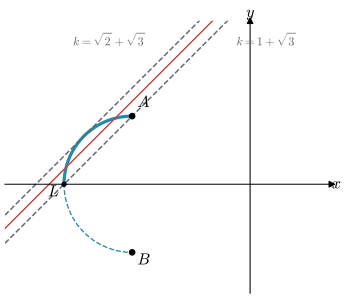
2. The arc. The argument of $\frac{\alpha - z}{\beta - z}$ is the oriented angle $\angle APB$ (⑨). $\angle APB = 90^\circ$ puts $P$ on the circle with diameter $AB$: center $-\frac{\sqrt3}{2}$ (midpoint of $A$ and $B$) and radius $\frac12$. The sign $+\frac\pi2$ picks the left half: with $P$ at the leftmost point, $\frac{\alpha - z}{\beta - z} = \frac{1 + i}{1 - i} = i$; at the rightmost point it gives $-i$.
3. The line. With $z = x + yi$: $(1 + i)z + (1 - i)\bar z = 2x - 2y$, and ② is $y = x + \frac k2$: slope 1 and intercept $\frac k2\,i$ on the imaginary axis.
4. Counting. ③ requires $y > 0$ (second quadrant; points of the arc already have $x < 0$). So $P$ runs over the quarter circle from $A\left(-\frac{\sqrt3}{2}, \frac12\right)$ to the leftmost point $L\left(-\frac{\sqrt3}{2} - \frac12, 0\right)$, endpoints excluded. A line of slope 1 meets this arc at most twice ($M = 2$).
- $A$ and $L$ lie on the same line of slope 1, the one with $k = 1 + \sqrt3$.
- The tangent of slope 1 to this arc touches it at $\left(-\frac{\sqrt3}{2} - \frac{\sqrt2}{4}, \frac{\sqrt2}{4}\right)$ and has $\frac k2 = \frac{\sqrt3 + \sqrt2}{2}$, that is, $k = \sqrt2 + \sqrt3$.
Between these two lines, each line meets the arc at two points: $1 + \sqrt3 < k < \sqrt2 + \sqrt3$.
Answers: A=5, B=6, C=7, D=6, E=9, F=3, G=2, H=1, I=2, J=1, K=1, L=2, M=2, N=1, O=3, P=2, Q=3.
Question IV
Q1: a product of base-3 logarithms
Statement. Let $x$ satisfy $2\left(\log_{1/3}x\right)^2 + 9\log_{1/3}x + 9 \le 0$ ①. We want the maximum of
$$f(x) = (\log_3x)\left(\log_3\frac x3\right)\left(\log_3\frac x9\right) \quad \text{②}.$$The $x$ satisfying ① are $\boxed{\text{A}}\sqrt{\boxed{\text{B}}} \le x \le \boxed{\text{CD}}$. With $t = \log_3x$, $\dfrac{\boxed{\text{E}}}{\boxed{\text{F}}} \le t \le \boxed{\text{G}}$. Writing the right-hand side of ② as $g(t)$, $g'(t) = \boxed{\text{H}}\,t^2 - \boxed{\text{I}}\,t + \boxed{\text{J}}$. So $f$ is largest at $x = \boxed{\text{KL}}$, with value $\boxed{\text{M}}$.
Solution.
1. The constraint. $\log_{1/3}x = -t$, and ① becomes $2t^2 - 9t + 9 \le 0$, or $(2t - 3)(t - 3) \le 0$: $\frac32 \le t \le 3$, that is, $3^{3/2} = 3\sqrt3 \le x \le 27$.
2. The function. $f = t(t - 1)(t - 2) = t^3 - 3t^2 + 2t$, and $g'(t) = 3t^2 - 6t + 2$, with roots $1 \pm \frac{\sqrt3}{3} \approx 0.42$ and $1.58$. On $\left[\frac32, 3\right]$, $g$ decreases until $1.58$ and increases afterwards: the maximum is at an endpoint. $g\left(\frac32\right) = -\frac38$ and $g(3) = 6$. The maximum is $6$, at $t = 3$, that is, $x = 27$.
Answers: A=3, B=3, CD=27, E=3, F=2, G=3, H=3, I=6, J=2, KL=27, M=6.
Q2: a volume that grows with time
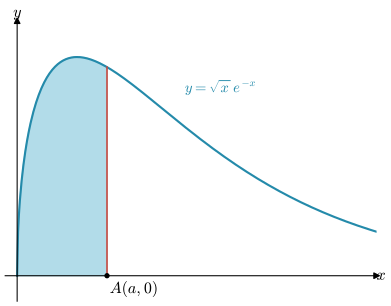
Statement. Let $a > 0$. The region bounded by the curve $y = \sqrt x\,e^{-x}$, the $x$-axis and the line $x = a$ (through $A(a, 0)$) is rotated about the $x$-axis, generating a solid of volume $V$.
- $V = -\dfrac\pi4\left\{\left(\boxed{\text{N}}\,a + \boxed{\text{O}}\right)e^{-\boxed{\text{P}}a} - \boxed{\text{Q}}\right\}$.
- The point $A$ starts at the origin and moves in the positive direction of the $x$-axis with speed $4t$ at time $t$. The rate of change of $V$ is $\dfrac{dV}{dt} = \boxed{\text{R}}\,\pi t^{\boxed{\text{S}}}e^{-\boxed{\text{T}}t^{\boxed{\text{U}}}}$, largest at $t = \dfrac{\sqrt{\boxed{\text{V}}}}{4}$. At that moment $V = -\dfrac\pi8\left(\boxed{\text{W}}\,e^{-\frac{\boxed{\text{X}}}{\boxed{\text{Y}}}} - \boxed{\text{Z}}\right)$.
Solution.
1. The volume. $V = \pi\int_0^a x e^{-2x}\,dx$. By parts, $\int xe^{-2x}dx = -\frac{x}{2}e^{-2x} - \frac14e^{-2x}$, so
$$V = \pi\left(\frac14 - \frac{2a + 1}{4}e^{-2a}\right) = -\frac\pi4\left\{(2a + 1)e^{-2a} - 1\right\}.$$2. The rate. The position of $A$ is $a = \int_0^t 4s\,ds = 2t^2$. By the chain rule, $\frac{dV}{dt} = \frac{dV}{da}\cdot\frac{da}{dt} = \pi ae^{-2a}\cdot4t = 8\pi t^3e^{-4t^2}$.
3. The maximum rate. $\frac{d}{dt}\left(t^3e^{-4t^2}\right) = (3t^2 - 8t^4)e^{-4t^2}$ vanishes at $t^2 = \frac38$, $t = \frac{\sqrt6}{4}$ (positive before, negative after). Then $a = 2t^2 = \frac34$ and
$$V = -\frac\pi4\left(\frac52e^{-3/2} - 1\right) = -\frac\pi8\left(5e^{-3/2} - 2\right).$$Answers: N=2, O=1, P=2, Q=1, R=8, S=3, T=4, U=2, V=6, W=5, X=3, Y=2, Z=2.