
Euler's Eyes
2026-10-11
The life of Blaise Pascal
Timeline
- 1623Born on 19 June in Clermont, in the Auvergne region of France.
- 1626His mother, Antoinette Begon, dies. Blaise is 3.
- 1631His father, Étienne Pascal, moves to Paris with his three children.
- 1635At 12, he rediscovers on his own that the angles of a triangle add up to two right angles.
- 1640At 16, he publishes the Essay on conics, with the hexagon theorem.
- 1642Starts building a calculating machine to help his father, a tax official in Rouen.
- 1647Publishes the New experiments concerning the vacuum. Descartes visits him.
- 1648Florin Périer, his brother-in-law, measures the weight of air by climbing the Puy de Dôme.
- 1654Exchanges letters with Fermat about games of chance and writes the Treatise on the arithmetic triangle. On 23 November he has his “night of fire”.
- 1656Begins publishing the Provincial letters under a pseudonym.
- 1658Solves the problems of the cycloid and launches a contest about them.
- 1662Opens a line of public coaches in Paris. Dies on 19 August, aged 39.
- 1670His friends publish the Pensées, put together from his notes.
- He is born in Clermont, in Auvergne. His mother dies when he is three.
- His father teaches him at home and takes him to Mersenne’s gatherings. At 16 he writes the Essay on conics.
- His father is a tax collector in Normandy. To help him, Blaise builds the Pascaline and carries out his experiments on the vacuum.
- At Pascal’s request his brother-in-law Florin Périer climbs the mountain with a barometer and shows that the air weighs less at the top.
- The letters to Fermat on games of chance, the night of fire, the Provincial Letters, the cycloid and the public coaches. He dies in 1662, aged 39.
- After the night of fire he spends periods at the convent where his sister Jacqueline lives and defends Port-Royal against the Jesuits.
- 1623–1631 · Clermont
- 1631–1639 · Paris
- 1640–1647 · Rouen
- 1648 · Puy de Dôme
- 1647–1662 · Paris
- 1655 · Port-Royal-des-Champs
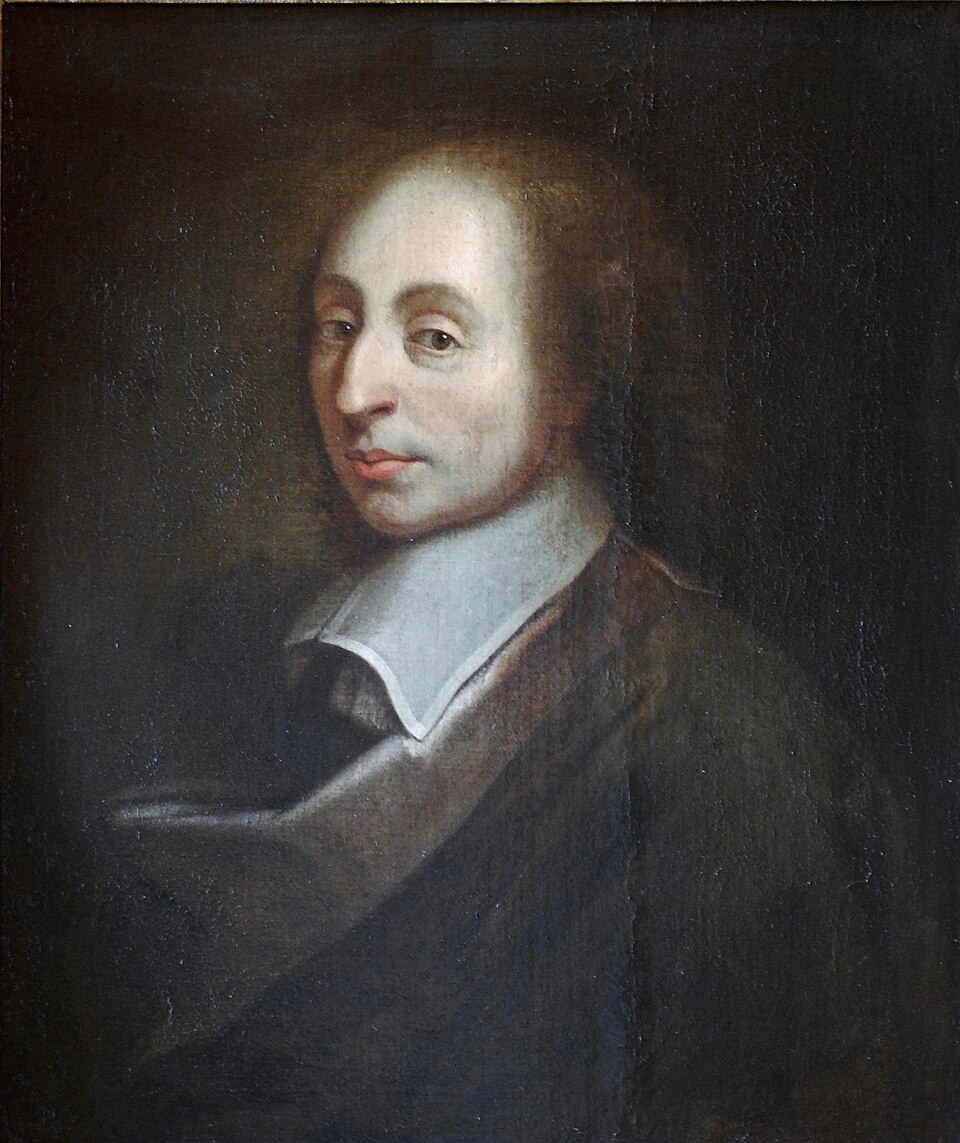
A father who hid geometry
Blaise Pascal was born in Clermont, in central France, in 1623. His mother died when he was 3, and his father, Étienne, a magistrate with a taste for mathematics, decided to educate his three children himself: Gilberte, Blaise and Jacqueline. In 1631 the family moved to Paris.
Étienne had a plan: first the boy would learn Latin and Greek; mathematics would wait until he was 15, so it would not crowd out the languages. He hid the geometry books and asked his friends not to talk about the subject in front of his son.
It did not work. According to his sister Gilberte, who later wrote her brother’s biography, Blaise, aged 12, began drawing figures with charcoal on the floor of his room. He did not know their names: he called straight lines “bars” and circles “rounds”. He made up his own definitions and axioms and kept deducing results until he reached, on his own, the fact that the angles of a triangle add up to two right angles, proposition 32 of the first book of Euclid.
Rouen: conics and taxes
In 1638 Étienne protested against a cut in the interest paid by the government and fell out of favour with Cardinal Richelieu. He had to flee Paris. The family was saved by the youngest sister, Jacqueline: at 13 she acted in a play in front of the cardinal and, at the end, asked him to pardon her father. Richelieu not only forgave him but, in 1639, appointed Étienne tax commissioner for Normandy, based in Rouen.
There, at 16, Blaise published the Essay on conics: a single printed sheet, carrying the theorem that bears his name today. And he watched his father spend whole nights adding up columns of livres, sols and deniers. In 1642, aged 19, he began building a machine to do the sums for him: the Pascaline.
The vacuum and the weight of air
In 1646 Étienne slipped on the ice and broke his hip. The two doctors who treated him followed Jansenism, a strict Catholic movement, and the whole family converted. For Blaise it was the first of two conversions.
That same year news of an Italian experiment reached Rouen: Evangelista Torricelli had filled a tube with mercury and turned it upside down in a basin, and the mercury dropped to about 76 cm, leaving an apparently empty space at the top. Pascal repeated it all on a grand scale, with glass tubes more than 12 metres long filled with water and with wine, in front of an audience. In 1647 he published the New experiments concerning the vacuum. Descartes came to see him in Paris and the two argued; they did not like each other.
The great proof came in 1648. Pascal asked his brother-in-law, Florin Périer, to climb the Puy de Dôme, an extinct volcano near Clermont, carrying a tube of mercury. At the top the column was more than 8 cm lower: air has weight, and above the mountain there is less air pushing down.
Salons and dice
His father died in 1651, and the following year Jacqueline entered the convent of Port-Royal. Blaise, alone and wealthy, spent a season in Paris society. He frequented salons, luxury coaches and gamblers, among them the Chevalier de Méré, who brought him two problems about dice and bets.
Pascal wrote to Pierre de Fermat in Toulouse, and in the summer of 1654 their letters founded probability theory. To solve the problems, Pascal gathered into a treatise a table of numbers that was already old: the arithmetic triangle.
The night of fire
On the night of 23 November 1654, from about half past ten until half past midnight, Pascal had an intense religious experience. He wrote it all down on a scrap of paper that begins with a single word: Fire. He then copied the text onto parchment and sewed it into the lining of his coat. He moved the stitching to every new coat. Nobody knew until his death, when a servant found the paper.
Fire. God of Abraham, God of Isaac, God of Jacob, not of the philosophers and scholars. Certainty. Certainty. Feeling. Joy. Peace.
— Blaise Pascal, the Memorial (23 November 1654)
From then on Pascal devoted almost his whole life to religion. In 1656 and 1657, under the pseudonym Louis de Montalte, he published the Provincial letters, eighteen ironic letters against the Jesuits in defence of Port-Royal. They were banned and burned by order of the king, but they were hugely successful and helped shape modern French prose.
The toothache and the cycloid
Mathematics came back one last time. According to Gilberte, one night in 1658 a terrible toothache kept Pascal awake. To distract himself he began thinking about the cycloid, the curve traced by a point on a wheel. The pain went away, and he took it as a sign that he could go on. In eight days he solved the main problems of the curve and launched a Europe-wide contest to see who could do better.
The five-sol coaches
Pascal had been in poor health since youth: he said that after the age of 18 he had not spent a day without pain. Even so, in the last year of his life he had one more practical idea. With his friend the Duke of Roannez he created in Paris the five-sol coaches: vehicles with fixed routes, regular times and a low fare that anyone could take. The first line started running on 18 March 1662. It is considered the first urban public transport system in history.
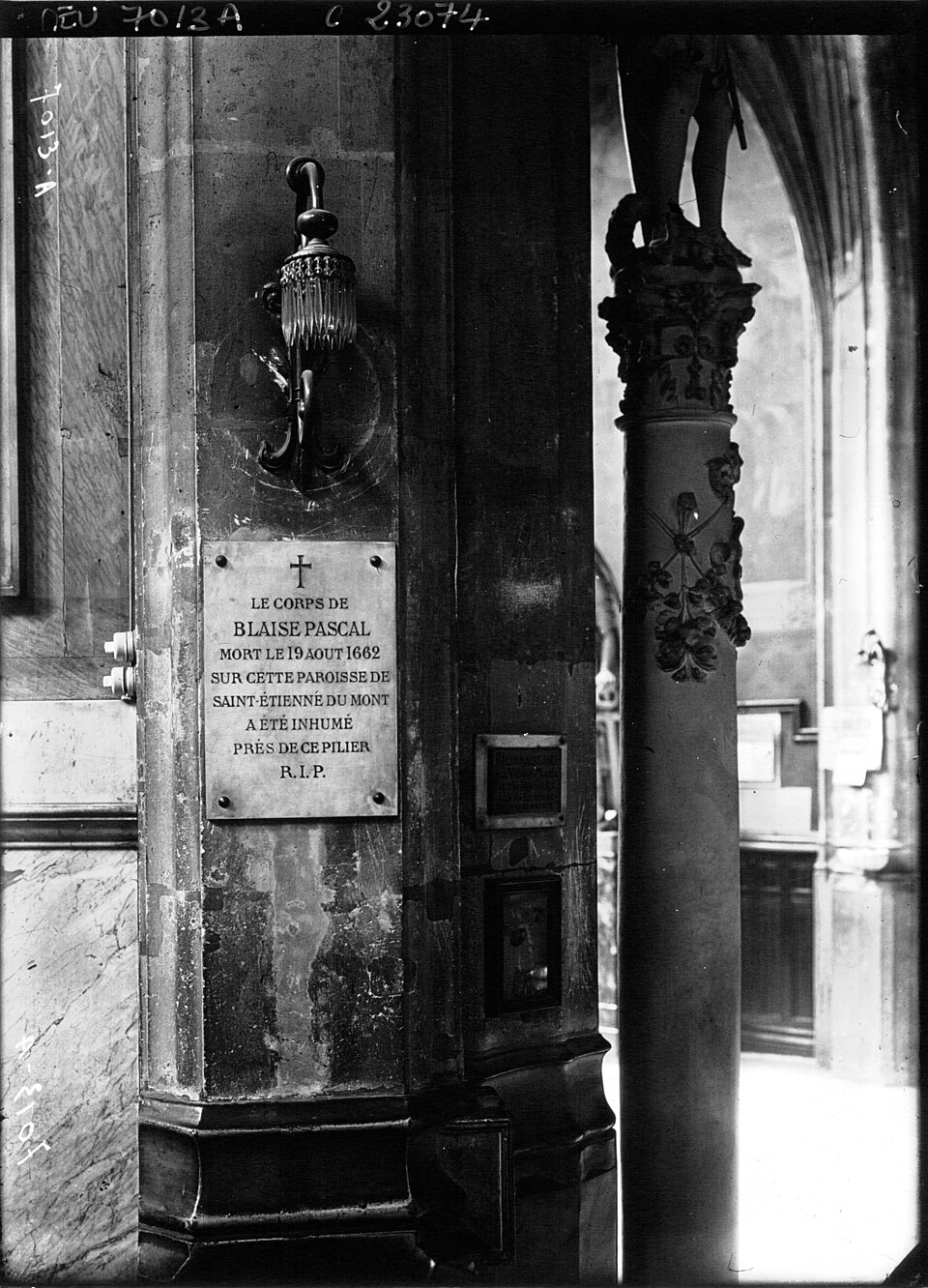
Pascal died on 19 August 1662, at his sister Gilberte’s house, aged 39. He was buried in the church of Saint-Étienne-du-Mont, in Paris. A plaque on a pillar still marks the spot: “The body of Blaise Pascal, who died on 19 August 1662 in this parish of Saint-Étienne-du-Mont, was buried near this pillar.”
He left hundreds of loose notes for a book in defence of Christianity that he never managed to write. His friends at Port-Royal arranged them and published them in 1670 as the Pensées (“Thoughts”). One of them reads as if written for his own short life:
All I know is that I must soon die; but what I know least is this very death, which I cannot escape.
— Blaise Pascal, Pensées
Sources: Pascal biography, MacTutor · Gilberte Périer, Life of Pascal, on Wikisource (French).