
Euler's Eyes
2026-10-14
The catenary: the hanging chain
Ut pendet continuum flexile, sic stabit contiguum rigidum inversum. (As hangs the flexible line, so but inverted will stand the rigid arch.)
— Robert Hooke, anagram deciphered in 1705
Take a thin chain by its two ends and let it hang. It forms a beautiful curve that looks like a parabola. Galileo, in 1638, thought it really was a parabola, at least approximately. The Dutchman Christiaan Huygens, at 17, showed that it could not be. But what curve it was, nobody knew.
In May 1690 Jakob Bernoulli published the question in the Acta Eruditorum as a challenge to readers. He himself tried for a year and failed. In June 1691 three correct solutions appeared: by Leibniz, by Huygens, then 62, and by Jakob’s youngest brother, Johann, aged 24. Johann never let anyone forget it:
My brother’s efforts were without success. As for me, I was more fortunate, for I found the skill (I say it without boasting, why should I conceal the truth?) to solve it in full. It is true that it cost me study that robbed me of rest for an entire night.
— Johann Bernoulli, letter to Pierre Rémond de Montmort (1718)
Looking at a piece of the chain
The trick is not to look at the whole chain, but at a piece of it. Put the origin at the lowest point, with $y$ upwards, and consider the stretch from that point to a point $P$ on the right.
This stretch is at rest, so the forces on it balance. There are three:
- at the lowest point, the chain pulls to the left, horizontally, with a force $H$;
- at $P$, the chain pulls along the tangent, with a force $T$;
- the weight of the stretch, $w\,s$, where $w$ is the weight per metre and $s$ is the length of the stretch.
Horizontally, the horizontal component of $T$ balances $H$; vertically, the vertical component of $T$ balances the weight. Since $T$ points along the tangent, the ratio of its two components is the slope $y'$:
$$y'=\frac{\text{vertical}}{\text{horizontal}}=\frac{w\,s}{H}=\frac sa,\qquad a=\frac Hw.$$The number $a$ has the dimension of a length and measures how taut the chain is.
The equation of the chain
Now we differentiate with respect to $x$. The length grows at the rate $\frac{ds}{dx}=\sqrt{1+y'^2}$, by Pythagoras’s theorem applied to a tiny piece of the curve. So
$$y''=\frac1a\sqrt{1+y'^2}.$$Calling $u=y'$, we separate the variables:
$$\frac{du}{\sqrt{1+u^2}}=\frac{dx}{a}.$$The integral on the left is $\operatorname{arsinh}u$, the inverse of the hyperbolic sine $\sinh z=\frac{e^z-e^{-z}}2$. Since the slope is zero at the lowest point, $u(0)=0$, and
$$u=y'=\sinh\frac xa.$$Integrating again, with $y(0)=0$:
$$\boxed{y=a\left(\cosh\frac xa-1\right),\qquad \cosh z=\frac{e^z+e^{-z}}2.}$$The function $\cosh$ is the hyperbolic cosine. The length of the stretch comes as a bonus: $s=a\,y'=a\sinh\frac xa$.
Johann did not write it this way: the number $e$ and the hyperbolic functions had no names yet. He described the curve by a geometric construction with logarithms. But the curve is the same, and the name Huygens gave it stuck: catenary, from the Latin catena, chain.
Why it looks like a parabola
Near the lowest point, the series for $\cosh$ gives
$$\cosh z=1+\frac{z^2}2+\frac{z^4}{24}+\cdots\quad\Longrightarrow\quad y\approx\frac{x^2}{2a}.$$Near the bottom, the catenary is almost a parabola. Galileo was not so wrong: the error only shows up far from the lowest point, where the catenary rises faster. The parabola really appears when the weight is distributed per metre of horizontal distance, not per metre of chain. That is the case of a suspension bridge, where the light cable holds up a heavy, flat deck.
The arch that is a chain upside down
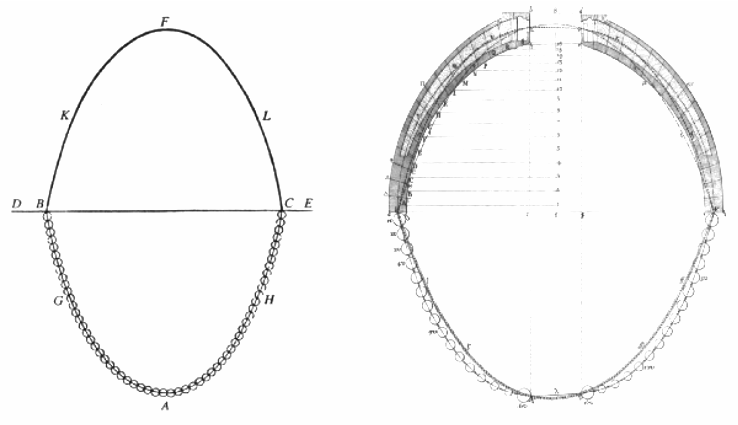
In a hanging chain, each link is only pulled by its neighbours, always along the curve. If you froze the chain and turned it upside down, each stone would only be pushed by its neighbours along the curve, with no force making it slip sideways. That is why an arch shaped like an inverted catenary stands without mortar. Robert Hooke had realised this in 1675 and hid the discovery in an anagram, which was only deciphered after his death: it is the quotation at the start of this post.
In 1748 Giovanni Poleni used the idea to examine the dome of St Peter’s Basilica, which had developed cracks. The Catalan architect Antoni Gaudí designed the arches of the Colònia Güell church and of the Sagrada Família by hanging chains with little bags of sand and photographing them upside down.
Exercise: a chain with a = 2 m. How high is it 2 m to the right of the lowest point? Compare with the parabola.
With $x=a=2$, $y=2(\cosh1-1)=2(1.5431-1)\approx1.086$ m. The parabolic approximation gives $\frac{x^2}{2a}=\frac44=1$ m. The difference, almost 9 cm, shows that far from the bottom the catenary rises faster than the parabola.
Exercise: show that y = a cosh(x/a), the form without the −1, satisfies y² − s² = a², where s is the length from the lowest point.
We have $y=a\cosh\frac xa$ and $s=a\sinh\frac xa$. So
$$y^2-s^2=a^2\left(\cosh^2\frac xa-\sinh^2\frac xa\right)=a^2,$$by the identity $\cosh^2z-\sinh^2z=1$, which follows directly from the definitions with $e^z$. It is the hyperbolic version of $\cos^2+\sin^2=1$.
Sources: Johann Bernoulli, “Solutio problematis funicularii”, Acta Eruditorum (June 1691) · biography of Johann Bernoulli, MacTutor · Jacques Heyman, The Stone Skeleton (Cambridge, 1995).
All topics on Johann Bernoulli · ← The life of Johann Bernoulli · L’Hôpital’s rule: the lessons sold to a marquis →