
Euler's Eyes
2026-11-03
EJU 2018 (2nd session) – Mathematics Course 2 solved
Source: JASSO – Mathematics paper in English, in Japanese and official answer key. Files on the page for the 2nd session of 2018.
Course 2 is the advanced mathematics paper of the EJU. Each letter $\boxed{\text{A}}$, $\boxed{\text{B}}$, … is a digit from 0 to 9 or the minus sign; in some blanks the answer is the number of a choice. The statements below are summarized from the official English version.
Answer key
| Question | Topic | Answers |
|---|---|---|
| I | Same as Question I of Course 1 | A=1, B=2, C=1, D=1, E=6, F=5, G=6, H=8, I=3, J=6, K=1, LM=−2; N=5, OPQ=216, R=3, S=6, TU=36, VW=36, X=3, Y=8 |
| II Q1 | Recurrence and series | A=2, B=8, C=4, D=5, E=3, F=1, G=4, HI=−1, J=4, K=1, L=4, M=1, N=1, O=4 |
| II Q2 | Tangents to a circle | PQ=10, R=9, S=5, T=5, U=9, V=0, W=3, X=4, Y=7 |
| III | A cubic with a parameter | A=3, B=2, C=1, D=1, EF=−1, G=0, H=1, I=2, J=1, K=0, L=0, MN=−8, OP=−1, QR=−4, S=3, T=2, U=4, V=4, W=3, X=3, Y=3 |
| IV | $x\log ax$ and a tangent | A=0, B=3, C=3, D=3, E=3, F=2, G=3, H=2, I=2, J=9, K=4, L=2 |
Question I
Question I of Course 2 is identical to that of Course 1 (a quadratic with a parameter and a quadratic whose coefficients come from dice). The full solution is in the Course 1 post.
Answers: A=1, B=2, C=1, D=1, E=6, F=5, G=6, H=8, I=3, J=6, K=1, LM=−2; N=5, OPQ=216, R=3, S=6, TU=36, VW=36, X=3, Y=8.
Question II
Q1: a recurrence and its series
Statement. The sequence $(a_n)$ is given by
$$a_1 = \frac29, \qquad a_n = \frac{(n + 1)(2n - 3)}{3n(2n + 1)}\,a_{n-1} \quad (n = 2, 3, \dots).$$We want the general term and the sum $\sum_{n=1}^\infty a_n$.
- Choose $\boxed{\text{A}}$ to $\boxed{\text{E}}$ from ⓪ $n - 1$, ① $n$, ② $n + 1$, ③ $2n - 1$, ④ $2n + 1$, ⑤ $2n - 3$, ⑥ $2n + 3$, ⑦ $3n - 1$, ⑧ $3n$, ⑨ $3n + 1$. With $b_n = \dfrac{n + 1}{3^na_n}$, $\dfrac{b_n}{b_{n-1}} = \dfrac{\boxed{\text{A}}}{\boxed{\text{B}}}\cdot\dfrac{a_{n-1}}{a_n} = \dfrac{\boxed{\text{C}}}{\boxed{\text{D}}}$, hence $a_n = \dfrac{n + 1}{3^n\left(\boxed{\text{E}}\right)(2n + 1)}$.
- Let $c_n = \dfrac{1}{3^n(2n + 1)}$ ($n = 0, 1, 2, \dots$). Writing $a_n = A\,c_{n-1} + B\,c_n$, $A = \dfrac{\boxed{\text{F}}}{\boxed{\text{G}}}$ and $B = \dfrac{\boxed{\text{HI}}}{\boxed{\text{J}}}$. Then $S_n = \sum_{k=1}^n a_k = \dfrac{\boxed{\text{K}}}{\boxed{\text{L}}}\left(\boxed{\text{M}} - c_n\right)$ and $\sum_{n=1}^\infty a_n = \dfrac{\boxed{\text{N}}}{\boxed{\text{O}}}$.
Solution.
1. The ratio $b_n/b_{n-1}$.
$$\frac{b_n}{b_{n-1}} = \frac{n + 1}{n}\cdot\frac{3^{n-1}}{3^n}\cdot\frac{a_{n-1}}{a_n} = \frac{n + 1}{3n}\cdot\frac{a_{n-1}}{a_n}.$$By the recurrence, $\frac{a_{n-1}}{a_n} = \frac{3n(2n + 1)}{(n + 1)(2n - 3)}$, leaving $\frac{b_n}{b_{n-1}} = \frac{2n + 1}{2n - 3}$ (②, ⑧; ④, ⑤).
2. The telescoping product. $b_1 = \frac{2}{3\cdot\frac29} = 3$. Multiplying the ratios from $k = 2$ to $n$, the numerators $5, 7, \dots, 2n + 1$ and the denominators $1, 3, \dots, 2n - 3$ cancel, except the last two numerators and the first two denominators:
$$b_n = 3\cdot\frac{(2n - 1)(2n + 1)}{1\cdot3} = (2n - 1)(2n + 1).$$So $a_n = \frac{n + 1}{3^n(2n - 1)(2n + 1)}$ (③).
3. The decomposition. $A\,c_{n-1} + B\,c_n = \frac{3A(2n + 1) + B(2n - 1)}{3^n(2n - 1)(2n + 1)}$. For the numerator to be $n + 1$: $6A + 2B = 1$ and $3A - B = 1$, so $A = \frac14$ and $B = -\frac14$.
4. The sum. $a_k = \frac14(c_{k-1} - c_k)$ telescopes: $S_n = \frac14(c_0 - c_n) = \frac14(1 - c_n)$. Since $c_n \to 0$, the sum is $\frac14$.
Answers: A=2, B=8, C=4, D=5, E=3, F=1, G=4, HI=−1, J=4, K=1, L=4, M=1, N=1, O=4.
Q2: tangents to a circle
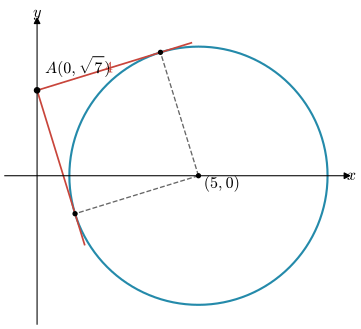
Statement. $C$ is the circle of radius 4 centered at $(5, 0)$.
- If $P(p, q)$ is on $C$, then $p^2 - \boxed{\text{PQ}}\,p + q^2 + \boxed{\text{R}} = 0$. The tangent to $C$ at $P$ is $(p - \boxed{\text{S}})x + qy = \boxed{\text{T}}\,p - \boxed{\text{U}}$.
- From the point $A(0, a)$ on the $y$-axis, with $a \ge 0$, draw a tangent to $C$ with point of tangency $P(p, q)$. The length $AP$ is smallest at $a = \boxed{\text{V}}$, where it equals $\boxed{\text{W}}$. The two tangents through $A$ are perpendicular when $AP = \boxed{\text{X}}$; in that case, $a = \sqrt{\boxed{\text{Y}}}$.
Solution.
1. $(p - 5)^2 + q^2 = 16$ gives $p^2 - 10p + q^2 + 9 = 0$. The tangent at $P$ is $(p - 5)(x - 5) + q\cdot y = 16$, or $(p - 5)x + qy = 16 + 5(p - 5) = 5p - 9$.
2. The radius at the point of tangency is perpendicular to the tangent, so, with the center $K = (5, 0)$, $AP^2 = AK^2 - 16 = 25 + a^2 - 16 = a^2 + 9$. The minimum is at $a = 0$, with $AP = 3$.
3. If the two tangents through $A$ are perpendicular, $A$, the two points of tangency and $K$ form a square with side equal to the radius: $AP = 4$. Then $a^2 + 9 = 16$, that is, $a = \sqrt7$.
Answers: PQ=10, R=9, S=5, T=5, U=9, V=0, W=3, X=4, Y=7.
Question III: a cubic with a parameter
Statement. Let $f(x) = x^3 - 3ax^2 - 3(2a + 1)x + a + 2$.
- Choose $\boxed{\text{G}}$ to $\boxed{\text{K}}$ from ⓪ a local maximum, ① a local minimum,
② increasing, ③ decreasing, ④ a maximum, ⑤ a minimum; in the other blanks, write the number.
Since $f'(x) = \boxed{\text{A}}\left(x - \boxed{\text{B}}\,a - \boxed{\text{C}}\right)\left(x + \boxed{\text{D}}\right)$:
- if $a > \boxed{\text{EF}}$, $f$ has $\boxed{\text{G}}$ at $x = -\boxed{\text{D}}$ and $\boxed{\text{H}}$ at $x = \boxed{\text{B}}\,a + \boxed{\text{C}}$;
- if $a = \boxed{\text{EF}}$, $f$ is always $\boxed{\text{I}}$;
- if $a < \boxed{\text{EF}}$, $f$ has $\boxed{\text{J}}$ at $x = -\boxed{\text{D}}$ and $\boxed{\text{K}}$ at $x = \boxed{\text{B}}\,a + \boxed{\text{C}}$.
- The minimum $m$ of $f$ on $-1 \le x \le 1$ is: (i) $m = \boxed{\text{MN}}\,a$ if $a \ge \boxed{\text{L}}$; (ii) $m = \boxed{\text{QR}}\left(a^3 + \boxed{\text{S}}\,a^2 + \boxed{\text{T}}\,a\right)$ if $\boxed{\text{OP}} \le a < \boxed{\text{L}}$; (iii) $m = \boxed{\text{U}}\,a + \boxed{\text{V}}$ if $a < \boxed{\text{OP}}$.
- The value of $m$ is largest at $a = \dfrac{-\boxed{\text{W}} + \sqrt{\boxed{\text{X}}}}{\boxed{\text{Y}}}$.
Solution.
1. The derivative. $f'(x) = 3x^2 - 6ax - 3(2a + 1) = 3(x^2 - 2ax - 2a - 1) = 3(x - 2a - 1)(x + 1)$. The roots $-1$ and $2a + 1$ coincide at $a = -1$.
- $a > -1$: $-1 < 2a + 1$, local maximum at $-1$ and local minimum at $2a + 1$.
- $a = -1$: $f' = 3(x + 1)^2 \ge 0$, $f$ is increasing.
- $a < -1$: $2a + 1 < -1$, so there is a local minimum at $-1$ and a local maximum at $2a + 1$.
2. The values we need. $f(-1) = 4a + 4$, $f(1) = -8a$ and, factoring, $f(2a + 1) = -4a(a + 1)(a + 2) = -4(a^3 + 3a^2 + 2a)$.
3. The minimum on $[-1, 1]$.
- $a \ge 0$: $2a + 1 \ge 1$, and $f$ decreases on the whole interval: $m = f(1) = -8a$.
- $-1 \le a < 0$: the local minimum $2a + 1$ is in $[-1, 1)$: $m = -4(a^3 + 3a^2 + 2a)$.
- $a < -1$: $f$ increases on $[-1, 1]$ (it is to the right of both roots): $m = f(-1) = 4a + 4$.
4. The maximum of $m$. For $a < -1$, $m$ increases up to $0$; for $a \ge 0$, it decreases from $0$. On $[-1, 0)$, $g(a) = -4(a^3 + 3a^2 + 2a)$ has $g'(a) = -4(3a^2 + 6a + 2)$, which vanishes at $a = -1 \pm \frac{\sqrt3}{3}$. Only $a = -1 + \frac{\sqrt3}{3} = \frac{-3 + \sqrt3}{3}$ is in the interval, and there $g'$ changes from positive to negative: it is the maximum. With $s = \frac{\sqrt3}{3}$, $g = -4(s - 1)s(s + 1) = 4s(1 - s^2) = \frac{8\sqrt3}{9} > 0$, larger than the value $0$ at the ends.
Answers: A=3, B=2, C=1, D=1, EF=−1, G=0, H=1, I=2, J=1, K=0, L=0, MN=−8, OP=−1, QR=−4, S=3, T=2, U=4, V=4, W=3, X=3, Y=3.
Question IV: x·log(ax) and a tangent line
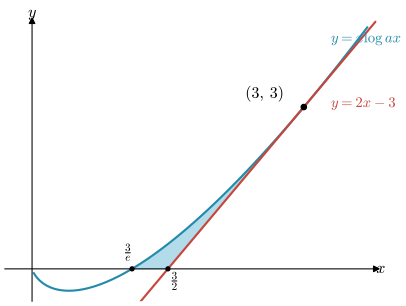
Statement. Consider $y = x\log ax$ ① and $y = 2x - 3$ ②, with $a > 0$ and $\log$ the natural logarithm.
- We want $a$ so that the graph of ① is tangent to that of ②. The tangent to ① at the point $(t, t\log at)$ is $\boxed{\text{A}}$ (choose from ⓪ $y = (\log at + 1)x - t$, ① $y = (\log at + a)x - t$, ② $y = (a\log t + 1)x + t$, ③ $y = (a\log t + a)x + t$). So ① is tangent to ② when $a = \dfrac{e}{\boxed{\text{B}}}$, at the point $\left(\boxed{\text{C}}, \boxed{\text{D}}\right)$.
- With $a = \frac{e}{\boxed{\text{B}}}$, function ① is smallest at $x = \boxed{\text{E}}\,e^{-\boxed{\text{F}}}$, with minimum value $-\boxed{\text{G}}\,e^{-\boxed{\text{H}}}$.
- With the same $a$, let $S$ be the area of the region bounded by the graphs of ① and ② and the $x$-axis. Since $\int x\log ax\,dx = \boxed{\text{I}} + C$ (choose from ⓪ $\frac12x^2\log ax - \frac12x^2$, ① $2x^2\log ax - 2x^2$, ② $\frac12x^2\log ax - \frac14x^2$, ③ $2x^2\log ax - 4x^2$), $S = \dfrac{\boxed{\text{J}}}{\boxed{\text{K}}}\,e^{-\boxed{\text{L}}}$.
Solution.
1. The tangent. $y' = \log ax + 1$. At $x = t$: $y = (\log at + 1)(x - t) + t\log at = (\log at + 1)x - t$ (⓪). For this to be $y = 2x - 3$: $t = 3$ and $\log 3a + 1 = 2$, that is, $3a = e$, $a = \frac e3$. The point is $(3, 3\log e) = (3, 3)$.
2. The minimum. $y' = \log\frac{ex}{3} + 1 = 0$ gives $\frac{ex}{3} = e^{-1}$, or $x = 3e^{-2}$. There $\log ax = -1$, and $y = -3e^{-2}$. ($y'$ is increasing, so this is a minimum.)
3. The integral. By parts, $\int x\log ax\,dx = \frac{x^2}{2}\log ax - \int\frac{x^2}{2}\cdot\frac1x\,dx = \frac12x^2\log ax - \frac14x^2 + C$ (②).
4. The region. Curve ① meets the $x$-axis at $x = \frac1a = \frac3e \approx 1.10$; line ② meets it at $x = \frac32$; and the two touch at $(3, 3)$. The curve is convex ($y'' = \frac1x > 0$), so it lies above the tangent. The region runs from $\frac3e$ to $3$, below the curve and above the $x$-axis and the line. So
$$S = \int_{3/e}^{3} x\log\frac{ex}{3}\,dx - \int_{3/2}^{3}(2x - 3)\,dx.$$The second integral is a triangle with base $\frac32$ and height $3$: $\frac94$. The first:
$$\left[\frac{x^2}{2}\log\frac{ex}{3} - \frac{x^2}{4}\right]_{3/e}^{3} = \left(\frac92 - \frac94\right) - \left(0 - \frac{9}{4e^2}\right) = \frac94 + \frac{9}{4e^2}.$$So $S = \frac{9}{4e^2} = \frac94e^{-2}$.
Answers: A=0, B=3, C=3, D=3, E=3, F=2, G=3, H=2, I=2, J=9, K=4, L=2.