
Euler's Eyes
2026-10-11
Exercises from chapter 7 — Notable quadrilaterals
Exercises and resolutions
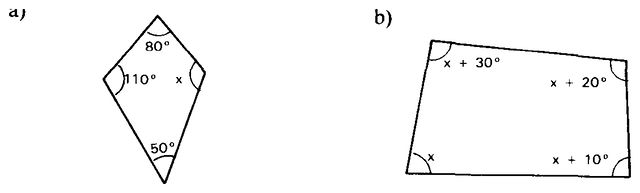
Determine the value of $x$ in the following cases:
Ver resposta
a) $x = 120^{\circ}$ · b) $x = 75^{\circ}$
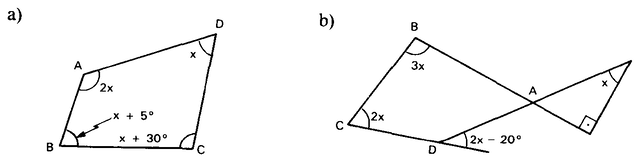
Determine the angles of the quadrilateral $ABCD$ in the cases:
Ver resposta
a) $130^{\circ}$, $70^{\circ}$, $95^{\circ}$, $65^{\circ}$ · b) $55^{\circ}$, $105^{\circ}$, $70^{\circ}$, $130^{\circ}$
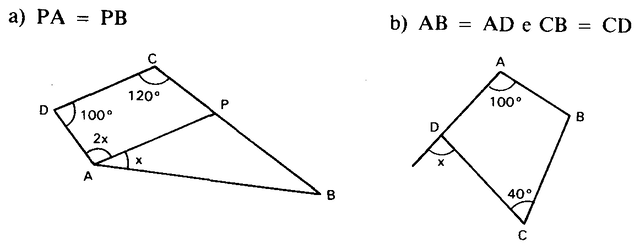
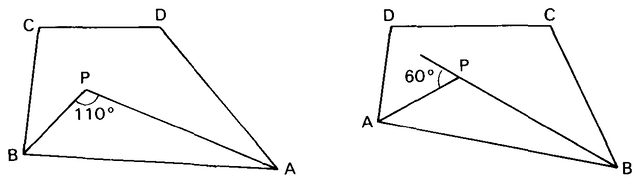
Determine the value of $x$ in the cases: a) $PA = PB$; b) $AB = AD$ and $CB = CD$.
Ver resposta
a) $x = 35^{\circ}$ · b) $x = 70^{\circ}$
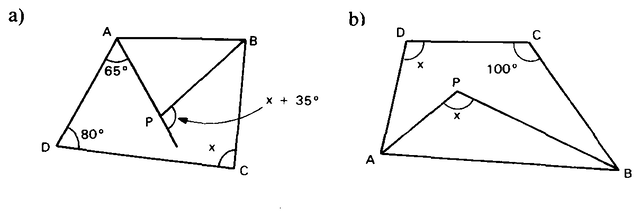
If $\overline{AP}$ and $\overline{BP}$ are angle bisectors, determine $x$ in the cases:
Ver resposta
a) $x = 70^{\circ}$ · b) $x = 100^{\circ}$
If $\overline{AP}$ and $\overline{BP}$ are angle bisectors, determine: a) $\hat{C} + \hat{D}$; b) $\hat{C}$, which exceeds $\hat{D}$ by $10^{\circ}$.
Ver resposta
a) $\hat{C} + \hat{D} = 220^{\circ}$ · b) $\hat{C} = 125^{\circ}$
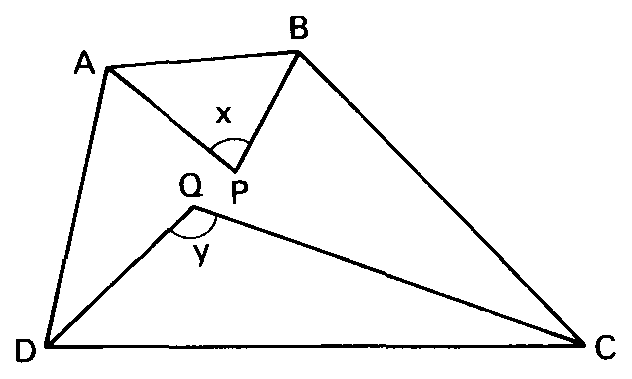
If $\overline{BP}$, $\overline{AP}$, $\overline{CQ}$, and $\overline{DQ}$ are angle bisectors, determine $x + y$.
Ver resposta
$x + y = 180^{\circ}$
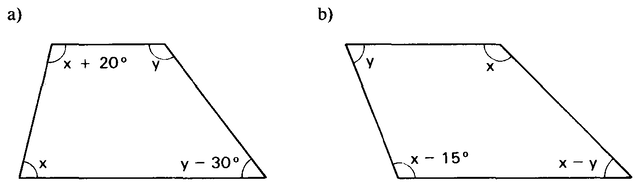
If $ABCD$ is a trapezoid of bases $\overline{AB}$ and $\overline{CD}$, determine $x$ and $y$.
Ver resposta
a) $x = 80^{\circ}$, $y = 105^{\circ}$ · b) $x = 125^{\circ}$, $y = 70^{\circ}$
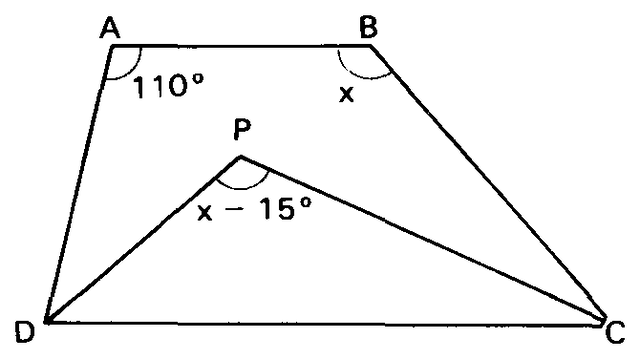
$ABCD$ is a trapezoid of bases $\overline{AB}$ and $\overline{CD}$. If $\overline{DP}$ and $\overline{CP}$ are angle bisectors, determine $x$ and $B\hat{C}D$.
Ver resposta
$x = 140^{\circ}$ e $B\hat{C}D = 40^{\circ}$
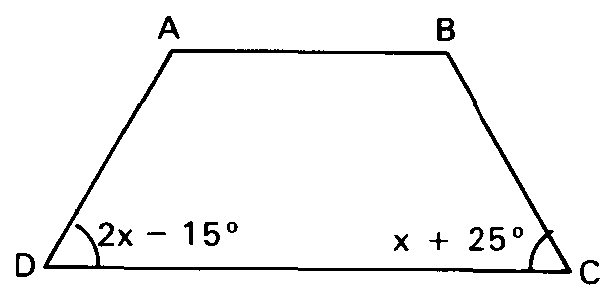
If the trapezoid $ABCD$ is isosceles of bases $\overline{AB}$ and $\overline{CD}$, determine $\hat{A}$.
Ver resposta
$\hat{A} = 115^{\circ}$
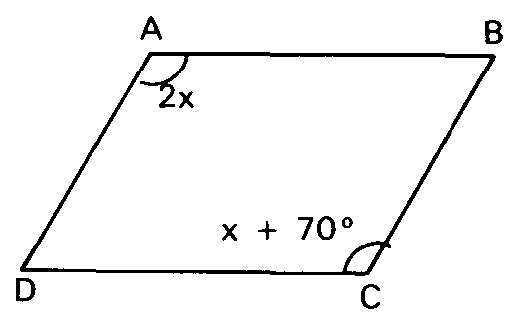
If $ABCD$ is a parallelogram with $\hat{A} = 2x$ and $\hat{C} = x + 70^{\circ}$, determine $\hat{B}$.
Ver resposta
$\hat{B} = 40^{\circ}$
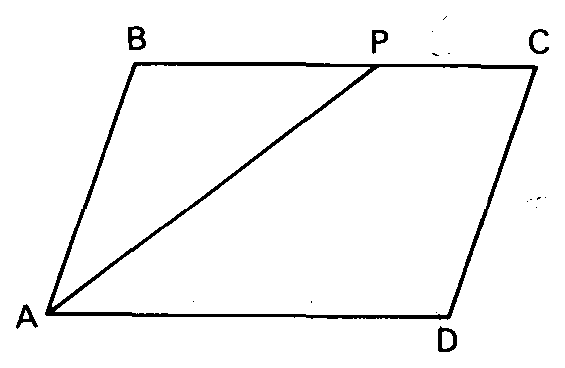
Since $ABCD$ is a parallelogram, $\overline{AP}$ angle bisector, $AB = 7$ cm and $PC = 3$ cm, determine the perimeter of the parallelogram.
Ver resposta
34 cm
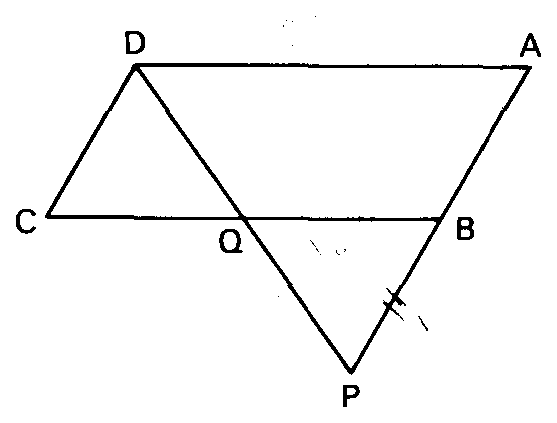
If $ABCD$ is a parallelogram, $AD = 20$ cm, $BQ = 12$ cm and $BP = BQ$, determine the perimeter of this parallelogram.
Ver resposta
56 cm
Exercise 236 — Classify as true (V) or false (F)
-
Every rectangle is a parallelogram.
Verdadeiro. Congruent opposite angles.
-
Every parallelogram is a rectangle.
Falso. The angles may not be right.
-
Every square is a rectangle.
Verdadeiro. It has four congruent angles.
-
Every rectangle is square.
Falso. The sides can be different.
-
Every parallelogram is a rhombus.
Falso. The sides can be different.
-
Every square is a rhombus.
Verdadeiro. It has four congruent sides.
Exercise 237 — Classify as true (V) or false (F)
-
Every rectangle that has two congruent sides is square.
Falso. Opposite sides of any rectangle are already congruent; two adjacent sides would be needed.
-
Any parallelogram that has two adjacent congruent sides is a rhombus.
Verdadeiro. With congruent opposites, the four become equal.
-
If a parallelogram has two consecutive congruent vertex angles, then it is a rectangle.
Verdadeiro. Consecutives are supplementary; equal, they are straight.
-
If two opposite angles of a quadrilateral are congruent, then it is a parallelogram.
Verdadeiro. According to the book (thinking about convex quadrilaterals with the two pairs of congruent opposites).
Exercise 238 — Classify as true (V) or false (F)
-
If two sides of a quadrilateral are congruent, then it is a parallelogram.
Falso. A kite (deltoid) is a counterexample.
-
If two opposite sides of a quadrilateral are congruent, then it is a parallelogram.
Falso. The isosceles trapezoid is a counterexample.
-
If two opposite sides of a quadrilateral are congruent and parallel, then it is a parallelogram.
Verdadeiro. It is the theorem of two parallel and congruent sides.
Exercise 239 — Classify as true (V) or false (F)
-
The diagonals of a rhombus are congruent.
Falso. Only in the square.
-
The diagonals of a rectangle are perpendicular.
Falso. Only in the square.
-
The diagonals of a rectangle are angle bisectors of its angles.
Falso. Only in the square.
-
The diagonals of a parallelogram are angle bisectors of its angles.
Falso. Only in the diamond.
-
The diagonals of a square are angle bisectors of its angles and are perpendicular.
Verdadeiro. The square is a rhombus.
-
If the diagonals of a quadrilateral are angle bisectors of its angles, then it is a rhombus.
Verdadeiro. The triangles formed are congruent and the sides are equal.
-
If the diagonals of a quadrilateral are perpendicular, then they are angle bisectors of its angles.
Falso. A kite has perpendicular diagonals and only one is angle bisector.
-
If the diagonals of a quadrilateral are congruent and perpendicular, then it is a square.
Falso. They also need to cut themselves in half.
-
If the diagonals of a quadrilateral are angle bisectors and congruent, then it is a square.
Verdadeiro. Rhombus with congruent diagonals.
-
If one diagonal of a quadrilateral is angle bisector of both angles, then it is perpendicular to the other diagonal.
Verdadeiro. The two triangles formed are congruent (ALA), and the figure is symmetrical.
Calculate the sides of a rectangle whose perimeter measures 40 cm, knowing that the base exceeds the height by 4 cm.
Ver resposta
12 cm and 8 cm
Determine the base and height of a rectangle, knowing that the perimeter is 288 m and that the base exceeds three times the height by 4 m.
Ver resposta
Base 109 m and height 35 m.
Calculate the sides of a parallelogram, knowing that its perimeter measures 84 m and that the sum of the smaller sides represents $\dfrac{2}{5}$ of the sum of the longer sides.
Ver resposta
30 m e 12 m
The sum of two opposite angles of a parallelogram is equal to $\dfrac{5}{13}$ of the sum of the other two opposite angles. Determine them.
Ver resposta
$50^{\circ}$, $130^{\circ}$, $50^{\circ}$ e $130^{\circ}$
Determine the measures of the angles of a parallelogram, knowing that the difference between two consecutive ones is equal to $\dfrac{1}{9}$ of the sum of their angles.
Ver resposta
$70^{\circ}$, $110^{\circ}$, $70^{\circ}$ e $110^{\circ}$
Prove that the angle bisectors of two consecutive angles of a parallelogram cut at right angles.
Ver resposta
The two consecutive angles add up to $180^{\circ}$; its halves add up to $90^{\circ}$, and in the triangle formed by angle bisectors the third angle is $90^{\circ}$. (A triangle with two complementary angles is a right angle.)
In a rectangular trapezoid, the angle bisector of a right angle forms an angle of $110^{\circ}$ with the angle bisector of the acute angle of the trapezoid. Determine the greatest angle of the trapezoid.
Ver resposta
$130^{\circ}$
The diagonal of a rhombus forms an angle with one of its sides equal to the third of a straight line. Determine the four angles of the rhombus.
Ver resposta
$60^{\circ}$, $120^{\circ}$, $60^{\circ}$ e $120^{\circ}$
The angle bisector of an obtuse angle of the rhombus makes one of the sides an angle of $55^{\circ}$. Determine the value of acute angles.
Ver resposta
$70^{\circ}$
The largest base of an isosceles trapezoid measures 12 cm and the smallest base 8 cm. Calculate the length of the non-parallel sides, knowing that the perimeter is 40 cm.
Ver resposta
10 cm
One of the interior angles of an isosceles trapezoid is the $\dfrac{2}{7}$ of the adjacent exterior angle. Determine the four angles of the trapezoid.
Ver resposta
$40^{\circ}$, $40^{\circ}$, $140^{\circ}$ e $140^{\circ}$
The sum of two consecutive angles of a trapezoid is equal to $78^{\circ}$ and their difference is $4^{\circ}$. Determine the greatest angle of the trapezoid.
Ver resposta
$143^{\circ}$
Determine the measures of the angles formed by the internal angle bisectors of a trapezoid in which two consecutive acute angles measure $80^{\circ}$ and $60^{\circ}$.
Ver resposta
$70^{\circ}$, $110^{\circ}$, $90^{\circ}$, $90^{\circ}$, $160^{\circ}$ e $160^{\circ}$
With a wire 36 m long we build a equilateral triangle and, with the same wire, we then build a square. Determine the ratio of the side of the triangle to the side of the square.
Ver resposta
$\dfrac{4}{3}$
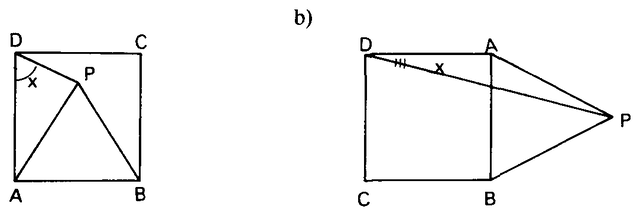
If $ABCD$ is square and $ABP$ is equilateral triangle, determine $x$ in the cases:
Ver resposta
a) $x = 75^{\circ}$ · b) $x = 15^{\circ}$
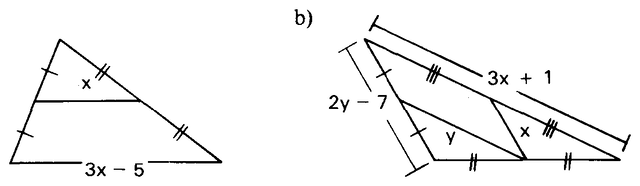
Considering the segments with “equal marks” to be congruent, determine the values of the unknowns in the cases:
Ver resposta
a) $x = 5$ · b) $x = 6$ e $y = \dfrac{19}{2}$
In the triangle $ABC$ with sides $AB = 9$, $BC = 14$ and $AC = 11$, the points $D$, $E$ and $F$ are midpoints of $\overline{AB}$, $\overline{AC}$ and $\overline{BC}$, respectively. Calculate the perimeter of the triangle $DEF$.
Ver resposta
17
Calculate the perimeter of the triangle $ABC$, with $MN = 7$ cm, $NR = 4$ cm and $MR = 8$ cm, and $M$, $N$, $R$ midpoints of the sides $\overline{AB}$, $\overline{AC}$ and $\overline{BC}$, respectively.
Ver resposta
38 cm
Prove that the midpoints of the sides of any quadrilateral are vertices of a parallelogram.
See the resolution of the book
Let $ABCD$ be a quadrilateral and $M$, $N$, $P$ and $Q$ be the midpoints of $\overline{AB}$, $\overline{BC}$, $\overline{CD}$ and $\overline{DA}$. By average base:
$$\triangle ABC:\ \overline{MN} \parallel \overline{AC},\ MN = \frac{AC}{2} \qquad \triangle DAC:\ \overline{PQ} \parallel \overline{AC},\ PQ = \frac{AC}{2}.$$Therefore $\overline{MN} \parallel \overline{PQ}$ and $MN = PQ$: $MNPQ$ is a parallelogram.
What conditions must the diagonals of a convex quadrilateral comply with for the midpoints of its sides to be vertices of a rhombus? And a rectangle?
Ver resposta
Rhombus: congruent diagonals. Rectangle: perpendicular diagonals.
What conditions must the diagonals of a convex quadrilateral comply with for the midpoints of its sides to be vertices of a square?
Ver resposta
Congruent and perpendicular.
Let $ABCD$ be a trapezoid with a larger base $\overline{AB}$ and a smaller base $\overline{CD}$, $M$ be the midpoint of the side $\overline{AD}$ and $N$ be the midpoint of $\overline{BC}$. The points $P$ and $Q$ are the intersection points of $\overline{MN}$ with the diagonals $\overline{AC}$ and $\overline{BD}$. Given $AB = a$ and $CD = b$, calculate $MN$, $MP$, $MQ$, $NP$, $NQ$ and $PQ$.
See the resolution of the book
As $\overline{MN}$ is the middle base of the trapezoid, it is parallel to the bases; hence $P$ and $Q$ are the midpoints of $\overline{AC}$ and $\overline{BD}$. Using the average triangle and trapezoid bases:
$$MN = \frac{a + b}{2};\quad MP = \frac{b}{2};\quad MQ = \frac{a}{2};\quad NP = \frac{a}{2};\quad NQ = \frac{b}{2};\quad PQ = MQ - MP = \frac{a - b}{2}.$$The average base of a trapezoid is 20 cm and the largest base is the $\dfrac{3}{2}$ of the smallest base. Determine the bases.
Ver resposta
16 cm and 24 cm
In a trapezoid, the bases $AB = 20$ cm and $CD = 12$ cm are given. Consider the midpoints $P$ and $Q$ of the diagonals $\overline{AC}$ and $\overline{BD}$ and then the midpoints $R$ and $S$ of the sides $\overline{BC}$ and $\overline{AD}$. Calculate the segments $PR$, $RQ$ and $RS$.
Ver resposta
$PR = 10$ cm, $RQ = 6$ cm and $RS = 16$ cm
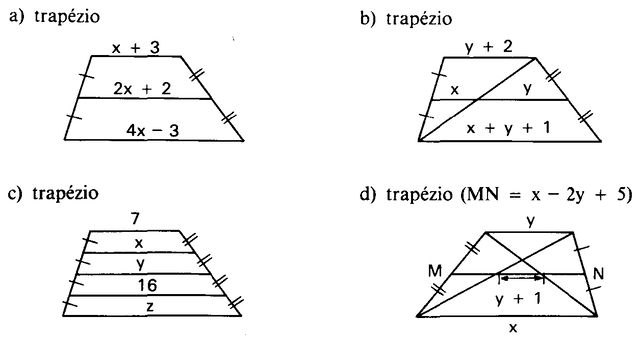
Considering that the segments with “equal marks” are congruent, determine the values of the unknowns in the cases:
Ver resposta
a) $x = 4$ · b) $x = 3$, $y = 4$ · c) $x = 10$, $y = 13$, $z = 19$ · d) $x = 20$, $y = 6$
In a rectangular trapezoid in which the acute angle measures $45^{\circ}$, the height is equal to the difference between the bases.
Ver resposta
A right triangle with an angle of $45^{\circ}$ is isosceles: draw the height through the vertex of the smaller base.
Prove that the height of a rectangular trapezoid that has an acute angle measuring $30^{\circ}$ is equal to half of the side not perpendicular to the bases.
Ver resposta
The side opposite an angle of $30^{\circ}$ is half the hypotenuse (use a equilateral triangle).
Prove that the angle bisectors of the obtuse angles of a parallelogram are parallel.
Ver resposta
Use the parallelogram they determine.
Prove that the angle bisectors of the angles formed by the diagonals of a rectangle are parallel to the sides of the rectangle.
Ver resposta
Use adjacent and supplementary angles.
In an isosceles trapezoid $ABCD$, the smaller base $\overline{AB}$ is congruent to the non-parallel sides. Prove that the diagonals are angle bisectors of the angles $\hat{C}$ and $\hat{D}$ of the trapezoid.
Ver resposta
Use isosceles triangles.
In a parallelogram $ABCD$ we draw its diagonal $\overline{AC}$. Through the vertices $B$ and $D$ we draw two segments $\overline{BP}$ and $\overline{DQ}$ perpendicular to the diagonal $\overline{AC}$, with $P$ and $Q$ in $\overline{AC}$. Prove that $\overline{BP}$ is congruent to $\overline{DQ}$.
Ver resposta
Use LAAₒ.
Through the midpoint $M$ of the base $\overline{BC}$ of a isosceles triangle $ABC$ we draw the segments $\overline{MP}$ and $\overline{MQ}$ respectively parallel to the sides $\overline{AB}$ and $\overline{AC}$ of the triangle. Prove that $APMQ$ is a rhombus.
Ver resposta
Use the middle base of the triangle.
Let us consider a convex quadrilateral with two right opposite angles. Prove that the angle bisectors of the other two internal angles of the quadrilateral are rays parallel to each other.
Ver resposta
Use the sum of the angles of the triangle, the quadrilateral and corresponding angles.
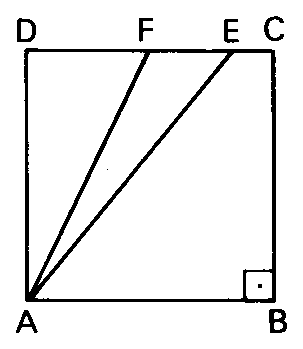
In the figure, $ABCD$ is a square, where $BC + CE = AE$. Since $F$ is the midpoint of $\overline{DC}$, prove that $B\hat{A}E = 2F\hat{A}D$.
Ver resposta
Join $E$ with the midpoint of $\overline{BC}$, extend until you find $\overleftrightarrow{AB}$ and use congruence.