
Euler's Eyes
2026-10-10
The Königsberg bridges and the birth of graphs
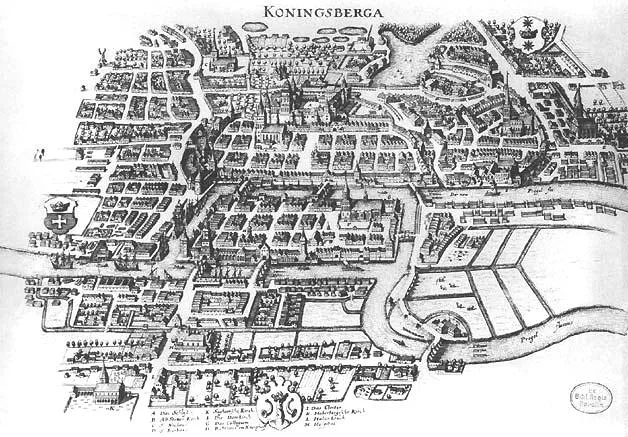
The city of Königsberg (today Kaliningrad, Russia) was crossed by the Pregel River, which formed two islands. Seven bridges connected the four regions of the city. Residents wondered if it was possible take a walk across each bridge exactly once.
Before reading the answer, try it yourself:
Euler realized that the shape of the streets, the size of the islands and the length of the bridges did not matter. It only mattered which regions are linked to which. He replaced the map with a drawing with dots (the regions) and lines (the bridges). Today this is called graph:
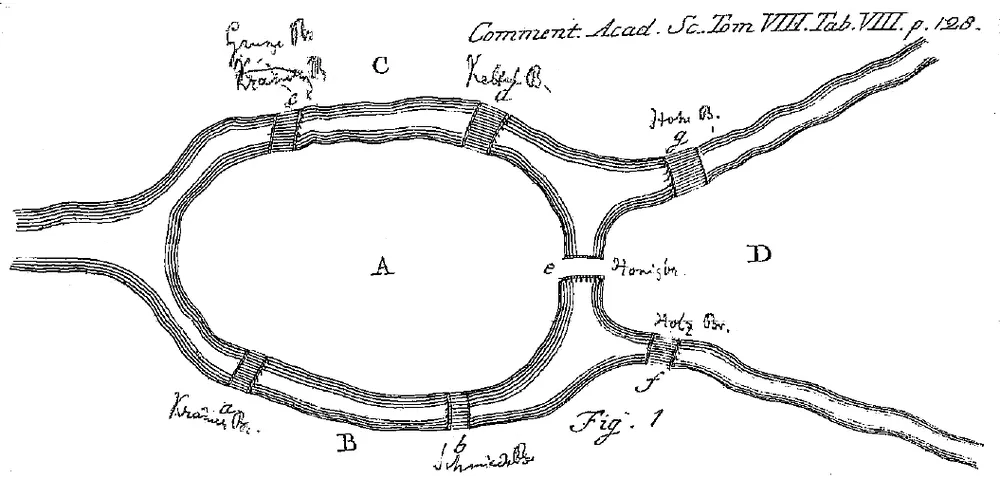
Today we draw the same problem like this:
Now the deduction. On a tour, every time you pass through a region (without starting or ending it), uses a bridge to enter and another to exit. Then bridges from an intermediate region come always in pairs: the number of bridges arriving at it must be even. Only the starting region and The arrival stage may have an odd number of bridges.
Conclusion: the tour is only possible if at most two regions have an odd number of bridges.
Counting in Königsberg:
| Region | Bridges | Even or odd? |
|---|---|---|
| Kneiphof Island | 5 (a, b, c, d, e) | odd |
| North bank | 3 (a, b, f) | odd |
| South bank | 3 (c, d, g) | odd |
| Lomse Island | 3 (e, f, g) | odd |
There are four odd regions, so the tour is impossible. Euler presented the argument in 1735, and it is considered the first result of graph theory, an area that today is behind GPS, social networks and delivery routes.
All topics by Leonhard Euler · ← The spring and differential equations · $V - A + F = 2$ and the soccer ball →