It is unworthy of excellent men to lose hours like slaves in the labour of calculation, which could safely be relegated to anyone else if machines were used.
— Gottfried Wilhelm Leibniz
Gottfried Wilhelm Leibniz (1646–1716) taught himself Latin at eight, entered university at fourteen, and was a lawyer, diplomat, librarian, mining engineer, historian and philosopher. In his spare time he invented differential and integral calculus, a multiplying machine, and the binary system that now runs inside every computer.
More than results, Leibniz sought good notation: symbols that do the thinking for us. The $dx$, the $\dfrac{dy}{dx}$ and the $\int$ you use at school are his, and they have survived for more than three centuries precisely because they work.
In this trail we tell Leibniz’s life and rework, with all the steps shown, seven of his ideas. The figures are interactive: switch bits on and off, compare the parts of a derivative and watch a series approach $\pi$.
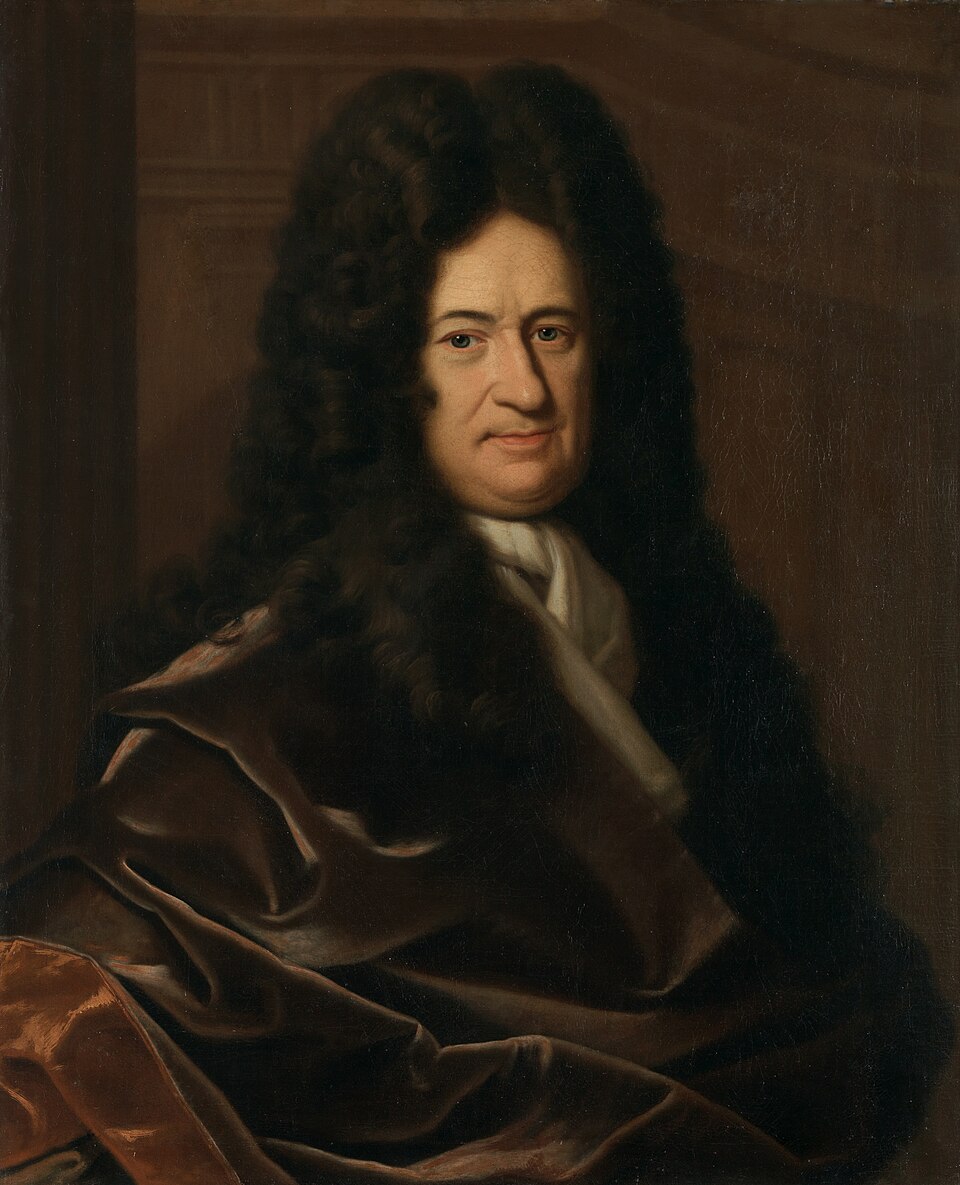
Who he was
Gottfried Wilhelm Leibniz
- Nascimento
- 1 July 1646, Leipzig
- Morte
- 14 November 1716, Hanover
- Origem
- German lands of the Holy Roman Empire
- Áreas
- Calculus, arithmetic, logic, philosophy and law
Reading guide
Biography
Discovery and proof
- Leibniz’s notation: a language for change
- The product rule: two changes in one calculation
- The ∫ sign: from sum to accumulation
- Binary arithmetic: writing numbers with 0 and 1
- Leibniz’s machine: turning sums into motion
- The Leibniz series for π: a simple, slow sum
- Calculemus: the idea of calculating with reasoning