
Euler's Eyes
2026-10-15
The slide rule: logarithms that slide
A table of logarithms still requires looking numbers up, adding and looking up again. A few years after Napier, the English realised that the logarithms could be put on a ruler and the addition done with the hands.
Gunter’s scale
In 1620 the astronomer Edmund Gunter, Briggs’s colleague at Gresham College, drew a ruler on which each number $x$ stood at a distance proportional to $\log x$ from the mark for 1:
$$\text{position of }x=L\cdot\log x.$$The 1 is at the start, the 10 at the end, and the 2 at $0.301$ of the length; the 3 at $0.477$; the 5 at $0.699$. The numbers crowd together towards the right. To multiply, one opened a pair of dividers from 1 to $a$ and carried that opening from $b$: the point fell on $a\times b$, because the distances add:
$$L\log a+L\log b=L\log(ab).$$Oughtred’s two rules
Around 1622 the clergyman and mathematician William Oughtred did away with the dividers: he put two identical scales side by side, one sliding over the other. To compute $2\times3.5$, place the 1 of the lower scale under the 2 of the upper scale and read, on top, the number above the 3.5 of the lower scale: 7. It was the first slide rule.
Division is the same calculation in reverse: for $8\div2.5$, put the 2.5 of the lower scale under the 8 of the upper scale and read above the 1 of the lower scale: 3.2. The rule does not say where the decimal point goes. The person calculating must know whether the answer is 3.2, 32 or 0.32, exactly as with the characteristic of Briggs’s logarithms.
Three hundred and fifty years
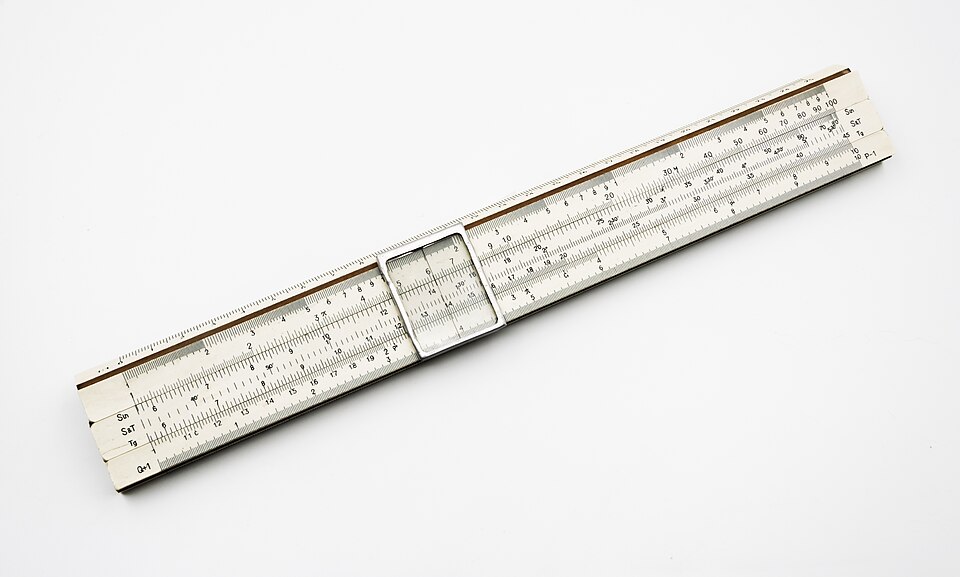
The slide rule gained scales for squares, roots, sines and logarithms, and a glass cursor with a hairline for precise reading. It gave three correct digits, which was enough for almost all of engineering. Bridges, aircraft, power stations and rockets were designed with it. The engineers of the Apollo programme used slide rules, and there was one on board the spacecraft. The slide rule disappeared within a few years after 1972, when scientific pocket calculators arrived.
Exercise: on a 25 cm rule, how many centimetres from the 1 mark are the 2, the 4 and the 8?
The positions are $25\log x$: the 2 is at $25\times0.301\approx7.5$ cm, the 4 at $25\times0.602\approx15.1$ cm and the 8 at $25\times0.903\approx22.6$ cm. The distances from 1 to 2, from 2 to 4 and from 4 to 8 are equal: multiplying by 2 is always moving the same stretch.
Exercise: how do you compute 4.5² and √20 on a rule with two identical scales?
For $4.5^2$, multiply 4.5 by 4.5. On a single-decade rule, putting the lower 1 under the upper 4.5 would leave the reading off the rule; so one puts the lower 10 under the upper 4.5 and reads above the lower 4.5: 2.025. Since $4.5^2$ lies between 16 and 25, the answer is 20.25. For $\sqrt{20}$, look for the number $x$ that, placed under itself, gives 20; it is more practical to use the scale of squares that modern rules have, where one reads $\sqrt{20}\approx4.47$.
Sources: Edmund Gunter, Description and Use of the Sector, the Crosse-staffe and other Instruments (1623) · William Oughtred, The Circles of Proportion and the Horizontall Instrument (1632) · Florian Cajori, A History of the Logarithmic Slide Rule (1909).
All topics on John Napier · ← Napier’s bones: multiplying with rods · The legacy of John Napier →