
Euler's Eyes
2026-10-15
The life of John Napier
Timeline
- 1550Born at Merchiston Castle, near Edinburgh. His father, Archibald, is 16.
- 1563His mother dies. At 13, John enters the University of St Andrews.
- c. 1564Leaves St Andrews without a degree and goes to study on the Continent.
- 1571Returns to Scotland.
- 1572Marries Elizabeth Stirling. Goes to live at Gartness, where he builds a castle.
- 1593Publishes A Plaine Discovery of the Whole Revelation of Saint John, his most famous book in his lifetime.
- 1594Signs a contract to search for treasure hidden at Fast Castle.
- 1596Describes his “secret inventions” of war in a manuscript.
- 1608On his father’s death he becomes laird of Merchiston.
- 1614Publishes the Description of the Wonderful Canon of Logarithms.
- 1615Receives at Merchiston a visit from Henry Briggs, professor in London.
- 1617Publishes the Rabdologia, with his calculating rods. Dies on 4 April.
- 1619His son Robert publishes the Construction of the Wonderful Canon of Logarithms.
The boy from Merchiston
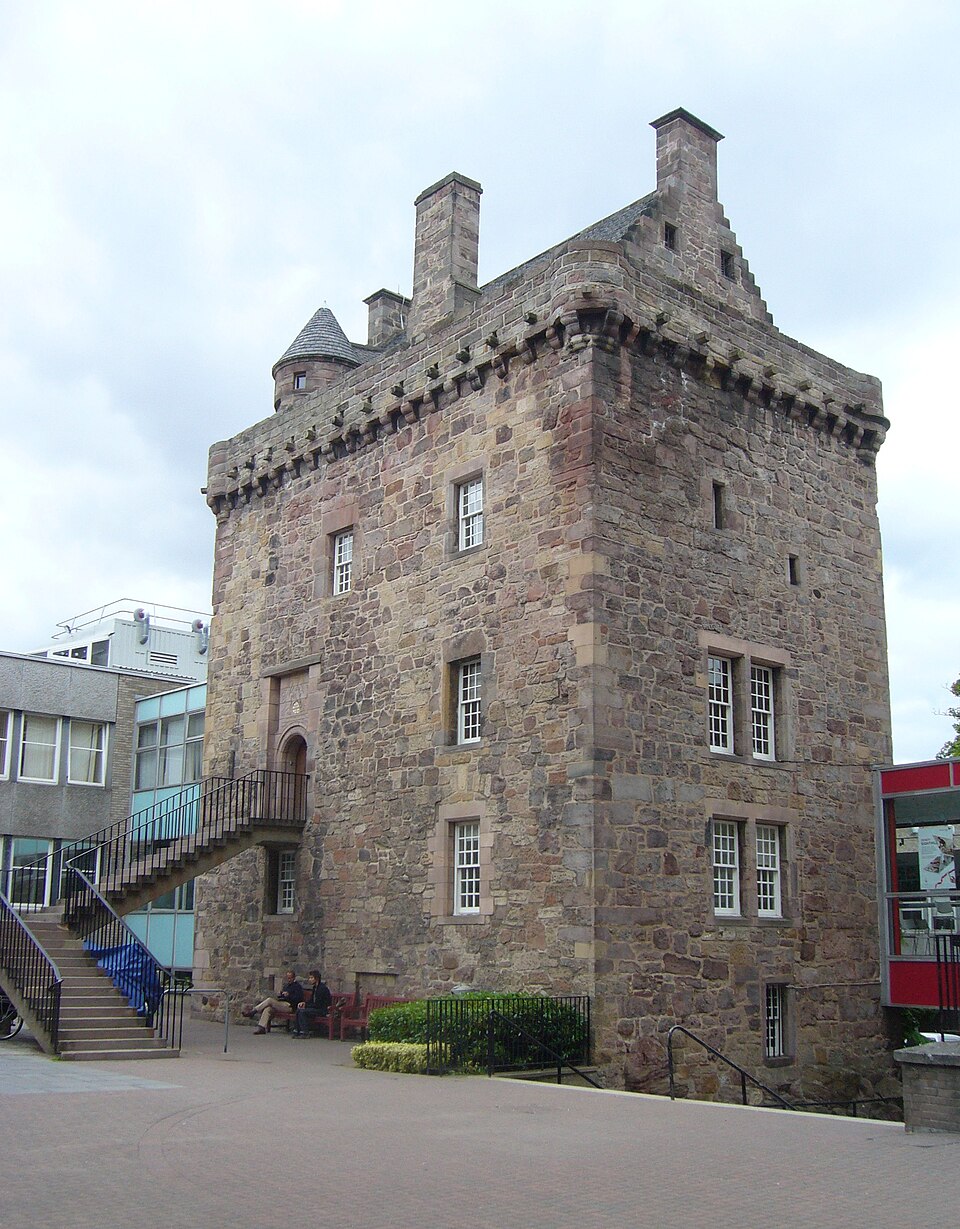
John Napier was born in 1550 in Merchiston Tower, a small stone castle a little over three kilometres from Edinburgh. His father, Sir Archibald Napier, was only 16. The family belonged to the Scottish nobility, and the name was spelled in many ways: Napier, Napeir, Nepair, and in Latin Neperus, from which comes the French form Neper.
Scotland at the time was torn by religious war. In 1560 the parliament broke with Rome and adopted the Protestant Reformation, and the Catholic queen Mary Stuart was deposed a few years later. Napier grew up a fervent Protestant, and that faith shaped his whole life.
In 1563, the year his mother died, John was sent at 13 to the University of St Andrews, the oldest in Scotland. He stayed only a short time and left without a degree. An uncle, Bishop Adam Bothwell, had advised his father to send him to study abroad, and he probably spent the following years in France or the Low Countries. The records do not say where. By 1571 he was back.
- He is born in Merchiston Tower, near Edinburgh, the son of a 16-year-old nobleman.
- He enters Scotland’s oldest university at 13 and leaves without a degree.
- He studies abroad, probably in France or the Low Countries. The records do not say where; the point on the map is only indicative.
- He lives in the castle he built on the family lands. He writes on the Apocalypse and begins the calculations of the logarithms.
- He signs a contract with Robert Logan to find treasure hidden in the castle, in exchange for a third of it.
- Laird of Merchiston. He publishes the logarithms (1614), receives Briggs (1615), publishes the Rabdologia and dies in 1617.
- At Gresham College Henry Briggs reads the book and sets off for Edinburgh to meet the author.
- Kepler sees the tables, writes to the baron without knowing he has died and uses logarithms in the Rudolphine Tables.
- 1550–1563 · Merchiston
- 1563 · St Andrews
- c. 1564–1571 · Continental Europe
- 1574–1608 · Gartness
- 1594 · Fast Castle
- 1608–1617 · Merchiston
- 1615 · London
- 1617–1627 · Linz
The laird of Gartness
In 1572 Napier married Elizabeth Stirling and went to live at Gartness, a family estate inland, where he built a castle. Elizabeth died in 1579, leaving two children; he married again, Agnes Chisholm, and had ten more. Napier was an active landowner. He experimented with fertilising his fields with salt and invented a hydraulic screw to pump water out of coal mines.
His fame, however, came from a book about the end of the world. In 1593 he published A Plaine Discovery of the Whole Revelation of Saint John, a Protestant reading of the last book of the Bible in which the Pope appeared as the Antichrist. Napier calculated that the Last Judgement would come between 1688 and 1700. The book was a success: it went through several editions and translations into French, Dutch and German. To his contemporaries Napier was above all a theologian.
The wizard of Merchiston
His neighbours thought he was in league with the devil. Stories are told, perhaps invented later, that show how he was seen. One: to find out which servant was stealing from him, Napier shut a black cockerel in a dark room and had each of them go in and stroke it, because the bird would crow when the thief touched it. He had covered the cockerel in soot; the guilty one, afraid, did not touch it and came out with clean hands. Another: annoyed with a neighbour’s pigeons that ate his grain, he scattered peas soaked in brandy and picked up the drunken birds from the ground.
In 1594 he signed a contract with Robert Logan of Restalrig to find, by means he did not explain, treasure supposedly hidden in Fast Castle, in exchange for a third of whatever was found. Nobody knows whether he searched for anything. Two years later, in 1596, fearing a Spanish invasion, he described his secret inventions in a manuscript: mirrors that would concentrate sunlight to burn ships, a piece of artillery able to sweep a whole field, and a metal chariot, moved from inside, that would fire through small openings. None was built.
Twenty years of calculation
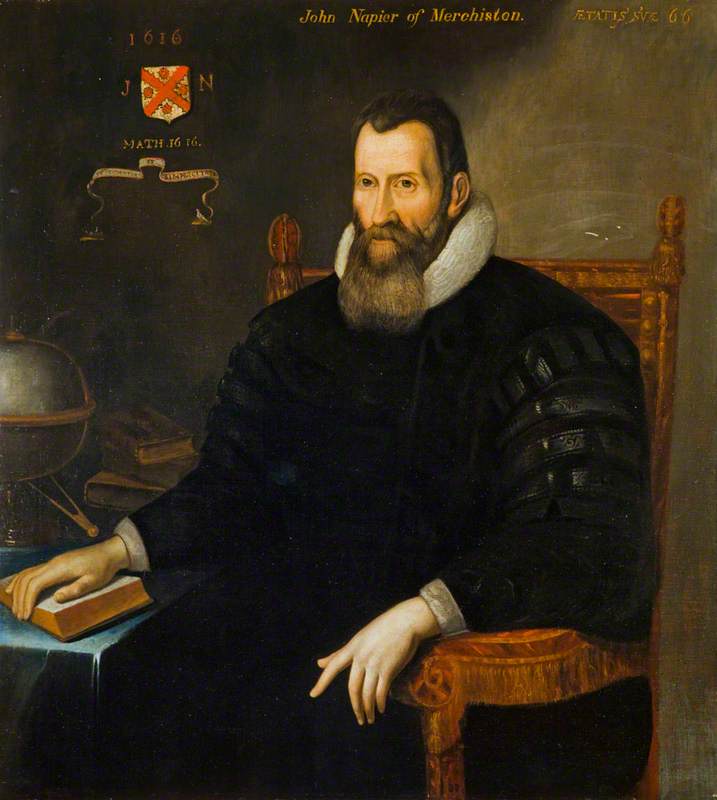
Around 1594 Napier began to think of a way to replace multiplications by sums. The idea was old, but nobody had managed to make it practical. Napier spent twenty years carrying out, by hand, millions of operations. In 1614 he published in Edinburgh the Mirifici logarithmorum canonis descriptio, the Description of the Wonderful Canon of Logarithms: 57 pages of explanation and 90 of tables. The word logarithm, coined by him, combines two Greek terms: lógos, ratio, and arithmós, number.
The book reached London and fell into the hands of Henry Briggs, professor of geometry at Gresham College, who was so excited that he made the long journey to Edinburgh in the summer of 1615 just to meet the author. The two agreed to improve the tables by using base 10. Briggs returned the following year and intended to come again in 1617.
There was no time. In 1617 Napier published the Rabdologia, with his calculating rods, and died at Merchiston, of gout, on 4 April. He was buried in St Cuthbert’s Church in Edinburgh. In 1619 his son Robert published the manuscript in which Napier explained how he had built the tables.
Sources: Julian Havil, John Napier: Life, Logarithms, and Legacy (Princeton University Press, 2014) · Mark Napier, Memoirs of John Napier of Merchiston (1834) · Napier biography, MacTutor.
All topics on John Napier · Multiplying by adding: the two progressions →