
Euler's Eyes
2026-10-13
Euclid: the figure and the proof
Around 300 BC, in Alexandria, Euclid gathered Greek geometry into thirteen books, the Elements. For more than two thousand years it was the most widely read mathematics book in the world, and its first proposition shows how it works:
On a given finite straight line, to construct an equilateral triangle.
— Euclid, Elements, book I, proposition 1
The recipe is short. Let $AB$ be the given line. With centre $A$ and radius $AB$, draw a circle; with centre $B$ and the same radius, draw another. Call $C$ a point where the two circles cut each other. Then $AC=AB$, because both are radii of the first circle, and $BC=AB$, because both are radii of the second. Things equal to the same thing are equal to each other, so $AC=BC=AB$, and triangle $ABC$ is equilateral.
Notice what kind of writing this is. There is no operation sign, no equation, no $x$. There are words, there is a drawing, and there are letters linking the two. The letter $C$ in the text points to a specific point in the drawing; without it, one would have to say “that point where the circles meet, the upper one”. Euclid’s letters are the first labels in mathematics.
The drawing shows, the text proves
Euclid’s drawing is always a particular drawing: a triangle with these angles, this size, this tilt on the page. But the proposition holds for any line $AB$. How can a particular drawing support a general claim?
The Greek answer is that it doesn’t. The text does the proving, step by step, using only what has been defined and postulated. The drawing guides the eye and keeps you from getting lost, but no sentence in the proof says “as can be seen in the figure”. Whenever the drawing seems to show something the text has not justified, the reader has every right to be suspicious.
Here is an example we will use later. A median of a triangle joins a vertex to the midpoint of the opposite side. Draw any triangle, draw a median, and the drawing seems to suggest that it cuts the triangle into two parts of equal area.
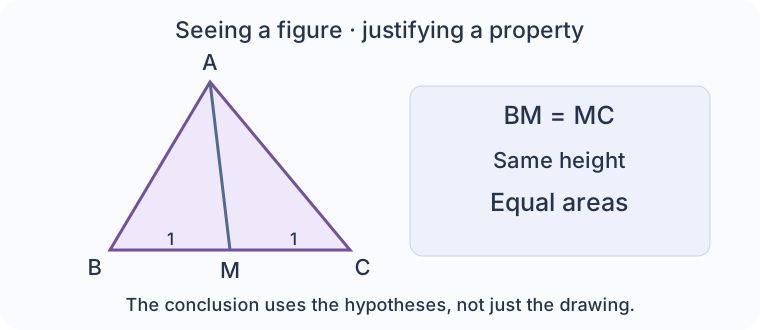
“Seems” is not enough. The proof goes like this: the two triangles formed have equal bases (the two halves of the side that was cut) and the same height (the distance from the vertex to the line of the base, which is the same for both). Since the area of a triangle is half the base times the height, the areas are equal. Notice that the proof does not depend on any measurement of the drawing: it would work just the same for a tall, flat or lopsided triangle.
A Euclid without letters
In 1847 the Irish engineer Oliver Byrne published an edition of the first six books of the Elements with a bold idea: replace the letters with colours. Instead of “angle $ABC$ is equal to angle $DEF$”, Byrne drew a small red angle, an equals sign and another red angle. The text almost disappears, and the proof becomes a sequence of coloured figures.
The book is beautiful and is still reprinted today as a work of art. But it never caught on as a way of writing mathematics. Colours were expensive to print, did not survive a black-and-white copy and, above all, did not scale: with twenty points in a figure, nobody can tell twenty shades apart. Euclid’s letters, which looked poor next to the colours, were the more active notation: they could be combined ($AB$, $ABC$), reused in other propositions and read aloud.
Good for proving, poor for calculating
Greek geometry did everything in words and figures, even what we would now call algebra. The identity we write as $(a+b)^2=a^2+2ab+b^2$ appears in the Elements (book II, proposition 4) like this: “if a straight line be cut at random, the square on the whole is equal to the squares on the segments and twice the rectangle contained by the segments”. It is correct, it is proved, and it is very hard to use in a calculation.
That is the border the chapter crosses next. Greek writing was excellent for showing why something is true, but heavy for handling unknown quantities. When problems began to call for that kind of handling, mathematics needed another way of writing.
Exercise: the median with coordinates
Take the triangle with vertices $A=(0,0)$, $B=(6,0)$ and $C=(1,4)$. The midpoint of $AB$ is $M=(3,0)$. Triangle $AMC$ has base $AM=3$ and height $4$ (the $y$-coordinate of $C$), so its area is $\frac{3\cdot4}{2}=6$. Triangle $MBC$ has base $MB=3$ and the same height $4$, so its area is also $6$. The whole triangle has area $\frac{6\cdot 4}{2}=12$. The median halved the area, even with $C$ pushed far to the left.
Exercise: does measuring prove?
You draw a triangle, measure the three angles with a protractor and get $61^\circ$, $58^\circ$ and $62^\circ$, which add up to $181^\circ$. Does this refute the theorem that the sum is $180^\circ$? No: measurement has error, and the drawing is only a representation. And if it had come out at exactly $180^\circ$, that would not prove the theorem either, because it would hold only for that triangle. Euclid’s proof (book I, proposition 32) draws a parallel to one side through the opposite vertex and uses the equality of alternate angles: the argument works for all triangles at once.
Chapter index · ← Zero and place value: numbers that calculate · Sine, leg and hypotenuse: trigonometry and its lost names →