
Euler's Eyes
2026-10-14
The life of Albert Einstein
Timeline
- 1879Born on 14 March in Ulm, in southern Germany. The family soon moves to Munich.
- 1891At 12, receives a book of Euclidean geometry, which he would call the “holy little book”.
- 1895Fails the entrance exam of the Zurich Polytechnic, despite high marks in mathematics and physics.
- 1900Graduates in Zurich. Spends two years without a steady job.
- 1902Starts work at the patent office in Bern, as a “technical expert, third class”.
- 1905The miraculous year: four papers that change physics and a doctoral thesis.
- 1909Leaves the patent office and becomes a professor in Zurich.
- 1914Moves to Berlin, as a member of the Prussian Academy of Sciences.
- 1915Presents the equations of general relativity.
- 1919The eclipse of 29 May, observed in Sobral and on the island of Príncipe, confirms the theory. Einstein becomes world-famous.
- 1922His Nobel Prize in Physics for 1921 is announced, for the photoelectric effect.
- 1925Visits Rio de Janeiro, from 4 to 12 May.
- 1933With the Nazis in power, leaves Germany for good. Settles in Princeton, in the United States.
- 1939Signs a letter to President Roosevelt about the possibility of an atomic bomb.
- 1955Dies on 18 April in Princeton.
- Born on 14 March. The family soon moves away.
- He receives the “holy little book” of geometry and hates his school, where everything is learned by heart.
- At 15 he leaves school and follows his family, which has moved to Italy.
- Having failed the Zurich exam, he finishes secondary school at a freer Swiss school.
- He studies at the Polytechnic and graduates in 1900. He spends two years without a steady job.
- Technical expert third class at the patent office. In 1905, the miracle year, he writes four papers that change physics.
- Professor at the University of Prague, between two periods in Zurich.
- A member of the Prussian Academy. He presents general relativity (1915) and becomes famous after the 1919 eclipse.
- He spends eight days in Rio, from 4 to 12 May, and is enchanted by the Botanical Garden.
- With the Nazis in power, he leaves Germany. He works at the Institute for Advanced Study until his death in 1955.
- 1879 · Ulm
- 1880–1894 · Munich
- 1894–1895 · Italy
- 1895–1896 · Aarau
- 1896–1902 · Zurich
- 1902–1909 · Bern
- 1911–1912 · Prague
- 1914–1932 · Berlin
- 1925 · Rio de Janeiro
- 1933–1955 · Princeton
The compass and the holy little book
Albert Einstein was born in Ulm, in southern Germany, into a non-observant Jewish family. His father, Hermann, and his uncle Jakob ran a small electrical equipment factory in Munich. Albert was slow to talk, and the family was worried for a while. At 4 or 5, ill in bed, he was given a compass by his father. He was fascinated: something invisible in space made the needle always point the same way. As an old man he would say that the needle taught him that “something deeply hidden” lay behind things.
The second wonder came at 12, with a book of Euclidean geometry. The idea that one could prove, with complete certainty, that the three altitudes of a triangle meet at a point impressed him so much that he called it the “holy little geometry book”. A poor medical student, Max Talmud, who dined with the family on Thursdays, began lending him books on mathematics and philosophy. By 16, Einstein had taught himself differential and integral calculus.
The pupil who could not stand school
Einstein hated his Munich school, where things were learned by heart and obeyed without question. At 15, when the family moved to Italy, he left school and followed them. In 1895, two years younger than the other candidates, he sat the entrance exam of the Zurich Polytechnic and failed: he got excellent marks in mathematics and physics, but did not pass the other subjects. He spent a year at a school in Aarau, in Switzerland, which he loved, and entered the Polytechnic in 1896.
There he met his Serbian classmate Mileva Marić, the only woman in the physics class, whom he would marry in 1903. He also skipped lectures: he studied the great physicists on his own and copied the notes of his friend Marcel Grossmann, who would be decisive years later. He graduated in 1900, but his professors, annoyed by his independence, did not recommend him. He spent two years giving private lessons and doing substitute teaching.
The technical expert, third class
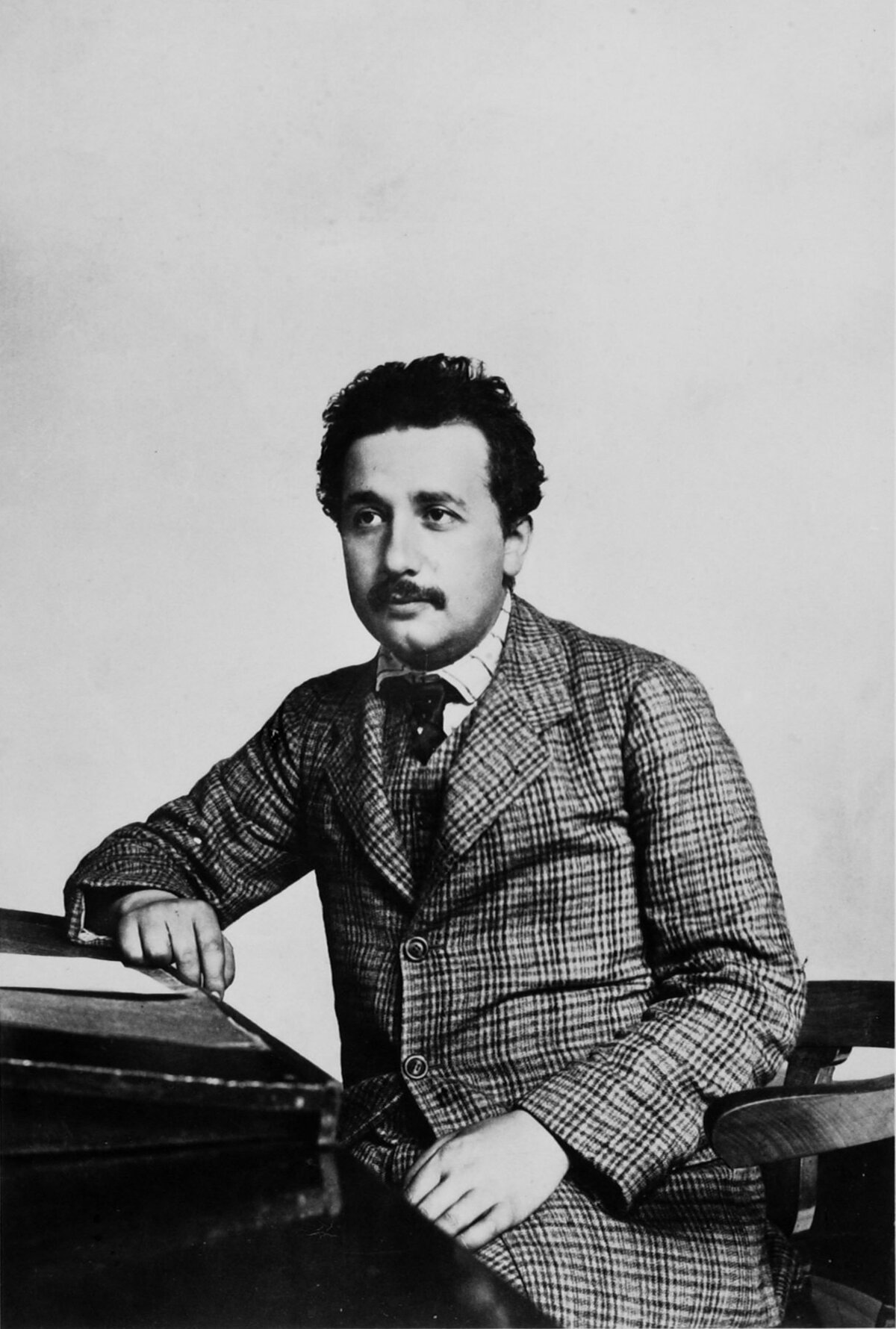
In 1902, thanks to Grossmann’s father, Einstein got a job at the federal patent office in Bern, as a “technical expert, third class”. The work was examining patent applications for electrical inventions, and he did it quickly. That left time to think, and Einstein said the office was the “worldly cloister” where he had hatched his best ideas. With two friends he formed a reading group on philosophy and science that they jokingly called the Olympia Academy.
In 1905, aged 26, with no academic post, no laboratory and no supervisor, Einstein published four papers in the Annalen der Physik and finished a doctoral thesis. In a single year he explained the photoelectric effect, gave the proof that atoms exist through Brownian motion, created special relativity and showed that mass is energy. Physicists call 1905 the miraculous year.
From Switzerland to Berlin, and the eclipse
Recognition came slowly. In 1909 Einstein left the patent office and became a professor in Zurich; then in Prague, in Zurich again and, in 1914, in Berlin. In those years he worked on the hardest problem of his life: bringing gravity into relativity. He had to learn a new geometry, Riemann’s, and called on his old friend Grossmann for help: “Grossmann, you must help me, or else I’ll go crazy!”. In November 1915 he arrived at the equations of general relativity.
The theory predicted that the light of a star, passing near the Sun, is bent by a tiny angle. The only way to see stars near the Sun is during a total eclipse. On 29 May 1919 two British expeditions photographed the eclipse, one on the island of Príncipe, off the coast of Africa, and the other in Sobral, in the Brazilian state of Ceará. On 6 November the results were announced in London: Einstein was right. The next day The Times of London ran the headline “Revolution in Science”. At 40, Einstein suddenly became famous all over the world.
A week in Rio de Janeiro
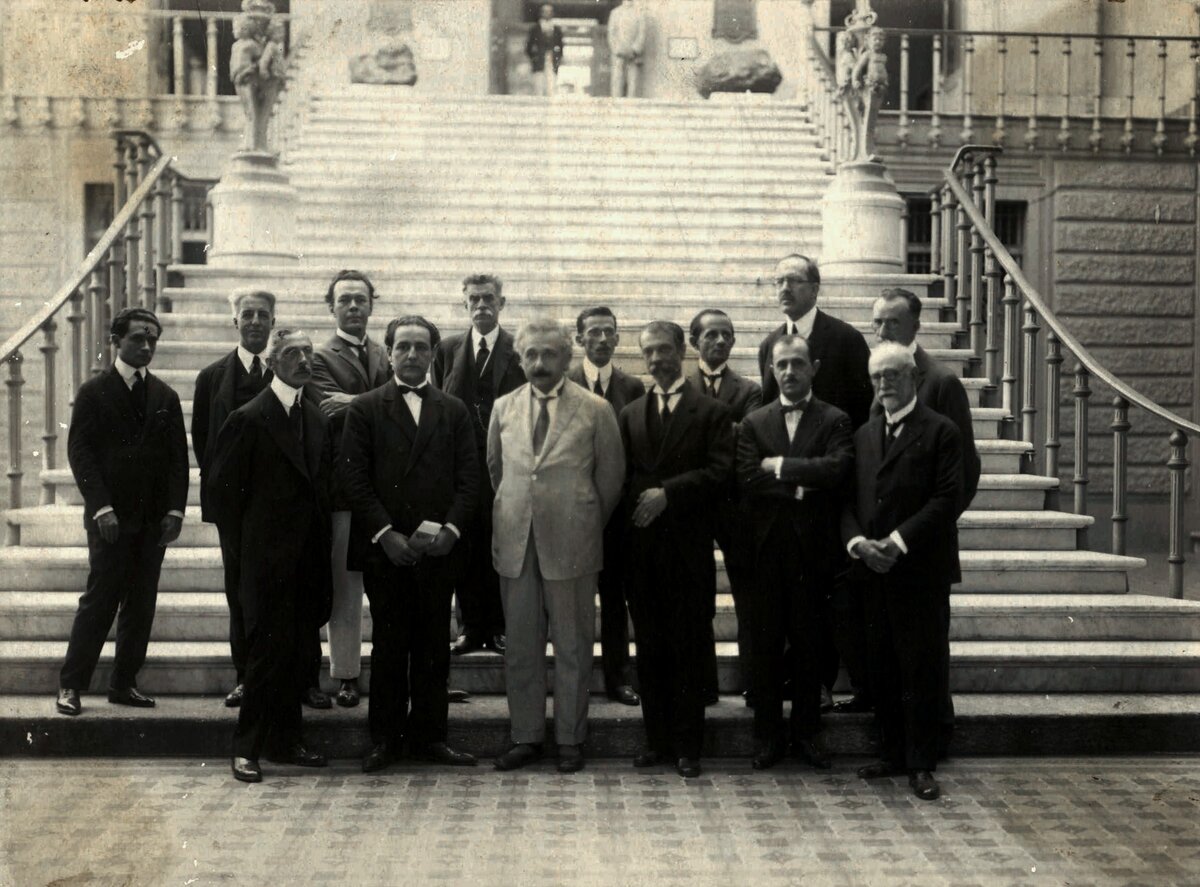
In 1925, on a trip through South America, Einstein passed through Rio de Janeiro and stayed in the city from 4 to 12 May. He lectured at the Engineering Club and the Polytechnic School, and visited the National Observatory, the National Museum, the Oswaldo Cruz Institute and the Botanical Garden. The press followed him everywhere. A Rio columnist joked about the theory, saying that in Brazil nothing was relative: not the cramped houses, not the price of beans, not the exchange rate, which was “thin, terribly thin”.
In his diary, Einstein noted his delight with nature:
The Botanical Garden, like the flora in general, surpasses the dreams of the Thousand and One Nights. Everything lives and grows, so to speak, before one’s eyes.
— Albert Einstein, travel diary (May 1925)
At the Brazilian Academy of Sciences, on 7 May, he recalled the Sobral eclipse with the sentence that opens this track: the problem his mind had conceived had been solved by the luminous sky of Brazil.
Exile
The Nobel Prize in Physics for 1921, only announced in 1922, rewarded the photoelectric effect: relativity still seemed too daring to the committee. Meanwhile, in Germany, Einstein was the target of antisemitic attacks, and there was even a campaign against “Jewish physics”. When Hitler came to power in 1933, Einstein was in the United States. He never went back. He settled at the Institute for Advanced Study in Princeton, where he spent his last 22 years.
In 1939 he signed a letter to President Roosevelt, written by the physicist Leó Szilárd, warning that Germany might build an atomic bomb. He took no part in the bomb project, and later said the letter had been the great mistake of his life. In 1952 he turned down the invitation to become president of Israel. He died in Princeton on 18 April 1955, aged 76. On the table beside his bed lay the calculations of a theory that tried to unify gravity and electromagnetism, which he never finished.
Sources: biography, Nobel Foundation · Walter Isaacson, Einstein: His Life and Universe (Simon & Schuster, 2007) · Ildeu de Castro Moreira and Antonio Augusto Passos Videira (eds.), Einstein e o Brasil (Editora UFRJ, 1995).
All topics on Albert Einstein · The photoelectric effect: light comes in packets →