
Euler's Eyes
2022-06-15
Division
Share without losing anyone


Check out the discovery
Each person receives 3 loaves of bread, since 5 × 3 = 15. Distribute one at a time to check that the parts are equal.
In this post, we will talk about Division, although this concept would be better defined when we get into rational numbers. Division expands the potential of the concept of subtraction and, without loss of generality, is the inverse of multiplication. Today many teachers have difficulty teaching division, as division is much more complex than subtraction and considered difficult to use in the 15th century.
In previous posts we talked about Lucas Pacioli and he said the following about division:
“If a person knows how to share, everything else is easy.”
Help us build the math website. Donate as much as you can.

The Concept
The concept of division is based on two concepts:
- share
- compare.
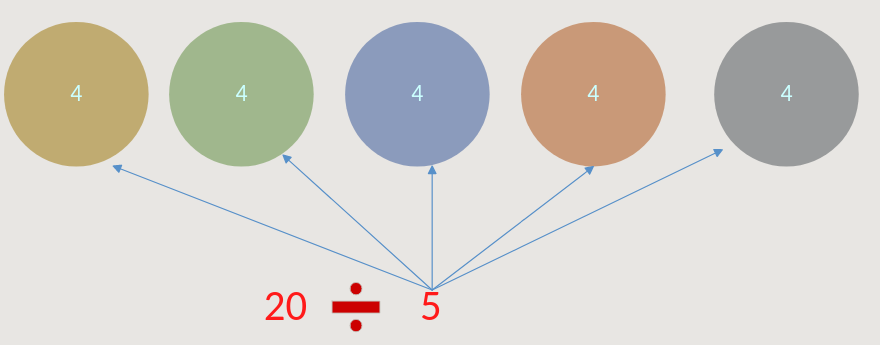
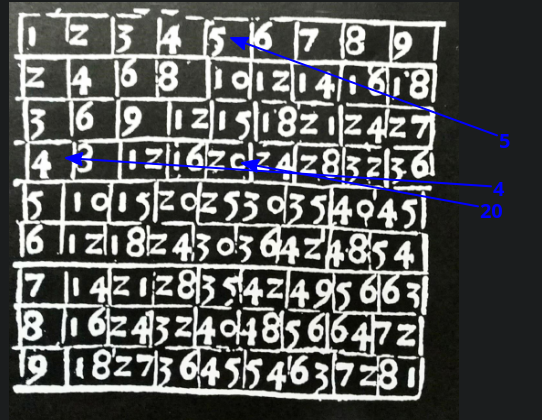
Division seen as apportionment occurs when we want to partition (allocate) a set of objects (or whatever it is to apportion) in groups. For example, we have 20 sweets to give to 5 children. How can we share?

| $$20\div 5$$ | multiplication table |
|---|---|
|
|
In this case, we will distribute (divide) the sweets into equal portions for each child. In this example there were no bullets left, that is, there were zero bullets left. Examples like these are taught in the first years of elementary school.
Now, we can share objects and still have objects left over. For example, we have 21 books to share with 5 children.

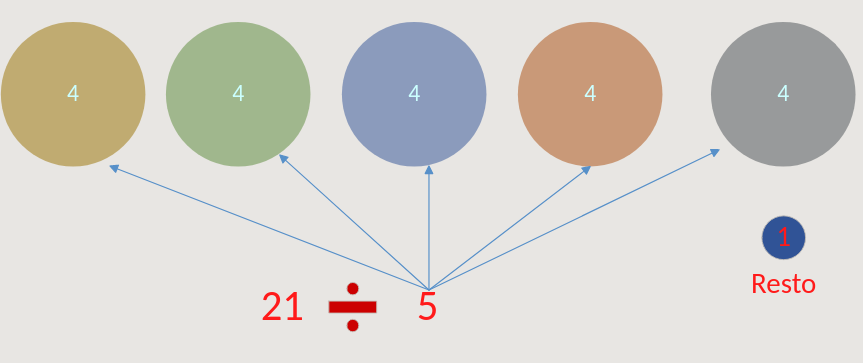
For this example, there was 1 book left, which is a concept used for the end of elementary school 1. In elementary 2, students can use equation concepts to understand division with remainder, as defined below.
Given a natural number a, suppose that a was divided into q groups with b elements each, and that r elements remained. This fact is represented by the fundamental division equation:
$$a = bq + r$$In problems without the remainder we can have the following definition:
$$a = bq $$because the remainder is zero.
Algorithms for division
Here we will study the genesis of the division algorithm, the one taught in elementary school 1. In this way, we can understand the division algorithm and the cause of difficulty among children.
Successive divisions
For the successive division algorithms, we will use the successive subtraction technique.
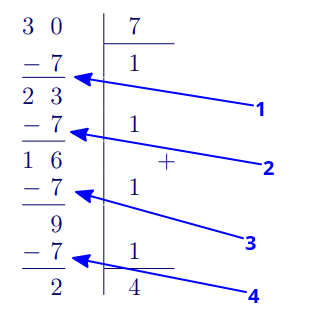
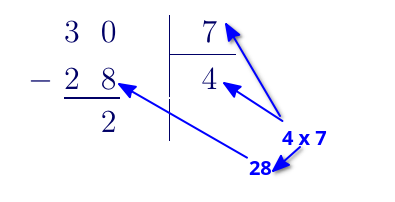
Example 1: Let’s suppose 30 Pokémon cards to distribute to 7 children. Use the successive subtraction algorithm.
- 30 - 7 = 23
- 23 - 7 = 16
- 16 - 7 = 9
- 9 - 7 = 2
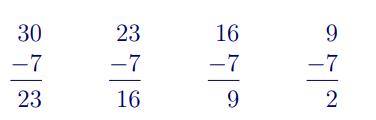
The bookish method uses the successive subtraction algorithm as follows:
In a reduced form, the construction is done as follows:
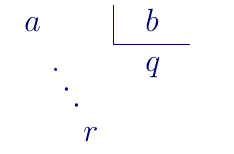
With this in mind, we will propose in a generic way:
| Equation | School Montage |
|---|---|
| $$a = bq + r$$ |
|
We define it as:
-
\(a\) : dividend
-
\(b\) : divider
-
\(q\) : quotient
-
\(r\) : rest
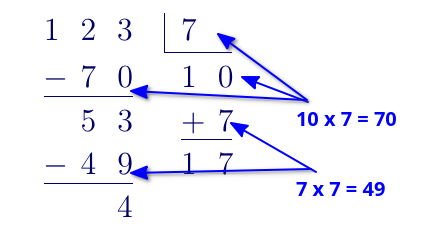
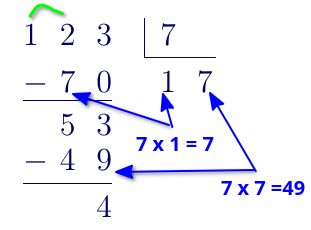
Example 2: Let’s suppose 123 cinema tickets to be distributed to 7 children. Use the successive subtraction algorithm.
| Ticket | Children |
|---|---|

|

|
Next we will present 2 methods for division:
| Method 1 | Method 2 |
|---|---|
|
|
The first is not used in elementary schools, as the child may get confused, but it avoids dropping the number 3. In addition, it requires subtraction operations on the left and addition on the right. The second method needs to lower 3 and avoids the sum of 10 + 7 = 17.
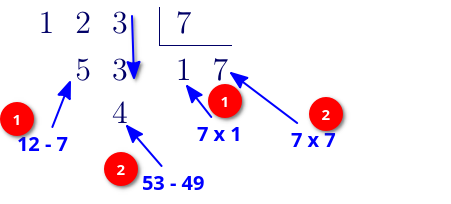
The latter is the direct method, in which we calculate the subtraction in our heads. However, the child must be trained to do the math in their head.
Egyptian Method
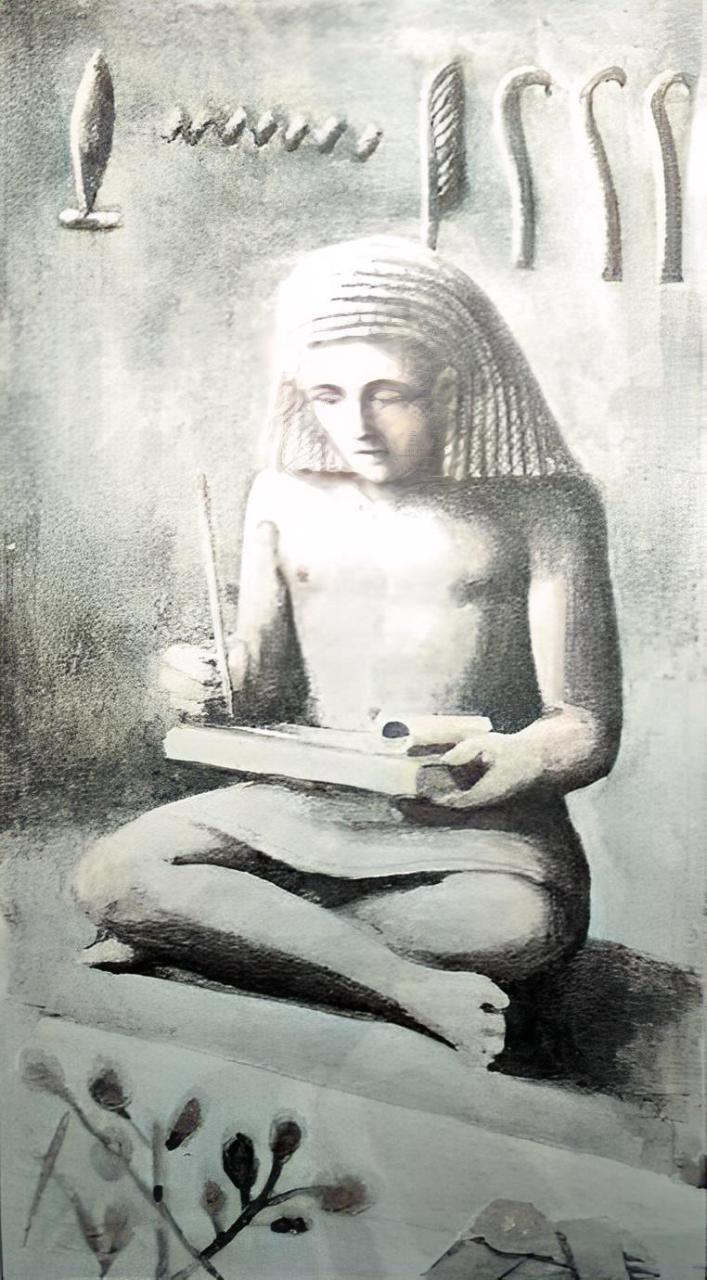
To illustrate the Egyptian method, let’s calculate 250 divided by 7.
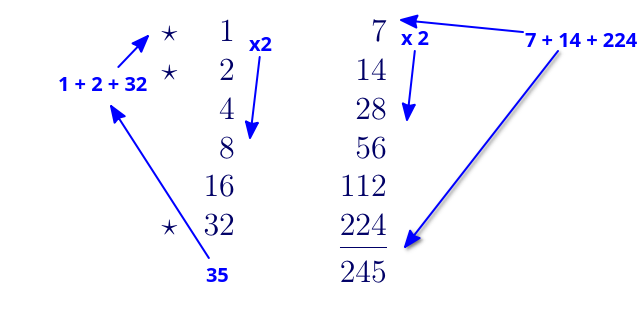
Egyptian algorithm:
- We set up two columns, one starting at 1 and the other at 7
- We duplicate the two columns until we reach a number close to the result. For example,
- 1 x 2 = 2, 2 x 2 = 4 , …, 16 x 2 = 32.
- 7 x 2 = 14, 14 x 2 = 28, …, 112 x 2 = 224.
- We look in the second column for numbers whose sum is less than or equal to 250.
- In this case 7 + 14 + 224 = 245.
- The quotient is the result of the sum of the first column:
- In this case 1 + 2 + 32 = 35.
- The rest is given by the result of 250 - 245 = 5.
So far we can cover the subject of division of natural numbers.
Training
Time to practice! Answer and see how many stars you get.