
Euler's Eyes
2022-09-20
Pi Number
The secret of the wheels
Change the diameter and compare C/d. The contour changes, but the ratio in the model remains π.
Archimedes’ constant, known as pi (Π) was widely studied in Greece (around the 3rd century BC). It all started with the study of one of the most important figures in geometry, which is the circle. This constant is obtained by the ratio ($\div$) of the length of the circumference and the diameter.
Below we present a gif produced by the website matemática.pt.
Appearance of the pi symbol (Π)
Note that the entrance to the Greek museums pays homage to the Π symbol.
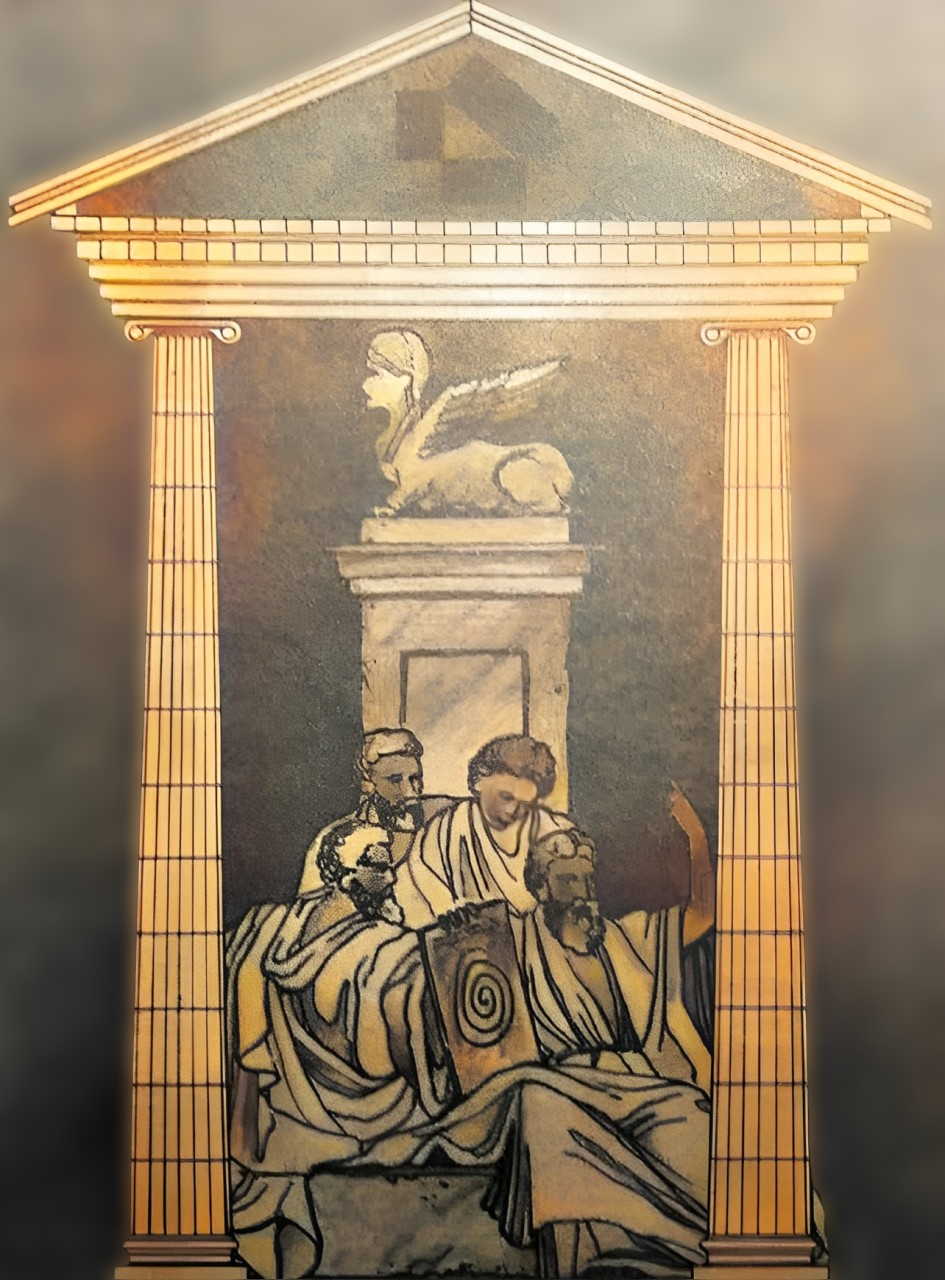
This irrational number is the most used constant in geometry and is represented by two columns and a beam.

The notation (Π) was first used by William Jones (about 1706) who took as inspiration the entrances to the Greek coliseums.
This symbol was adopted as official notation by Leonhard Euler. In this way, the scientific community began to apply it consistently, as it was used by one of the most important mathematicians in history.
Circle
Before we construct Archimedes’ constant, the definition of length and diameter is necessary.
Definition: perimeter (Greek: περίμετρος) or length ($L$) of the circumference is the measurement of the edge of the circle. Note that the word perimeter in Greek appears as the symbol for the studied constant.

Definition: radius ($R$) of the circle is the measurement from the center of the circle to the edge.
Definition: diameter ($D$) of the circle is twice the radius of the circle.
$$D = 2R$$
Conjecture of the existence of the number pi (Π)
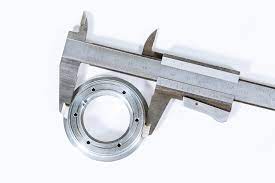
The conjecture of the existence of the number pi $\pi$ was proposed by Archimedes. To do this, he carried out an experiment, in which he measured the perimeter of the circle and divided it by the diameter.
$$\dfrac{\text{Perímetro} }{\text{Diâmetro} } = \text{Constante}$$$$\dfrac{L}{2R } = \text{Constante}$$With this, we have

| Measure the Perimeter | Measure the Diameter |
|---|---|

|
|
Archimedes’ experiment
Archimedes used the experiment of dividing the perimeter by the diameter of the circle. Below, we present some measurements made with everyday objects.
| Choice | Measuring instruments (Perimeter / Diameter) | Perimeter $(L)$ | Diameter $(D)$ | Reason $\left(\dfrac{L}{D}\right)$ |
|---|---|---|---|---|
| Cylindrical mug | tape measure and caliper | 23 | 7 | 3.28 |
| Styrofoam circle | (string + ruler) and caliper | 47.4 | 14.8 | 3.20 |
| soda can | tape measure and caliper | 20.7 | 6.3 | 3.28 |
Resources at the time of Archimedes were few. What was Archimedes’ idea?
Using something we call quadrature, which he judged to be a divine work.
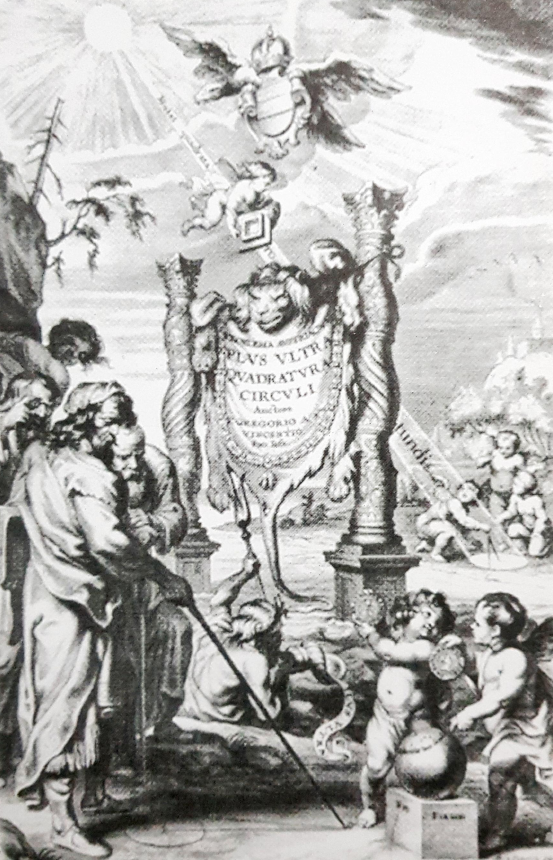
Squaring starts from the square and begins to increase the number of sides of the polygon.
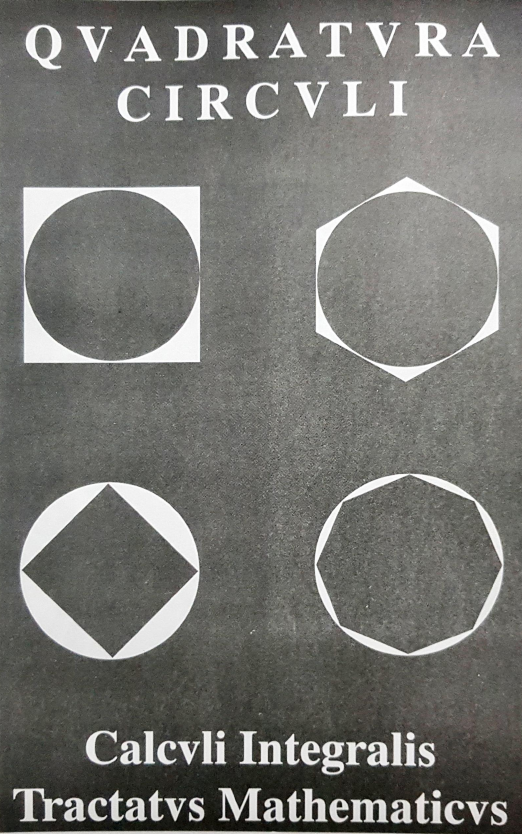
In this way, transforming a circle into a segment is what we call rectifying the circle.

With the rectification of the circumference, Archimedes obtained a good approximation to the circumference.
Application
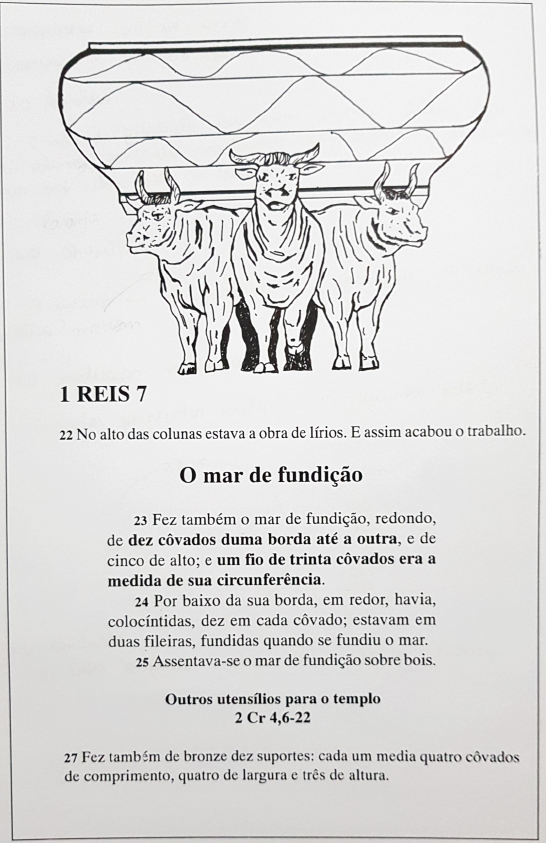
History
The molten sea was an immense pool, which King Solomon built to bathe his wives and cuncumbines. This report can be read in the figure. The united pi question the veracity of the biblical account?
Mathematical modeling
The data provided implies the following values:

Conclusion
In fact, Solomon measured a round artifact.
For now it is just for defining the number $\pi$. Wait for the next posts.