
Euler's Eyes
2026-10-15
The life of Niels Henrik Abel
Timeline
- 1802Born on 5 August near Stavanger, on the west coast of Norway.
- 1804The family moves to Gjerstad, where his father is the pastor.
- 1815Enters the Cathedral School of Christiania, today’s Oslo.
- 1818Bernt Holmboe becomes his mathematics teacher.
- 1820His father dies. Abel begins to support part of the family.
- 1821Enters the university. Believes he has solved the quintic and finds the mistake.
- 1824Publishes, at his own expense, the proof that there is no formula for the fifth degree.
- 1825Travels to Berlin, where he meets August Leopold Crelle.
- 1826In Paris, hands the Academy his great memoir on integrals. Cauchy loses it.
- 1827Returns to Norway, jobless and in debt. Publishes elliptic functions.
- 1829Dies of tuberculosis at Froland on 6 April, aged 26.
- 1830Receives, posthumously, the Grand Prize of the Paris Academy, with Jacobi.
- He is born on the west coast of Norway, the second of seven children of a pastor.
- He grows up in his father’s parish in the south of the country.
- At the Cathedral School his teacher Holmboe discovers his talent. In 1824 he publishes the six-page pamphlet on the quintic.
- He meets August Leopold Crelle, who publishes seven of his papers in the first volume of his journal.
- He hands the Academy his great memoir on integrals. Nobody pays attention to him, and Cauchy loses the manuscript.
- He returns jobless and in debt. He publishes elliptic functions and races Jacobi.
- He travels by sleigh at Christmas to see his fiancée, falls ill and dies of tuberculosis on 6 April. Two days later the appointment from Berlin arrives.
- 1802 · near Stavanger
- 1804–1815 · Gjerstad
- 1815–1825 · Christiania
- 1825–1826 · Berlin
- 1826 · Paris
- 1827–1828 · Christiania
- 1828–1829 · Froland
The pastor’s son
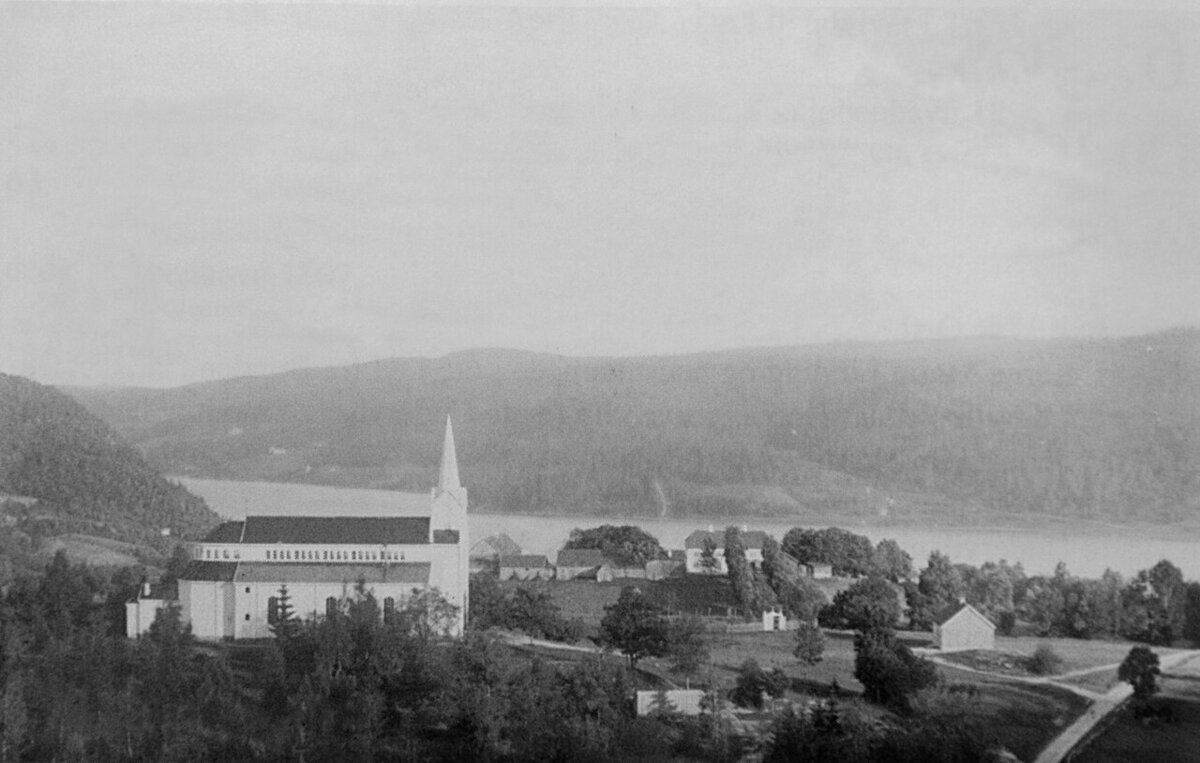
Niels Henrik Abel was born on 5 August 1802, the second of seven children of a Lutheran pastor, Søren Georg Abel, on the west coast of Norway. Two years later the family moved to Gjerstad, in the south, where his father took over the parish. Norway was then a poor province of Denmark, devastated by the Napoleonic wars and by the British blockade, which brought famine in 1812. In 1814 it gained its own constitution and entered a union with Sweden, and Abel’s father went on to sit in the new parliament.
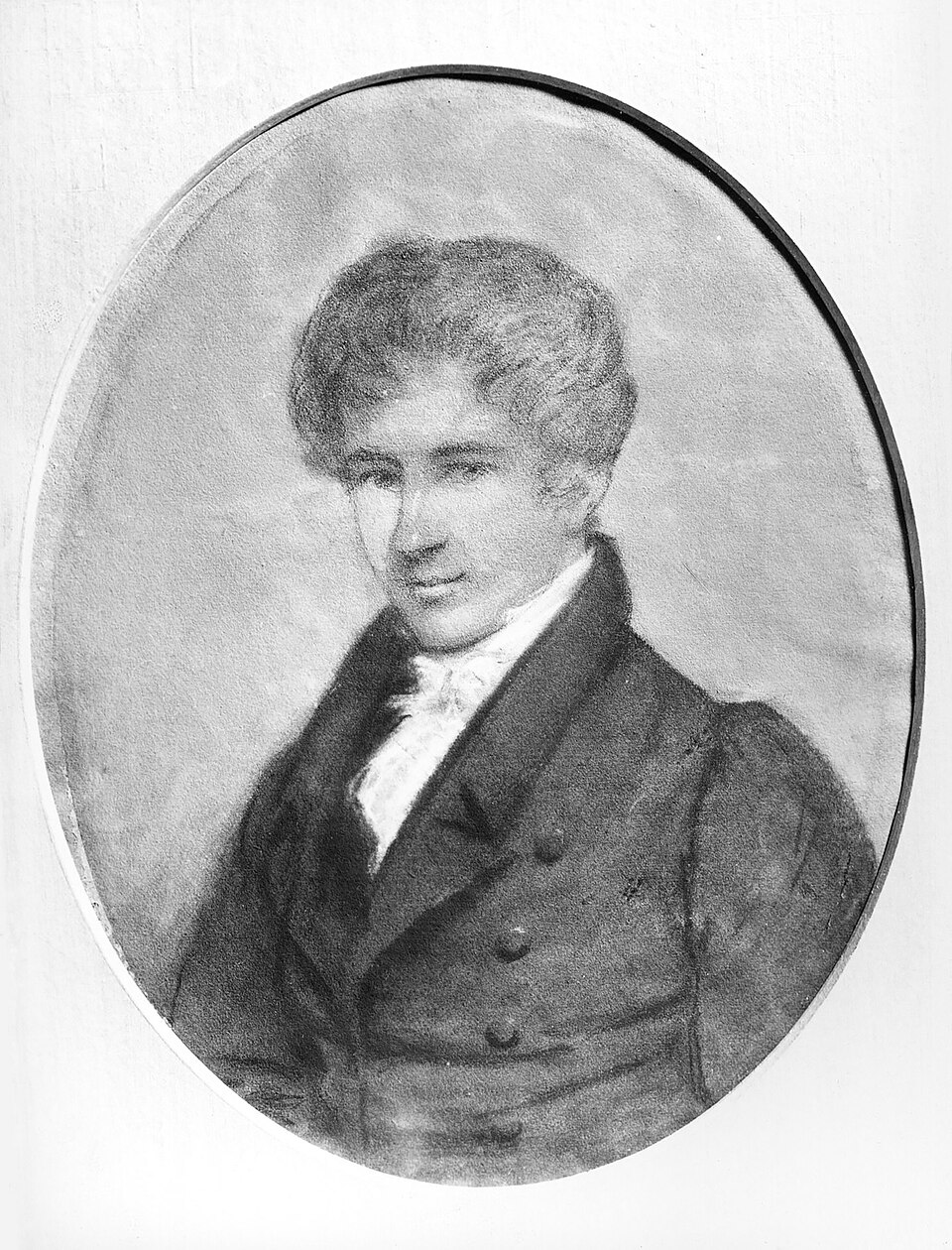
In 1815 Niels and his older brother were sent to the Cathedral School of Christiania, the capital, now Oslo. In his first years Niels was an ordinary pupil. Everything changed in 1818, when the mathematics teacher was dismissed for beating a pupil, who died shortly afterwards. His replacement, Bernt Michael Holmboe, was only seven years older than Abel. Holmboe set the class different problems and saw at once what he had in his hands. In the school report he wrote:
With the most extraordinary genius he unites such ardour for and interest in mathematics that, if he lives, he will probably become one of the greatest mathematicians.
— Bernt Holmboe, school report on Abel
“If he lives”: the proviso, common at the time, would come to sound like a prophecy. Holmboe lent Abel the books of Euler, Lagrange and Gauss, and before long the pupil was reading things the teacher could not follow.
The false solution
In 1820 Abel’s father died, an alcoholic and discredited, leaving the family destitute. Abel, at 18, began helping his mother and siblings by giving private lessons. He entered the university in 1821 thanks to professors who paid for his lodging out of their own pockets.
While still at school, he thought he had found a formula for the equation of the fifth degree, the most famous problem in algebra. Holmboe sent the work to Ferdinand Degen, the best mathematician in Copenhagen, who did not find the error but asked for a numerical example. Trying to produce one, Abel discovered that the method failed. Degen also gave him a piece of advice: that the young man should study elliptic integrals, “a Strait of Magellan” that would lead to an ocean. Abel followed both paths.
The six-page pamphlet
In 1824 Abel proved the opposite of what he had wanted: there is no general formula for the equation of the fifth degree. He had the proof printed at his own expense, in French, and to save paper he squeezed everything into six pages, which made it extremely hard to read. He sent a copy to Gauss, in Göttingen. Tradition says the pamphlet was found after Gauss’s death with its pages still uncut, as they had come from the printer.
Berlin and Paris
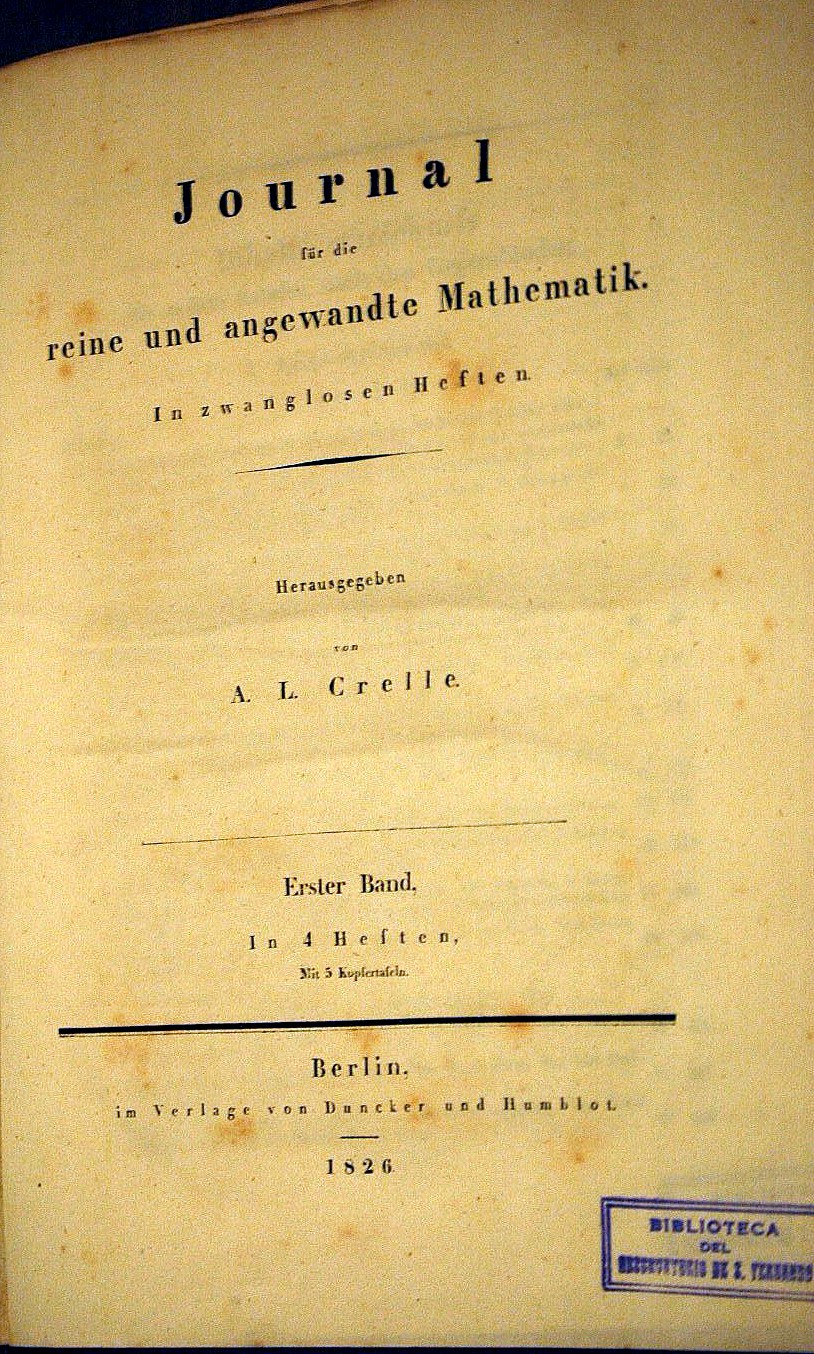
In 1825 the Norwegian government gave him a travel grant. In Berlin Abel met August Leopold Crelle, a railway engineer with a passion for mathematics who was founding a journal. The first volume of the Journal for Pure and Applied Mathematics, of 1826, has seven papers by Abel, among them the full version of the quintic proof and the study of the binomial series. Crelle became his friend and champion.
In July 1826 he reached Paris, the capital of mathematics, where nobody paid him any attention. On 30 October he handed the Academy of Sciences his most ambitious work, on the integrals of algebraic functions. The referees were Legendre, aged 74, and Cauchy. Legendre found the text hard to read; Cauchy took it home and forgot it among his papers. Abel wrote to Holmboe:
Every beginner has a great deal of difficulty getting noticed here. I have just finished an extensive treatise on a certain class of transcendental functions, but Mr Cauchy scarcely deigns to look at it.
— Niels Henrik Abel, letter to Holmboe (October 1826)
Of Cauchy he said in another letter that he was “mad”, but that he was also the only one who knew how mathematics ought to be done.
The return and the end
Abel returned to Norway in May 1827, penniless, in debt and already ill. There was no post at the university; he managed only to stand in for a professor who was travelling. Even so, it was the most productive period of his life. He published elliptic functions in Crelle’s Journal and raced the German Carl Jacobi, who was reaching the same results by another route. The mathematicians of Europe finally realised who he was. Four members of the Paris Academy wrote to the king of Sweden and Norway asking for a post for Abel, and Crelle was working to secure him a chair in Berlin.
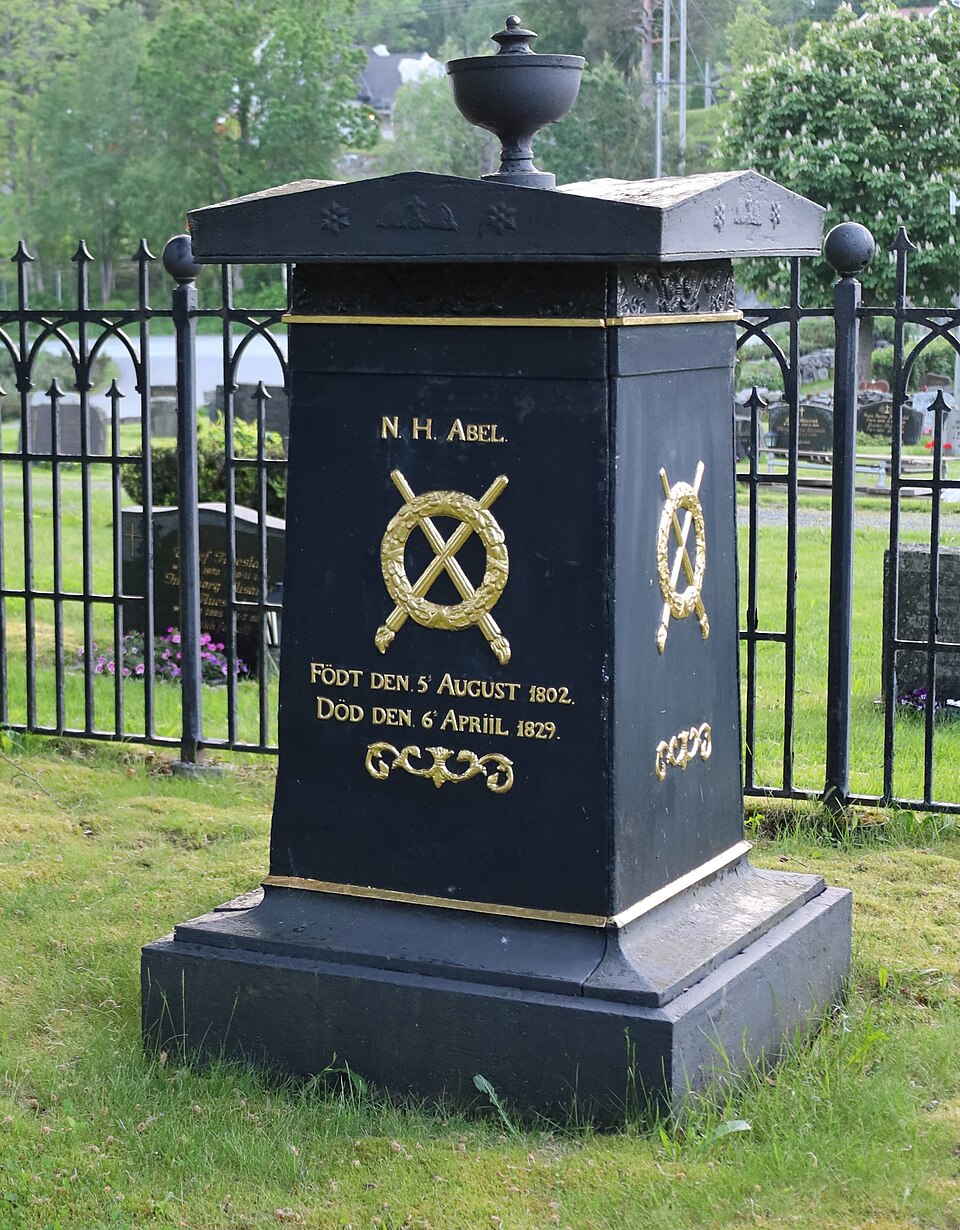
Abel was engaged to Christine Kemp, who worked as a governess at Froland, near Arendal. At Christmas 1828 he travelled by sleigh, in the cold, to spend the holidays with her. There he began to cough blood. The tuberculosis advanced quickly, and Abel died at Froland on 6 April 1829, aged 26. Two days later a letter from Crelle arrived: the University of Berlin had appointed him professor.
In 1830 the Paris Academy awarded its Grand Prize in mathematics, in equal parts, to Abel, who was dead, and to Jacobi. The memoir lost by Cauchy was found again and published only in 1841. The original manuscript vanished again and only reappeared in 1952, in a library in Florence.
Sources: Øystein Ore, Niels Henrik Abel: Mathematician Extraordinary (University of Minnesota Press, 1957) · Arild Stubhaug, Niels Henrik Abel and his Times (Springer, 2000) · Abel biography, MacTutor.
All topics on Niels Henrik Abel · The fifth-degree equation: the formula that does not exist →