Euler's Eyes
2026-10-23
The sine of π/n and notable arcs
We will verify that the circular functions of the reals $x = \dfrac{\pi}{n}$, with $n \in \mathbb{N}$ and $n \ge 3$, can be calculated from $\ell_n$, the side of the regular polygon with $n$ sides inscribed in the cycle.
The story
In book I of Almagest, Ptolemy constructed his table of chords exactly like this: he started from the sides of inscribed regular polygons — triangle, square, pentagon, hexagon and decagon —, which Euclid’s geometry knew how to calculate, and obtained the other arcs through formulas for sum, difference and half of arcs, which we will see in chapter VI. The chord of an arc $2\alpha$ in a circle of radius $R$ is $2R\operatorname{sen}\alpha$: the theorem in this chapter is the modern translation of this idea.
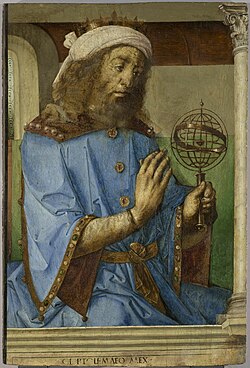
Sources: Ptolemy (MacTutor) · Euclid, Elements, book IV.
In everyday life
- Squares. The two squares in the school kit are the triangles of this chapter: one of $45^\circ$-$45^\circ$-$90^\circ$ and the other of $30^\circ$-$60^\circ$-$90^\circ$.
- Nuts and bolts. The hex head is a regular hexagon: the distance between two parallel faces, which defines the size of the wrench, is $\ell\sqrt{3}$ to one side $\ell$.
- Roofs. Slopes of $30^\circ$ and $45^\circ$ are common. On a $30^\circ$ half-width roof of 4 m, the ridge is $4\operatorname{tg} 30^\circ \approx 2{,}31$ m above the support.
Theory
Theorem
TeoremaThe sine of π/n
For all $n \in \mathbb{N}$ with $n \ge 3$,
$$\operatorname{sen}\frac{\pi}{n} = \frac{\ell_n}{2}.$$View the demo
Let $P$ and $P'$ be points of the cycle with $A\hat OP = A\hat OP' = \dfrac{\pi}{n}$, one on each side of the cosine axis. Like $P'\hat OP = \dfrac{2\pi}{n}$, the chord $\overline{P'P}$ is a side of the $n$ inscribed regular polygon: $P'P = \ell_n$.
In isosceles triangle $P'OP$ ($OP = OP' = 1$), the cosine axis is angle bisector of the angle at $O$ and therefore also height and median: $\overline{P'P} \perp u$ and $P_2$ is the midpoint of $\overline{P'P}$. Then
$$\operatorname{sen}\frac{\pi}{n} = \overline{P_2P} = \frac{\ell_n}{2}.$$Applications: n = 3, 4 and 6
The most common cases are those where $n = 3$, $4$ and $6$. In the cycle, $R = 1$.
PropriedadeValues in π/3
Applying Pythagoras’ theorem to the highlighted triangle, formed by the side $\ell_3$ of equilateral triangle, the side $\ell_6$ of the hexagon and a diameter (the triangle is rectangular, as it is inscribed in a semicircle):
$$\ell_3^2 + \ell_6^2 = (2R)^2 \;\Longrightarrow\; \ell_3^2 + R^2 = 4R^2 \;\Longrightarrow\; \ell_3^2 = 3R^2 \;\Longrightarrow\; \boxed{\ell_3 = R\sqrt{3}}$$Therefore, with $R = 1$:
$$\operatorname{sen}\frac{\pi}{3} = \frac{\ell_3}{2} = \frac{\sqrt{3}}{2} \qquad \cos\frac{\pi}{3} = \sqrt{1 - \frac{3}{4}} = \frac{1}{2} \qquad \operatorname{tg}\frac{\pi}{3} = \frac{\frac{\sqrt{3}}{2}}{\frac{1}{2}} = \sqrt{3}.$$PropriedadeValues in π/4
In the inscribed square, two consecutive sides and a diameter form an isosceles right triangle:
$$\ell_4^2 + \ell_4^2 = (2R)^2 \;\Longrightarrow\; 2\ell_4^2 = 4R^2 \;\Longrightarrow\; \ell_4^2 = 2R^2 \;\Longrightarrow\; \boxed{\ell_4 = R\sqrt{2}}$$Then
$$\operatorname{sen}\frac{\pi}{4} = \frac{\ell_4}{2} = \frac{\sqrt{2}}{2} \qquad \cos\frac{\pi}{4} = \sqrt{1 - \frac{1}{2}} = \frac{1}{\sqrt{2}} = \frac{\sqrt{2}}{2} \qquad \operatorname{tg}\frac{\pi}{4} = 1.$$PropriedadeValues in π/6
With $PQ = \ell_6$ being the side of the inscribed regular hexagon, the triangle $OPQ$ is equilateral (the angles are from $60^\circ$), and then $\boxed{\ell_6 = R}$. We have:
$$\operatorname{sen}\frac{\pi}{6} = \frac{\ell_6}{2} = \frac{1}{2} \qquad \cos\frac{\pi}{6} = \sqrt{1 - \frac{1}{4}} = \frac{\sqrt{3}}{2} \qquad \operatorname{tg}\frac{\pi}{6} = \frac{\frac{1}{2}}{\frac{\sqrt{3}}{2}} = \frac{1}{\sqrt{3}} = \frac{\sqrt{3}}{3}.$$Table of notable arches
ResumoExact values
| $\frac{\pi}{6} = 30^\circ$ | $\frac{\pi}{4} = 45^\circ$ | $\frac{\pi}{3} = 60^\circ$ | |
|---|---|---|---|
| sine | $\frac{1}{2}$ | $\frac{\sqrt{2}}{2}$ | $\frac{\sqrt{3}}{2}$ |
| cosine | $\frac{\sqrt{3}}{2}$ | $\frac{\sqrt{2}}{2}$ | $\frac{1}{2}$ |
| tangent | $\frac{\sqrt{3}}{3}$ | $1$ | $\sqrt{3}$ |
A way to remember: the sines of $30^\circ$, $45^\circ$ and $60^\circ$ are $\frac{\sqrt{1}}{2}$, $\frac{\sqrt{2}}{2}$ and $\frac{\sqrt{3}}{2}$; the cosines are the same, in reverse order.
With the reductions in chapter IV, these three values give those of all arcs marked in the cycle above: for example, $\operatorname{sen}\frac{5\pi}{6} = \operatorname{sen}\frac{\pi}{6} = \frac{1}{2}$ and $\cos\frac{5\pi}{4} = -\cos\frac{\pi}{4} = -\frac{\sqrt{2}}{2}$.
The exercises in this chapter are in chapter list.