
Euler's Eyes
2026-09-26
ENEM 2022 – Solved mathematics: questions 136 to 150
Source: INEP – proof and template of the 2nd day, Notebook 5 – Yellow (1st application).
The ENEM Mathematics and Technologies test 2022 was administered on the 2nd day and will from question 136 to 180. This post addresses questions 136 to 150. The numbering used here is that of the Notebook 5 – Yellow; us In other notebooks the same questions appear in a different order.
Template
| Question | Subject | Template |
|---|---|---|
| 136 | Percentage and weighted average of salaries | D |
| 137 | Ratio and time unit conversion | B |
| 138 | Ratio between time units | A |
| 139 | Distance × time graph reading | A |
| 140 | Percentage increases and discounts | A |
| 141 | Guidance and mesh paths | C |
| 142 | Cylinder volume | E |
| 143 | Ratio between quantities in graphs | B |
| 144 | Big numbers: billion | E |
| 145 | Shortest path: reflection and similarity | D |
| 146 | Cost Comparison | A |
| 147 | Sphere volume and proportion | E |
| 148 | Cone volume and percentage | C |
| 149 | Percentage: 75% drop | C |
| 150 | Combinatorial analysis: combinations | B |
Question 136: Salary increase and average salary (percentage)
Statement
At a university, professors work who are functionally for your highest degree: master or doctor. There are currently 60 masters and 40 doctors. The monthly salaries of master teachers and doctors are, respectively, R$ 8 000,00 and R$ 12 000,00.
The institution’s management intends to provide a salary increase differentiated for the following year, in such a way that the average monthly salary of teachers at this institution does not exceed R$ 12 240,00. The university already established that the salary increase will be 25% for masters and still needs define the adjustment percentage for doctors.
Maintaining the current number of teachers with their current titles, the increase salary, in percentage, to be granted to doctors must be, at most,
- A) 14,4.
- B) 20,7.
- C) 22,0.
- D) 30,0.
- E) 37,5.
Resolution
The average salary is the total salary divided by the number of teachers (60 + 40 = 100). So the average cannot exceed R$ 12 240,00 exactly when the total payroll does not exceed $100 \cdot 12\thinspace 240 = 1\thinspace 224\thinspace 000$ reais.
1. Masters sheet after increase. With 25% increase, each master starts earning $8000 \cdot 1{,}25 = 10\thinspace 000$ reais. 60 masters cost
$$60 \cdot 10\thinspace 000 = 600\thinspace 000$$2. How much is left for the doctors. At most $1\thinspace 224\thinspace 000 - 600\thinspace 000 = 624\thinspace 000$ real, that is, per doctor:
$$\frac{624\thinspace 000}{40} = 15\thinspace 600$$3. Percentage increase. The doctor’s salary can range from 12 000 to 15 600:
$$\frac{15\thinspace 600}{12\thinspace 000} = 1{,}30 \quad\Rightarrow\quad \text{aumento de } 30\%$$Answer: alternative D (30,0%).
Be careful with the catch: the average is weighted by the number of teachers. Who makes the simple average of the two salaries, $\frac{10\thinspace 000 + x}{2} = 12\thinspace 240$, finds $x = 14\thinspace 480$ and an increase of about 20,7% (alternative B), which is wrong because there are more masters than doctors.
To review, see Increases and Discounts.
Question 137: Insecticide released with each activation
Statement
An automatically actuated sprayer releases, with each activation, the same amount of insecticide. The container of this product, when full, contains 360 mL of insecticide, which lasts 60 days if the sprayer remains on uninterruptedly and is triggered every 48 minutes.
The amount of insecticide that is released with each sprayer activation, in milliliter, is
- A) 0,125.
- B) 0,200.
- C) 4,800.
- D) 6,000.
- E) 12,000.
Resolution
1. Total time in minutes. A day has $24 \cdot 60 = 1440$ minutes. In 60 days:
$$60 \cdot 1440 = 86\thinspace 400 \text{ minutos}$$2. Number of triggers. One trigger every 48 minutes:
$$\frac{86\thinspace 400}{48} = 1800 \text{ acionamentos}$$3. Quantity per actuation. The 360 mL are divided equally:
$$\frac{360}{1800} = 0{,}2 \text{ mL}$$Answer: alternative B (0,200 mL).
Be careful with the trick: who forgets to convert days into minutes (for example, divide 360 by 60 days) arrives at 6 mL, alternative D.
To review, see Rule of 3.
Question 138: The year of planet Z in days of Z
Statement
The day and year of a planet in a solar system are defined as being, respectively, the time it takes the planet to make 1 a complete turn around of its own axis of rotation and the time to make 1 a complete turn around your Sun.
Suppose there exists a planet Z, in some solar system, where one day corresponds to 73 Earth days and that 2 of its years correspond to 1 year terrestrial. Consider that 1 Earth year has 365 of its days.
On Planet Z, how many of your days would your year correspond to?
- A) 2,5
- B) 10,0
- C) 730,0
- D) 13 322,5
- E) 53 290,0
Resolution
Let’s measure everything in earth days and then convert.
1. The year of Z. Two years of Z are worth 1 Earth year, which has 365 days terrestrial. Therefore, one year of Z lasts
$$\frac{365}{2} = 182{,}5 \text{ dias terrestres}$$2. How many Z-days fit in this. Each Z-day lasts 73 Earth days:
$$\frac{182{,}5}{73} = 2{,}5$$In other words, Planet Z only rotates two and a half times around its own axis during a revolution around its Sun.
Answer: alternative A (2,5).
Beware of the catch: multiplying instead of dividing leads to numbers huge, like $182{,}5 \cdot 73 = 13\thinspace 322{,}5$ (option D).
Question 139: Overtaking in a race (distance × time graph)
Statement
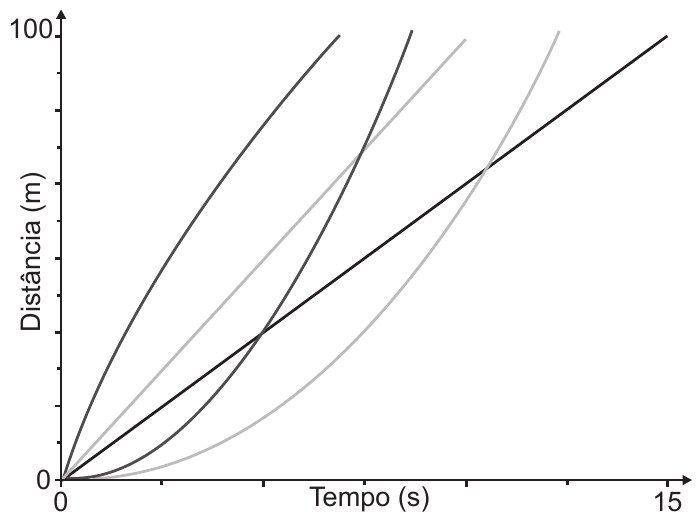
In a speed competition, overtaking is said to occur when a vehicle that is behind another passes in front of it, with both moving in the same direction. same sense. Consider an automobile competition between five cars in a track 100 m long, where everyone starts at the same moment and from same line. The graph shows the variation in the distance covered by each vehicle, depending on time, throughout the competition.
What is the number of overtakings, after the start of the competition, carried out by the vehicle that arrived last?
- A) 0
- B) 1
- C) 2
- D) 3
- E) 4
Resolution
On the graph, at each instant, the car that is furthest in front is the one with the highest curve (longest distance traveled).
1. Who arrived last. It’s the car that takes the longest to reach 100 m: the black straight line, which only reaches 100 m in $t = 15$ s. All others arrive earlier.
2. Overtaking on the graph. A car overtakes another when it turns, which was below, crosses that of the other and moves to up.
3. Looking at the black straight. Right after the start, it is below the two left curves (which go up quickly) and above the two curves that start slowly (those that curve upwards). After that, the black line is only crossed from bottom to topby the other curves: these are the other cars that the exceed. She never crosses any curve by climbing over it.
Therefore, the last placed driver did not overtake.
Answer: alternative A (0).
Be careful with the catch: the black straight line has two intersections with other curves, but in both cases it is the one that is passed. Count these intersections and overtaking leads to alternative C (2).
Question 140: Price of the refrigerator on the card (increases and discounts)
Statement
In a store, the promotional price for a refrigerator is R$ 1 000,00 for payment in cash only. Its regular price, outside of the promotion, is 10% higher. For payments made with the store’s credit card, a discount of 2% is given over the normal price.
A customer decided to buy this refrigerator, choosing to pay by card store credit. She calculated that the amount to be paid would be the price promotional plus 8%. When informed by the store of the amount to be paid, according to your choice, you noticed a difference between your calculation and the value you was presented.
The value presented by the store, compared to the value calculated by the customer, was
- A) R$ 2,00 smaller.
- B) R$ 100,00 smaller.
- C) R$ 200,00 smaller.
- D) R$ 42,00 greater.
- E) R$ 80,00 greater.
Resolution
1. Regular price. 10% more than the promotional price:
$$1000 \cdot 1{,}10 = 1100$$2. Store value (card). 2% discount on the normal price:
$$1100 \cdot 0{,}98 = 1078$$3. Value calculated by the client. She added the percentages (+10% − 2% = +8%) and applied to the promotional price:
$$1000 \cdot 1{,}08 = 1080$$4. Comparison. $1078 - 1080 = -2$: the store value is R$ 2,00 lower.
The customer made a mistake because percentage increases and discounts don’t add up: they multiply, $1{,}10 \cdot 0{,}98 = 1{,}078$, which is an increase of 7,8%, and not from 8%.
Answer: alternative A (R$ 2,00 smaller).
To review, see Increases and Discounts.
Question 141: Describing a route with E, F and D
Statement
A person needs to travel by car from point P to point Q, indicated in the figure, in which the vertical and horizontal lines symbolize streets.
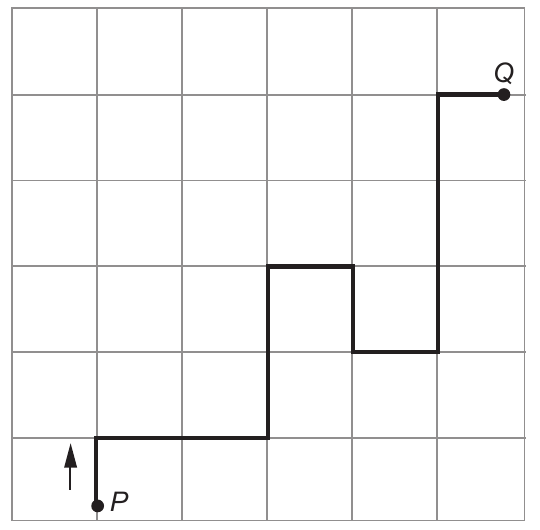
Because of the direction of traffic on these streets, the highlighted polygonal path is the shorter possibility of making this journey. To describe it, the direction to be taken at each street intersection must be specified, in relative to the direction of travel of the car, which will move continuously. To do this, the letters E, F and D are used to indicate “turn to left”, “go straight” and “turn right”, respectively.
The sequence of letters that describes the highlighted polygonal path is
- A) DDEFDDEEFFD.
- B) DFEFDDDEFFD.
- C) DFEFDDEEFFD.
- D) EFDFEEDDFFE.
- E) EFDFEEEDFFE.
Resolution
The important thing is that left and right are in relation to the car, and not to the paper. A trick: when the car goes up (north) or down (south), imagine yourself inside it.
We will go through each intersection along the way, starting from P (the car leaves moving upwards, as indicated by the arrow):
| Crossing | Car coming… | Go to… | Letter |
|---|---|---|---|
| 1º | rising (north) | right of paper (east) | D |
| 2º | east | head east | F |
| 3º | east | go up (north) | E |
| 4º | rising | keeps rising | F |
| 5º | rising | east | D |
| 6º | east | descends (south) | D |
| 7º | going down (south) | east | E |
| 8º | east | go up (north) | E |
| 9º | rising | keeps rising | F |
| 10º | rising | keeps rising | F |
| 11º | rising | east, to Q | D |
The delicate point is the 7th intersection: the car is going down on paper and turns to the right of the paper. For those inside the car, facing downwards, the The right side of the paper is on your left side, so the letter is E.
String: DFEFDDEEFFD.
Answer: alternative C (DFEFDDEEFFD).
Be careful with the catch: alternative B (DFEFDDDEFFD) is what is you get when using the paper right at the 7th intersection, forgetting that the car is going down.
Question 142: Larger volume water tank (cylinder)
Statement
A store sells five models of water tanks (I, II, III, IV and V), all in the shape of a straight cylinder with a circular base. Models II, III, IV and V have the specifications of their dimensions given in relation to the dimensions of the model I, whose depth is P and base area is Ab, as follows:
- model II: twice the depth and half the base area of model I;
- model III: twice the depth and half the base radius of model I;
- model IV: half the depth and twice the area of the base of model I;
- model V: half the depth and twice the radius of the base of model I.
A person intends to buy a water tank model in this store that offers the greater volumetric capacity.
The model chosen must be the
- A) I.
- B) II.
- C) III.
- D) IV.
- E) V.
Resolution
The volume of a cylinder is base area × height. For model I, $V_I = A_b \cdot P$.
An important detail: the base area is $\pi r^2$. If the radius is multiplied by $k$, the area is multiplied by $k^2$.
1. Each model:
- II: $\;\frac{A_b}{2} \cdot 2P = A_b P = V_I$
- III: half radius ⇒ area $\frac{A_b}{4}$; $\;\frac{A_b}{4} \cdot 2P = \frac{V_I}{2}$
- IV: $\;2A_b \cdot \frac{P}{2} = V_I$
- V: folded radius ⇒ area $4A_b$; $\;4A_b \cdot \frac{P}{2} = 2V_I$
2. Comparison. Model V has twice the volume of model I, and is the largest.
Answer: alternative E (model V).
Be careful with the catch: whoever treats “double the radius” as “double the area” thinks that model V is equal to IV (same volume as I) and cannot decide. The radius enters squared into the area.
Question 143: Year of highest rental profitability
Statement
In the period from 2005 to 2013, the sales value of properties in a city increased, which resulted in an increase in rents. The graphs show the evolution of these values, for the same property, in the real estate market of that city.
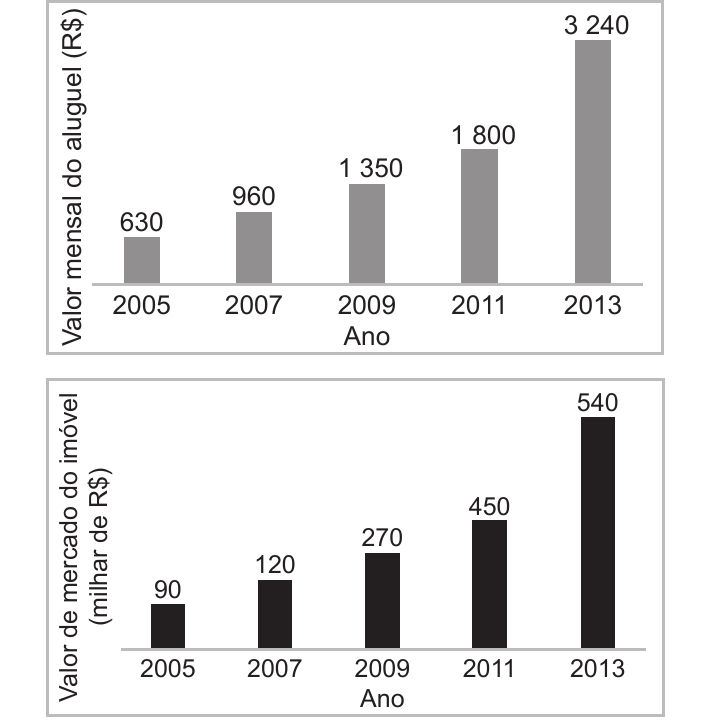
The profitability of renting a property is calculated by the ratio between the value monthly rent and the market value of that property.
Based on the data provided, in which year was the rental profitability highest?
- A) 2005
- B) 2007
- C) 2009
- D) 2011
- E) 2013
Resolution
Attention to the units: the rent is in reais and the value of the property in thousands of reais. As the same unit is valid for all years, for compare we can directly divide rent by (value in thousands), without converting:
| Year | Rent (R$) | Value (thousand R$) | Reason |
|---|---|---|---|
| 2005 | 630 | 90 | 7 |
| 2007 | 960 | 120 | 8 |
| 2009 | 1 350 | 270 | 5 |
| 2011 | 1 800 | 450 | 4 |
| 2013 | 3 240 | 540 | 6 |
(In percentage, the ratio 8 means $\frac{960}{120\thinspace 000} = 0{,}8\%$ per month.)
The biggest reason is 2007.
Answer: alternative B (2007).
Be careful with the catch: in 2013 the rent is the highest of all, but the property is also much more expensive. Profitability depends on the ratio, and not the rental value alone (alternative E).
To review, see Fees.
Question 144: Writing R$ 1,35 billion with all digits
Statement
Upon hearing the news that a recently released film grossed, in the first month release, R$ 1,35 billion in box office, a student wrote correctly the number that represents that amount, with all its digits.
The number written by the student was
- A) 135 000,00.
- B) 1 350 000,00.
- C) 13 500 000,00.
- D) 135 000 000,00.
- E) 1 350 000 000,00.
Resolution
One billion is $1\thinspace 000\thinspace 000\thinspace 000 = 10^9$ (nine zeros). Then
$$1{,}35 \text{ bilhão} = 1{,}35 \cdot 10^9 = 1\thinspace 350\thinspace 000\thinspace 000$$With the cents: 1 350 000 000,00.
Answer: alternative E (1 350 000 000,00).
Beware of the catch: alternative B (1 350 000,00) is 1,35 million, a thousand times less.
Question 145: Highway connection point (shortest route)
Statement
The government of a state intends to carry out infrastructure work to assist in the integration and flow process of agricultural production from two cities. The project consists of the direct interconnection of cities A and B with the Highway 003, for the construction of Highways 001 and 002. The two highways will be built in a straight line and must connect to Highway 003 in the same point, as shown in the figure, which also indicates the positions of cities A and B, considering the axis x positioned on the Highway 003, and five suggested locations for the connection point between three highways.
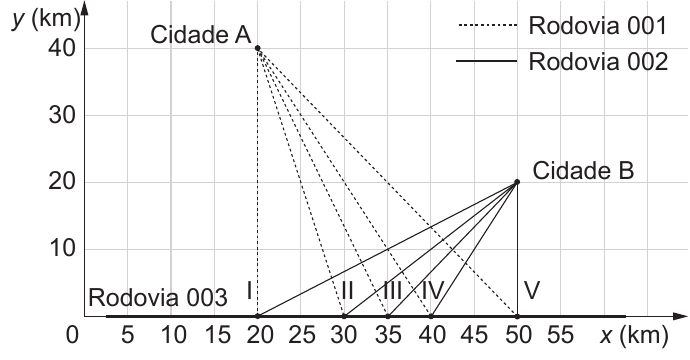
It is intended that the distance traveled between the two cities, via Highways 001 and 002, passing through the connection point, be as small as possible.
Given the project requirements, which of the suggested locations should be the chosen for the connection point?
- A) I
- B) II
- C) III
- D) IV
- E) V
Resolution
From the figure, $A = (20, 40)$ and $B = (50, 20)$, and the connection point $C = (x, 0)$ is on the x axis. We want to minimize $AC + CB$.
1. Reflection trick. Reflecting $B$ on the x axis, we obtain $B' = (50, -20)$. For any point $C$ on the axis, $CB = CB'$ (the axis is the perpendicular bisector from $BB'$). Then
$$AC + CB = AC + CB'$$and this is minimal when $A$, $C$ and $B'$ are aligned: the shortest path between two points is the straight line segment.
2. Where the segment $AB'$ cuts the axis. From $A$ to $B'$, the abscissa increases $50 - 20 = 30$ while the ordinate falls $40 - (-20) = 60$. To drop from 40 to 0 (i.e. 40 units, $\frac{2}{3}$ of total drop), the abscissa increases $\frac{2}{3} \cdot 30 = 20$:
$$x = 20 + 20 = 40$$3. Checking for similarity. The triangles formed by $A$, $C$ and the foot of $A$ on axis $(20,0)$, and by $B$, $C$ and the foot of $B$ $(50,0)$, are similar (same angle as $C$): $\frac{40}{x-20} = \frac{20}{50-x}$, which gives $2000 - 40x = 20x - 400$, i.e. $x = 40$.
Point $x = 40$ km is location IV.
Answer: alternative D (IV).
Be careful with the catch: the midpoint between the abscissa of the cities ($x = 35$, location III) seems “fair”, but it is not the least: how is A further from the highway than B, the sweet spot is closer to B.
To review, see Similarity of Triangles.
Question 146: Cheapest worker (cost comparison)
Statement
A person needs to hire a worker to do a job in their home. To do this, she posted an ad on a social network.
Five people responded stating prices per hour worked, daily expenditure with transportation and time required to complete the service, according to prices presented in the table.
| worker | Price per hour (actual) | Transport price (actual) | Time to completion (hour) |
|---|---|---|---|
| I | 120 | 0,00 | 8 |
| II | 180 | 0,00 | 6 |
| III | 170 | 20,00 | 6 |
| IV | 110 | 10,00 | 9 |
| V | 110 | 0,00 | 10 |
If the person intends to spend as little as possible on this contract, they will hire the worker
- A) I.
- B) II.
- C) III.
- D) IV.
- E) V.
Resolution
1. Cost of working hours(price per hour × time):
| worker | Hours | Transport | Minimum cost |
|---|---|---|---|
| I | $120 \cdot 8 = 960$ | 0 | 960 |
| II | $180 \cdot 6 = 1080$ | 0 | 1 080 |
| III | $170 \cdot 6 = 1020$ | 20 per day | 1 040 or more |
| IV | $110 \cdot 9 = 990$ | 10 per day | 1 000 or more |
| V | $110 \cdot 10 = 1100$ | 0 | 1 100 |
2. Comparison. Transportation is a daily expense, and the table does not say in how many days the service will be done. But that doesn’t matter: the worker I doesn’t charges for transportation and his hours (R$ 960,00) are already cheaper than hours from anyone else. Any transport would only increase the cost of the others.
Answer: alternative A (worker I, R$ 960,00).
Be careful with the catch: just look at the lowest price per hour (R$ 110,00, workers IV and V) is misleading: they take longer, and the total is higher.
Question 147: Bigger sweets (sphere volume)
Statement
A cook produces special sweets to order. Using a base recipe of dough, she prepares a portion, with which she produces 50 massive sweets of spherical shape, with 2 cm in diameter. A customer orders 150 these sweets, but ask that each one be spherical in shape with 4 cm in diameter. A The cook intends to prepare the exact number of portions of the base pasta recipe necessary to produce the sweets for this order.
How many portions of the base dough recipe should she prepare to meet this customer?
- A) 2
- B) 3
- C) 6
- D) 12
- E) 24
Resolution
1. How much does the volume grow. The volume of the sphere is $V = \frac{4}{3}\pi r^3$: it is proportional to the cube of the radius. Doubling the diameter (from 2 cm to 4 cm), the radius doubles and the volume is multiplied by $2^3 = 8$.
In other words, a large sweet uses the mass of 8 small sweets.
2. Order dough, in “small sweets”:
$$150 \cdot 8 = 1200$$3. Portions. Each portion yields 50 small sweets:
$$\frac{1200}{50} = 24$$Answer: alternative E (24 portions).
Be careful with the trick: finding that twice the diameter gives twice the volume leads to $\frac{150 \cdot 2}{50} = 6$ (option C). Use the square (factor 4) leads to 12 (alternative D).
Question 148: Chocolate in a cone with smaller volume 19%
Statement
A company produces and sells a solid, cone-shaped type of chocolate straight circular with base diameter and height measurements equal to 8 cm and 10 cm, respectively, as shown in the figure.
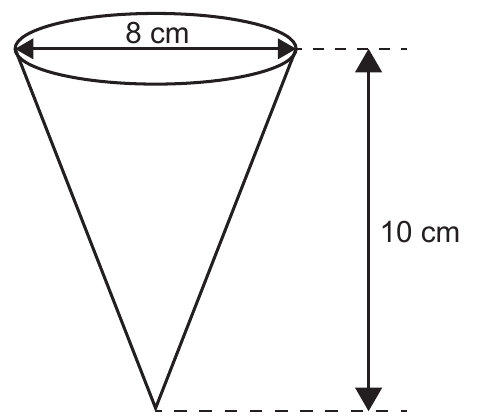
Due to an increase in the price of the ingredients used in the production of this chocolate, the company decides to produce the same type of chocolate with a volume 19% smaller, in the same shape as a straight circular cone with a height of 10 cm.
To achieve this, the company will produce these new chocolates measuring the radius of the base, in centimeters, equal to
- A) 1,52.
- B) 3,24.
- C) 3,60.
- D) 6,48.
- E) 7,20.
Resolution
The volume of the cone is $V = \frac{1}{3}\pi r^2 h$. The original radius is half the diameter: $r = 4$ cm.
1. New volume. 19% smaller means 81% of original: $V' = 0{,}81 \cdot V$. Writing both volumes with the same height ($h = 10$):
$$\frac{1}{3}\pi r'^2 \cdot 10 = 0{,}81 \cdot \frac{1}{3}\pi \cdot 4^2 \cdot 10$$2. Simply put. Everything that is the same on both sides cancels out:
$$r'^2 = 0{,}81 \cdot 16 \quad\Rightarrow\quad r' = 0{,}9 \cdot 4 = 3{,}6$$Answer: alternative C (3,60 cm).
Be careful with the catch: the volume depends on $r^2$, so the radius does not decreases 19%. Whoever does $4 \cdot 0{,}81 = 3{,}24$ selects alternative B. And whoever uses the diameter 8 as if it were a radius arrives at 7,20 (alternative E) or 6,48 (option D).
Question 149: Job vacancies drop by 75%
Statement
In January 2013, 1 794 272 admissions and 1 765 372 were declared. dismissals in Brazil, that is, 28 900 job vacancies were created, according to data from the General Register of Employed and Unemployed Persons (Caged), released by the Ministry of Labor and Employment (MTE). According to Caged, the The number of vacancies created in January 2013 suffered a drop of 75%, when compared to the same period of 2012.
Available at: http://portal.mte.gov.br. Accessed at: 23 Feb. 2013 (adapted).
According to the information given, the number of vacancies created in January 2012 was
- A) 16 514.
- B) 86 700.
- C) 115 600.
- D) 441 343.
- E) 448 568.
Resolution
Let $x$ be the number of vacancies in January of 2012. A drop of 75% leaves $100\% - 75\% = 25\%$ from the original value:
$$0{,}25 \cdot x = 28\thinspace 900 \quad\Rightarrow\quad x = \frac{28\thinspace 900}{0{,}25} = 4 \cdot 28\thinspace 900 = 115\thinspace 600$$Answer: alternative C (115 600).
Be careful with the catch: the 75% were calculated on the value of 2012, which is the unknown. Therefore, there is no point in adding 75% to the value of 2013. Alternative B (86 700 $= 3 \cdot 28\thinspace 900$) is just the size of the drop, and not the total of 2012.
To review, see Percentage Basics.
Question 150: Apartments with sun in the morning (combinations)
Statement
A building, with 9 floors and 8 apartments with 2 rooms per floor, has all your apartments for sale. Apartments are identified by numbers formed by two digits, with the ten indicating the floor where the finds the apartment, and the unit, a digit from 1 to 8, which differentiates the apartments on the same floor. Regarding the incidence of sun in the rooms of these apartments, the following characteristics can be seen, depending on their identification numbers:
- in those that end in 1 or 2, both rooms receive sun only in the part of the morning;
- in those that end in 3, 4, 5 or 6, only one of the rooms receives sun in the part of the morning;
- in those that end in 7 or 8, both rooms receive sun only in the part of the afternoon.
A person intends to buy 2 of these apartments on the same floor, but wants that, in both, at least one of the rooms receives sun in the morning.
In how many different ways can this person choose 2 from these apartments for purchase under the desired conditions?
- A) $9 \times \dfrac{6!}{(6-2)!}$
- B) $9 \times \dfrac{6!}{(6-2)! \times 2!}$
- C) $9 \times \dfrac{4!}{(4-2)! \times 2!}$
- D) $9 \times \dfrac{2!}{(2-2)! \times 2!}$
- E) $9 \times \left(\dfrac{8!}{(8-2)! \times 2!} - 1\right)$
Resolution
1. Apartments that serve, on each floor. At least one room with sun in the morning: finals 1 and 2 (the two quarters) and finals 3, 4, 5 and 6 (one quarter). There are 6 apartments per floor. The endings 7 and 8 are not useful.
2. Choose 2 on the same floor. The order does not matter (buying 31 and 35 is the same as buying 35 and 31), then it is a combination of 6 elements taken 2 to 2:
$$C_{6,2} = \frac{6!}{(6-2)! \cdot 2!} = 15$$3. Choose the floor. There are 9 floors, and the two apartments must be on the same floor. By the multiplicative principle:
$$9 \times \frac{6!}{(6-2)! \times 2!} = 9 \cdot 15 = 135$$Answer: alternative B.
Beware of the catch: alternative A is the arrangement $\frac{6!}{(6-2)!}$, which counts each pair twice (considers the order). THE alternative C uses only the 4 apartments from the ends 3 to 6, forgetting that the of ends 1 and 2 also receive sun in the morning.