
Euler's Eyes
2026-11-04
EJU 2017 (1st session) – Mathematics Course 1 solved
Source: JASSO – Mathematics paper in English, in Japanese and official answer key. Files on the page for the 1st session of 2017.
Course 1 is the basic mathematics paper of the EJU. Each letter $\boxed{\text{A}}$, $\boxed{\text{B}}$, … is a digit from 0 to 9 or the minus sign; in some blanks the answer is the number of a choice. The statements below are summarized from the official English version.
Answer key
| Question | Topic | Answers |
|---|---|---|
| I Q1 | Translation and reflection | A=3, BC=12, DE=14, F=2, G=8, H=3, I=2, J=6, K=1, L=1, M=5 |
| I Q2 | Colored cards | NO=90, PQ=12, RS=33, T=4, UV=15, WX=13, YZ=30 |
| II Q1 | Absolute values and a line | A=3, B=2, C=9, D=6, E=3, F=2, G=9, HI=−3, JK=−1, L=2 |
| II Q2 | Two squares | M=8, N=4, O=4, P=3, QR=28, ST=10, UV=16, W=2, X=6 |
| III | $x^2 - y^2 = n$ | A=3, B=1, C=3, D=0, E=5, F=4, G=7, H=4, I=8, J=8, K=2, L=1, M=1, N=2, O=1, P=2, Q=1, R=1 |
| IV | Circle inscribed in a rhombus | A=4, B=8, C=1, D=0, E=5, F=8 |
Question I
Q1: translation and reflection of parabolas
Statement. Consider $y = 3x^2 - 6$.
- Translating the graph, we obtain a parabola through $(1, 5)$ and $(4, 14)$: $y = \boxed{\text{A}}\,x^2 - \boxed{\text{BC}}\,x + \boxed{\text{DE}}$ ①. It is the translation of $y = 3x^2 - 6$ by $\boxed{\text{F}}$ in the $x$ direction and $\boxed{\text{G}}$ in the $y$ direction.
- The reflection of $y = 3x^2 - 6$ in the line $y = c$ is $y = -\boxed{\text{H}}\,x^2 + \boxed{\text{I}}\,c + \boxed{\text{J}}$ ②. When ① and ② have exactly one common point, $c = \boxed{\text{K}}$ and the point is $\left(\boxed{\text{L}}, \boxed{\text{M}}\right)$.
Solution.
1. A translation keeps the coefficient $3$: $y = 3x^2 + bx + c$. From the points: $3 + b + c = 5$ and $48 + 4b + c = 14$. Subtracting, $45 + 3b = 9$, $b = -12$, and $c = 14$. Since $3x^2 - 12x + 14 = 3(x - 2)^2 + 2$, the vertex moved from $(0, -6)$ to $(2, 2)$: $2$ in $x$ and $8$ in $y$.
2. Reflecting in $y = c$ replaces $y$ by $2c - y$: $y = 2c - (3x^2 - 6) = -3x^2 + 2c + 6$. Setting it equal to ①: $6x^2 - 12x + 8 - 2c = 0$, with a double root when $\frac{\Delta}{4} = 36 - 6(8 - 2c) = 12c - 12 = 0$, that is, $c = 1$. The root is $x = 1$, and $y = 3 - 12 + 14 = 5$.
Answers: A=3, BC=12, DE=14, F=2, G=8, H=3, I=2, J=6, K=1, L=1, M=5.
Q2: colored cards
Statement. There are four white cards, three red and three black, each with a different number.
- Choose two of the ten cards and put one in box A and the other in box B. There are $\boxed{\text{NO}}$ ways.
- There are $\boxed{\text{PQ}}$ ways to choose two cards of the same color and $\boxed{\text{RS}}$ to choose two of different colors.
Now draw one card from the box and, without replacing it, a second.
- The probability that both have the same color is $\dfrac{\boxed{\text{T}}}{\boxed{\text{UV}}}$.
- The probability that the first is white or red and the second red or black is $\dfrac{\boxed{\text{WX}}}{\boxed{\text{YZ}}}$.
Solution.
-
Ordered choices: $10\cdot9 = 90$.
-
Same color: $\binom42 + \binom32 + \binom32 = 6 + 3 + 3 = 12$. Different colors: $\binom{10}{2} - 12 = 45 - 12 = 33$.
-
$\frac{12}{45} = \frac{4}{15}$.
-
Splitting by the color of the first:
- white ($\frac{4}{10}$), then red or black ($\frac69$): $\frac{24}{90}$;
- red ($\frac{3}{10}$), then red or black among the remaining 9 ($2 + 3 = 5$): $\frac{15}{90}$.
Total $\frac{39}{90} = \frac{13}{30}$.
Answers: NO=90, PQ=12, RS=33, T=4, UV=15, WX=13, YZ=30.
Question II
Q1: an equation with absolute values and a line
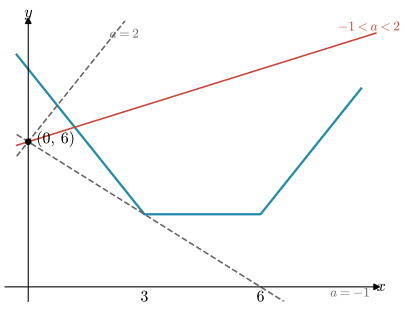
Statement. Consider real $a$ and $b$ such that the equation $|x - 3| + |x - 6| = ax + b$ ① has a solution. Let $y = |x - 3| + |x - 6|$. Without absolute values: if $x < \boxed{\text{A}}$, $y = -\boxed{\text{B}}\,x + \boxed{\text{C}}$; if $\boxed{\text{A}} \le x < \boxed{\text{D}}$, $y = \boxed{\text{E}}$; if $\boxed{\text{D}} \le x$, $y = \boxed{\text{F}}\,x - \boxed{\text{G}}$. Looking at the common points of the graph and the line $y = ax + b$:
- if $a = 1$, ① has a solution when $b \ge \boxed{\text{HI}}$;
- if $b = 6$, ① has two distinct solutions when $\boxed{\text{JK}} < a < \boxed{\text{L}}$.
Solution.
1. The graph. $y = -2x + 9$ for $x < 3$, $y = 3$ on $[3, 6)$ and $y = 2x - 9$ for $x \ge 6$: a “V” with a flat bottom at height 3.
2. $a = 1$. The equation is $y - x = b$. The function $y - x$ equals $-3x + 9$, $3 - x$ and $x - 9$ on the three pieces: it decreases until $x = 6$ (value $-3$) and increases afterwards. So it takes every value $\ge -3$: $b \ge -3$.
3. $b = 6$. The lines pass through $(0, 6)$, which lies below the graph ($y(0) = 9$).
- For $-1 < a < 2$: at $x = 3$, the line equals $3a + 6 > 3$, above the graph; so it crosses the left branch between $0$ and $3$. On the right, the line has slope less than 2 and the graph eventually passes above it: a second crossing. Two solutions.
- $a = -1$: the line $y = -x + 6$ only touches the graph at $(3, 3)$.
- $a \ge 2$: on the right the line is never reached; only the left crossing.
- $a < -1$: there is at most one crossing (with $x < 0$ when $a < -2$).
Hence $-1 < a < 2$.
Answers: A=3, B=2, C=9, D=6, E=3, F=2, G=9, HI=−3, JK=−1, L=2.
Q2: two squares
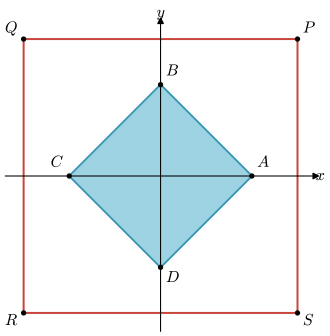
Statement. The squares $ABCD$ and $PQRS$ have vertices $A(2t, 0)$, $B(0, 2t)$, $C(-2t, 0)$, $D(0, -2t)$ and $P(4 - t^2, 4 - t^2)$, $Q(-4 + t^2, 4 - t^2)$, $R(-4 + t^2, -4 + t^2)$, $S(4 - t^2, -4 + t^2)$, with $0 < t < 2$. Let $S_1$ and $S_2$ be their areas. Then $S_1 = \boxed{\text{M}}\,t^2$ and $S_2 = \boxed{\text{N}}\left(t^2 - \boxed{\text{O}}\right)^2$.
- $S_1 + S_2$ is smallest at $t = \sqrt{\boxed{\text{P}}}$, with value $\boxed{\text{QR}}$.
- Choose $\boxed{\text{W}}$ and $\boxed{\text{X}}$ from ⓪ $t^2 < 4$ or $6 < t^2$, ① $4 < t^2 < 6$, ② $t^2 < 2$ or $8 < t^2$, ③ $2 < t^2 < 8$, ④ $t^2 \ne 4$, ⑤ $0 < t < 2$, ⑥ $0 < t < \sqrt2$, ⑦ $\sqrt2 < t < 2$, ⑧ $2 < t < \sqrt6$, ⑨ $t \ne 2$. If $S_1 < S_2$, then $t^4 - \boxed{\text{ST}}\,t^2 + \boxed{\text{UV}} > 0$, which gives the condition $\boxed{\text{W}}$ on $t^2$. Hence $S_1 < S_2$ if and only if $\boxed{\text{X}}$.
Solution.
1. The areas. $ABCD$ has diagonals of length $4t$: $S_1 = \frac{(4t)^2}{2} = 8t^2$. $PQRS$ has side $2(4 - t^2)$: $S_2 = 4(t^2 - 4)^2$.
2. The sum. $S_1 + S_2 = 4t^4 - 24t^2 + 64 = 4(t^2 - 3)^2 + 28$, smallest at $t = \sqrt3$ (inside $(0, 2)$), with value $28$.
3. The inequality. $8t^2 < 4(t^2 - 4)^2$ gives $t^4 - 10t^2 + 16 > 0$, or $(t^2 - 2)(t^2 - 8) > 0$: $t^2 < 2$ or $t^2 > 8$ (②). With $0 < t < 2$, what remains is $0 < t < \sqrt2$ (⑥).
Answers: M=8, N=4, O=4, P=3, QR=28, ST=10, UV=16, W=2, X=6.
Question III: the equation x² − y² = n
Statement. Let $n$ be a positive integer and $x, y$ non-negative integers. We study the solutions of $x^2 - y^2 = n$ ①, or $(x + y)(x - y) = n$ ②.
-
If $n = 8$, $(x, y) = (\boxed{\text{A}}, \boxed{\text{B}})$. If $n = 9$, $(x, y) = (\boxed{\text{C}}, \boxed{\text{D}}), (\boxed{\text{E}}, \boxed{\text{F}})$, with $\boxed{\text{C}} < \boxed{\text{E}}$.
-
Choose $\boxed{\text{G}}$ to $\boxed{\text{R}}$ from ⓪ $0$, ① $1$, ② $2$, ③ $3$, ④ $4$, ⑤ $5$, ⑥ $6$, ⑦ even, ⑧ odd, ⑨ prime. We prove that ③ below is a necessary and sufficient condition for ① to have a solution.
If $x$ and $y$ are both even or both odd, $x + y$ and $x - y$ are $\boxed{\text{G}}$, and by ② $n$ is a multiple of $\boxed{\text{H}}$. If one is even and the other odd, $x + y$ and $x - y$ are $\boxed{\text{I}}$, and $n$ is $\boxed{\text{J}}$. So “$n$ is a multiple of $\boxed{\text{H}}$ or $n$ is $\boxed{\text{J}}$” ③ is necessary.
Conversely, if $n = \boxed{\text{H}}\,k$, taking $x + y = \boxed{\text{K}}\,k$ and $x - y = 2$ gives $(x, y) = (k + \boxed{\text{L}}, k - \boxed{\text{M}})$. If $n$ is $\boxed{\text{J}}$, $n = \boxed{\text{N}}\,\ell + \boxed{\text{O}}$ ($\ell \ge 0$ an integer); taking $x + y = \boxed{\text{P}}\,\ell + \boxed{\text{Q}}$ and $x - y = 1$ gives $(x, y) = (\ell + \boxed{\text{R}}, \ell)$. Hence ③ is necessary and sufficient.
Solution.
1. $x + y$ and $x - y$ have the same parity (they differ by $2y$), and $x + y \ge x - y$.
- $n = 8$: the only factor pair of equal parity is $4\cdot2$, so $x + y = 4$, $x - y = 2$: $(3, 1)$.
- $n = 9$: $9\cdot1$ gives $(5, 4)$ and $3\cdot3$ gives $(3, 0)$.
2. Necessity. If $x$ and $y$ have the same parity, both factors are even and $n$ is a multiple of 4. If they have different parities, both factors are odd and $n$ is odd. So $n$ is never of the form $4k + 2$.
3. Sufficiency. If $n = 4k$: $x + y = 2k$, $x - y = 2$ give $x = k + 1$ and $y = k - 1 \ge 0$. If $n = 2\ell + 1$: $x + y = 2\ell + 1$, $x - y = 1$ give $x = \ell + 1$ and $y = \ell$. (This is the identity $(\ell + 1)^2 - \ell^2 = 2\ell + 1$: every odd number is a difference of consecutive squares.)
Answers: A=3, B=1, C=3, D=0, E=5, F=4, G=7, H=4, I=8, J=8, K=2, L=1, M=1, N=2, O=1, P=2, Q=1, R=1.
Question IV: the circle inscribed in a rhombus
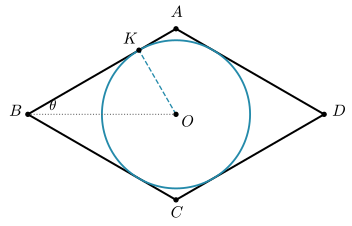
Statement. The rhombus $ABCD$ has side $a$ (a constant). Let $r$ be the radius of the inscribed circle $O$, tangent to the sides at $K$, $L$, $M$ and $N$, and $S$ the area of the part of the rhombus outside the circle. We want the possible values of $r$ and the largest value of $S$.
- Choose $\boxed{\text{A}}$ to $\boxed{\text{C}}$ from ⓪ $a$, ① $\frac a2$, ② $\frac a3$, ③ $a\sin\theta$, ④ $a\cos\theta$, ⑤ $a\tan\theta$, ⑥ $a\sin^2\theta$, ⑦ $a\cos^2\theta$, ⑧ $a\sin\theta\cos\theta$, ⑨ $a\tan^2\theta$. With $\angle ABO = \theta$, $OB = \boxed{\text{A}}$ and $OK = \boxed{\text{B}}$. Since $(\cos\theta - \sin\theta)^2 \ge 0$, $0 < r \le \boxed{\text{C}}$ ①.
- Choose $\boxed{\text{D}}$ to $\boxed{\text{F}}$ from ⓪ $2ar - \pi r^2$, ① $ar - \frac\pi2r^2$, ② $\frac a2r - \pi r^2$, ③ $\frac{ar - \pi r^2}{2}$, ④ $\frac{2a}{\pi}$, ⑤ $\frac a\pi$, ⑥ $\frac{a}{2\pi}$, ⑦ $\frac{4a^2}{\pi}$, ⑧ $\frac{a^2}{\pi}$, ⑨ $\frac{a^2}{4\pi}$. In terms of $r$, $S = \boxed{\text{D}}$. When $r = \boxed{\text{E}}$, $\boxed{\text{D}}$ is largest, and this $r$ satisfies ①. So at $r = \boxed{\text{E}}$, $S$ takes its maximum $\boxed{\text{F}}$.
Solution.
1. The diagonals of a rhombus are perpendicular and meet at $O$. In triangle $ABO$, right-angled at $O$: $OB = a\cos\theta$ (④). $OK$ is the altitude to the hypotenuse $AB$ (the radius is perpendicular to the side): $OK = OB\sin\theta = a\sin\theta\cos\theta$ (⑧). Since $2\sin\theta\cos\theta \le \sin^2\theta + \cos^2\theta = 1$, $r \le \frac a2$ (①), with equality for the square ($\theta = 45^\circ$).
2. The area of the rhombus is $\frac12\cdot\text{perimeter}\cdot r = \frac12\cdot4a\cdot r = 2ar$ (four triangles with vertex $O$ and height $r$). So $S = 2ar - \pi r^2$ (⓪), a parabola in $r$ with vertex $r = \frac a\pi$ (⑤). Since $\frac a\pi < \frac a2$, the vertex is in the interval, and $S_{\max} = \frac{2a^2}{\pi} - \frac{a^2}{\pi} = \frac{a^2}{\pi}$ (⑧).
Answers: A=4, B=8, C=1, D=0, E=5, F=8.