
Euler's Eyes
2022-08-12
Rule of 3
The rule of three is widely used by chemists for stoichiometric calculations. This rule is taught in elementary school and was used by Galileo in his work Variar Opera Mathematica of 1679.
Help us build the math website. Donate as much as you can.

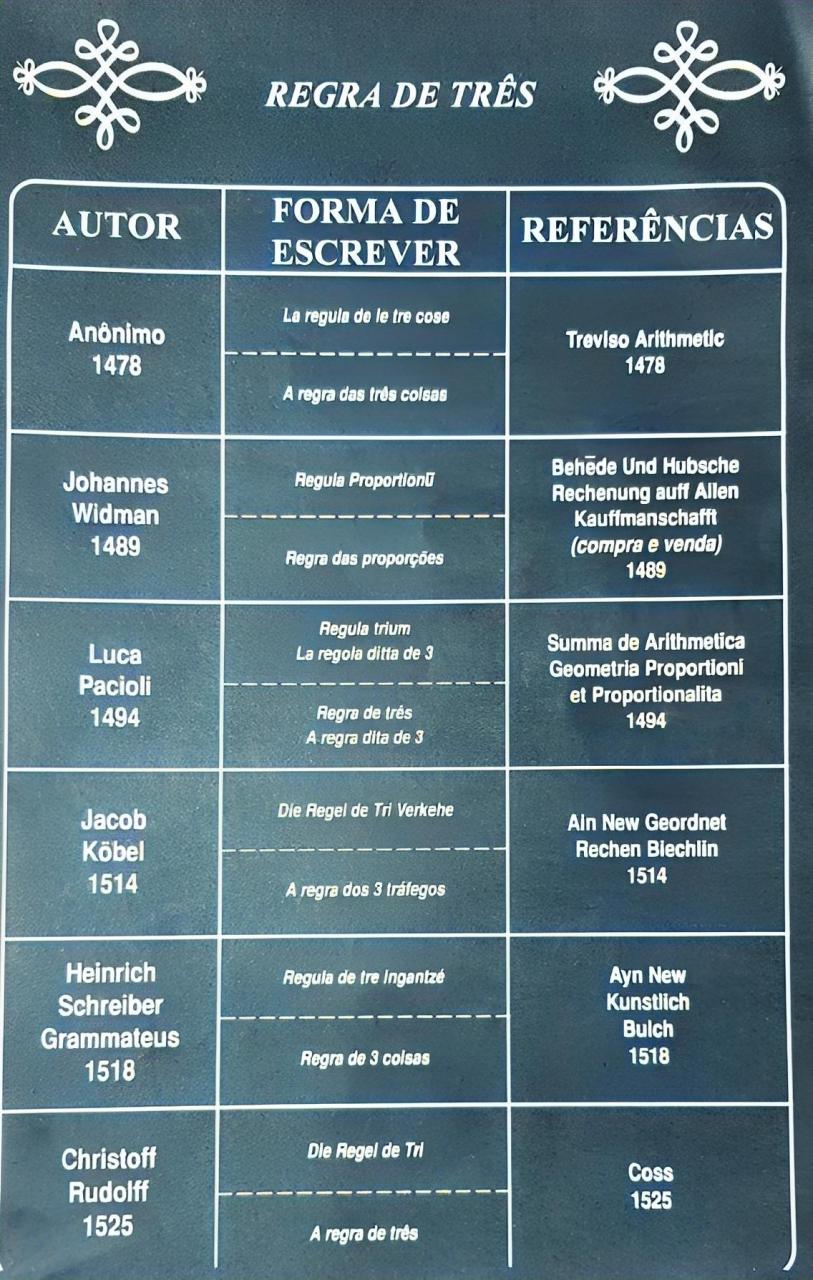
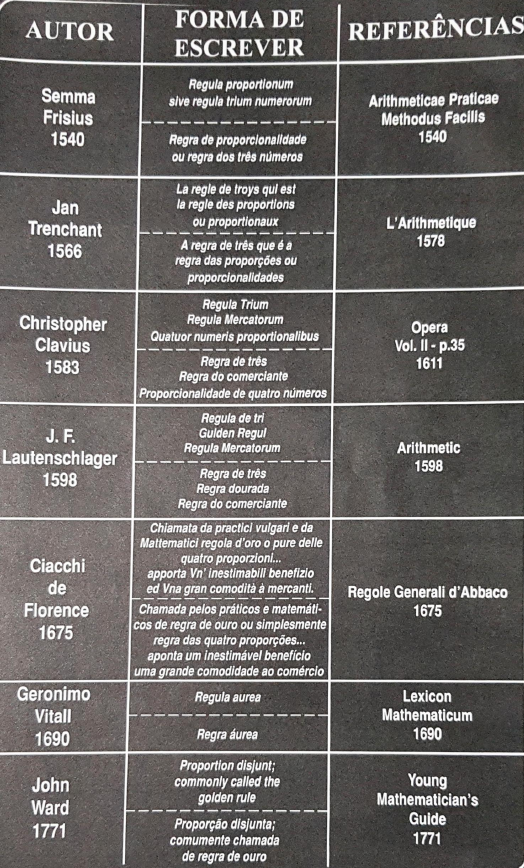
Below are some historical fragments about the rule of three:
| Rule of Three Chronology | Continuation |
|---|---|
|
|
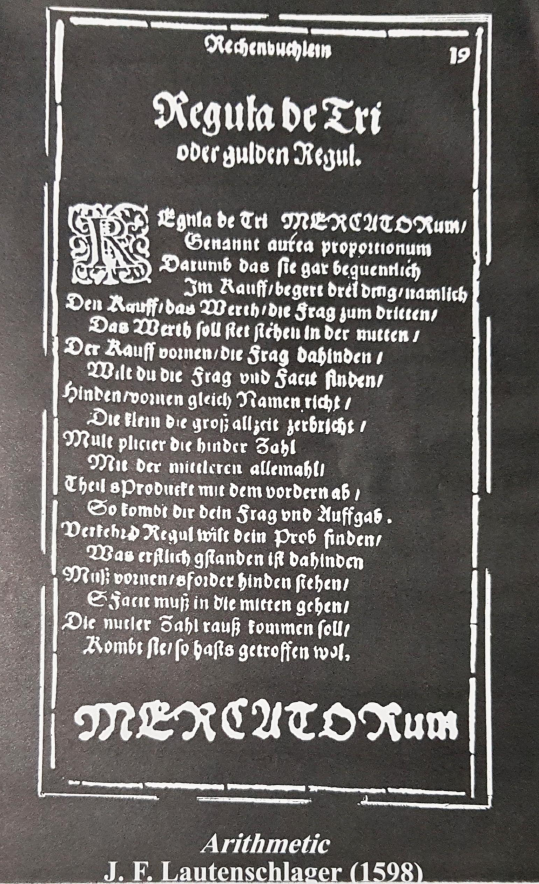
The author who perpetuated the use of the rule of three was J. F. Lautenschlager and today its use is enormous in entrance exams and in practice in various professions.
Rule of 3
Magnitude is a very important definition that is used worldwide by the International System of Units (SI). Without the International System of Units, it is not possible to have commercial exchanges, consequently globalization. For example, without this magnitude convention, a car headlight produced in Germany cannot be sold in Brazil for assembly in cars here, as it will not fit into a car assembled in another country.
In the previous post we talked a lot about proportions and proportionality ratios. Many books and references talk about directly and inversely proportional quantities, but in this post these definitions will come naturally. Before we continue with the rule of three, let’s explain how $x$ came about as an unknown (question) .
The bottom line
The origins of the morphology of a variable x, which originated from a lexical paranomasia (word similarity) syntactic and semantic phonos of that letter.
This letter has origins from the linguistic metaphorical plane and was heavily used in mathematics.
First Reason
Around 166 algebra authors spelled terms $x_1, x_2, x_3 ...$ belonging to
$$\cancel{1}, \cancel{2}, \cancel{3}, \dots$$Mathematician, philosopher and writer Pietro Antonio Cataldi wrote $x$ in two distinct and curious ways:
- 1 cut by inclined hairline
- letter x cut by perpendicular thin line.

Second Reason
In the Low German 11th century, which gave rise to Old English 13th century, we find the word Shei transcribed by Xei, which designated something unknown, enigmatic, ignored, …, unknown.

Third Reason
In the same semantic phonetic linguistic trunk that occurred in Europe, Low German, Old English (14th century) the facts, dates or references to Jesus Christ They were written in two basic ways:
- Christmas
- ✝but

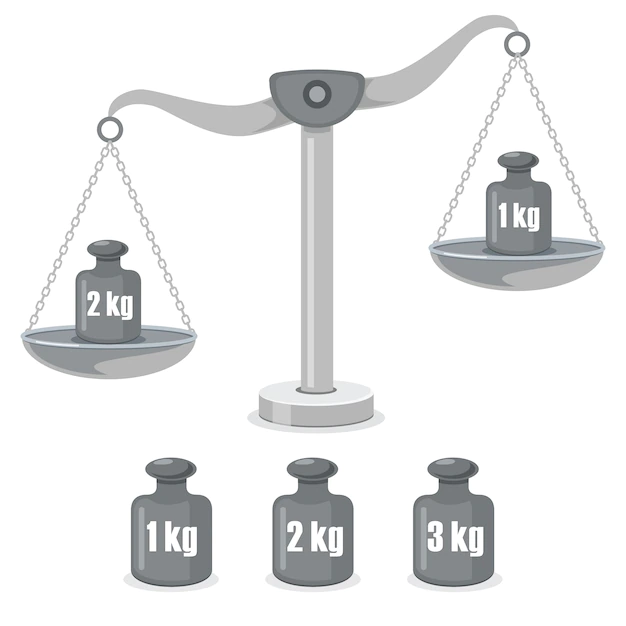
Directly proportional magnitude
For directly proportional quantities we take four values, two in each set of quantities. Let the set of quantities be $X$ and $Y,$ then:
- $x_1, x_2$ belonging to the set of quantities $X$.
- $x_1, x_2 \in X$
- $y_1, y_2$ belonging to the set of quantities $Y$.
- $y_1, y_2 \in Y$
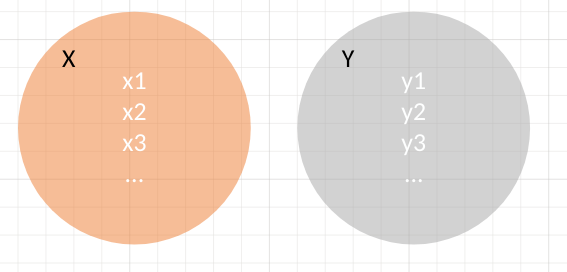
Having defined the values $x_1, x_2$ and $y_1, y_2$, belonging to the set of quantities, we obtain the reasons:
$$\dfrac{y_1}{x_1}=\dfrac{y_2}{x_2}$$This equation is what they explain at school as “cross multiplication” 😂😂😂😂 to explain the proportionality between quantities.
Example Paint Buckets
Problem: Joana has 4 buckets of blue paint, which represents a volume 120 mL. By using the same type of bucket, we want to obtain 3 buckets of orange paint. How much paint volume does 3 orange buckets represent.
Solution 1
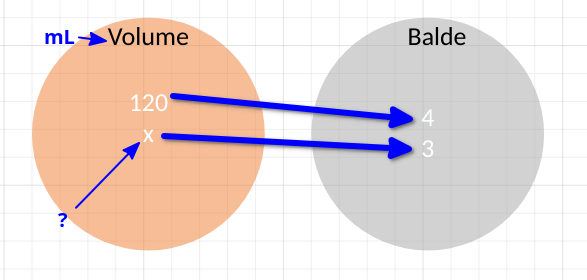 $$\dfrac{x}{120}=\dfrac{3}{4}$$
“Multiply cross” 😂😂
$$x= 120 ~.~\dfrac{3}{4}$$Just kidding, here we do not use this type of technique, but rather the scale method, that is, $\times$120 mL on both sides of the equation:
 $${\cancel{\color{red}{120 [~\text{mL}]} } } ~.~\dfrac{x~[\text{mL}] }{\cancel{120~[\text{mL}]} }={\color{red}{120 [~\text{mL}]} } ~.~\dfrac{3 ~[\cancel{\text{balde} }] }{4~[\cancel{\text{balde} }] }$$
$$x~[\text{mL}]= 120~[\text{mL}] ~.~\dfrac{3}{4}$$
$$x~[\text{mL}]= 90~[\text{mL}]$$
$$x= 90~\text{mL}$$
Solution 2
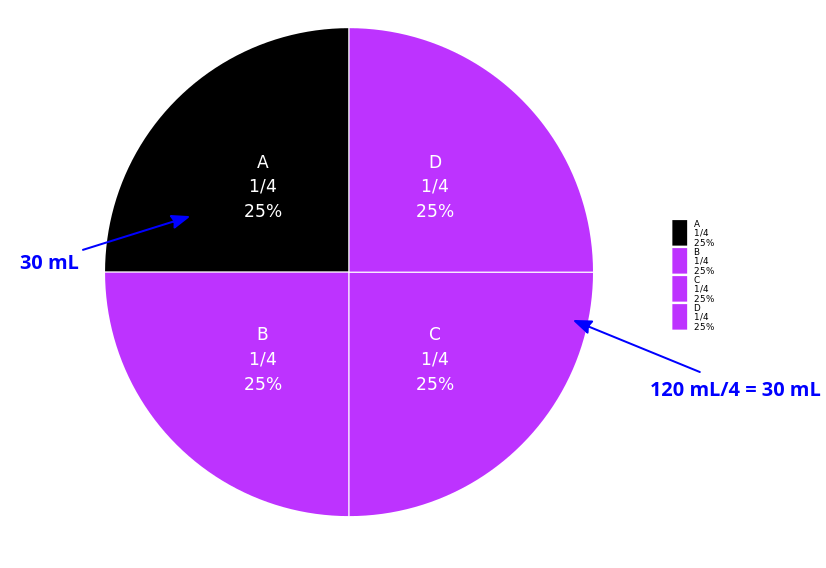
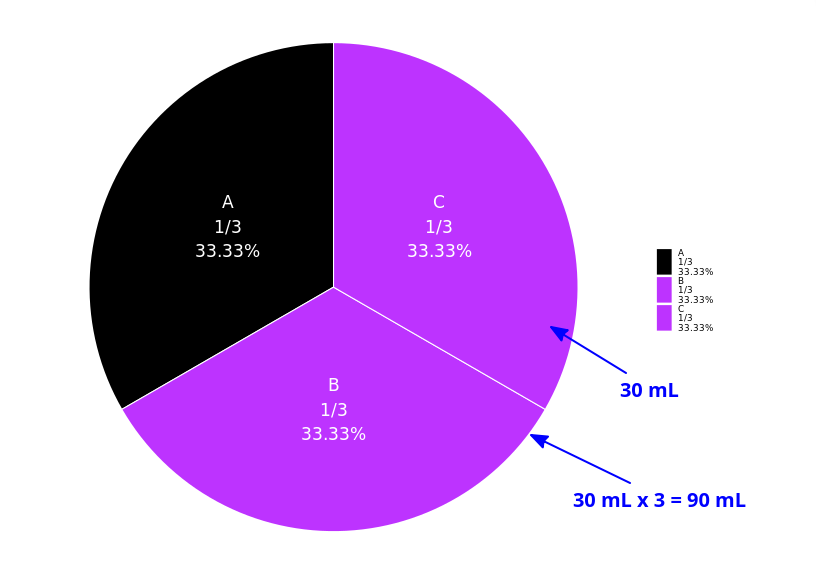
Another alternative is to solve with percentages, a topic covered in previous posts. Look at the figures:
| 4 Blue paint buckets | 3 Orange paint buckets |
|---|---|
|
|
From the left figure, we notice that each blue bucket contains 30 mL of ink $\dfrac{120~\text{mL} }{ 4 ~\text{baldes}}=30~\text{mL}$. As the buckets are proportional, each bucket also contains 30 mL of orange paint. Therefore, 3 orange paint buckets represents $30~\text{mL} \times 3~\text{baldes} =90~\text{mL}$
In this way, we finalize the concept of the rule of three, in the next post we will talk a little about rates.