
Euler's Eyes
2026-10-10
The number $e$ and compound interest
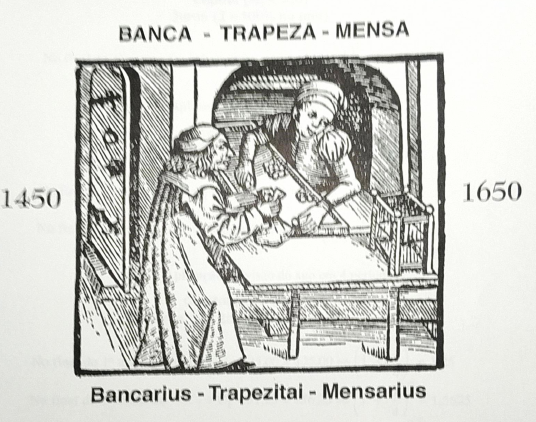
Before reaching Euler, the number $e$ passed through the banks. The vocabulary of money comes from Latin: depositum (what was put, from ponere), creditum (what was trusted, from credere, to believe) and juro (from jus, juris, the right).
Imagine R$ 100 applied to **100% per year**. If the bank pays you just once, at the end of the year, you receive R$ 200. But what if he divides the year into periods and pays interest on interest?
| Periods in the year | Rate per period | Account | At the end of the year |
|---|---|---|---|
| 1 (annual) | 100% | $(1 + \frac{1}{1})^1 = 2$ | R$ 200,00 |
| 2 (six-monthly) | 50% | $(1 + \frac{1}{2})^2 = 2{,}25$ | R$ 225,00 |
| 4 (quarterly) | 25% | $(1 + \frac{1}{4})^4 \approx 2{,}4414$ | R$ 244,14 |
| 12 (monthly) | ≈ 8,33% | $(1 + \frac{1}{12})^{12} \approx 2{,}6130$ | R$ 261,30 |
| 365 (daily) | ≈ 0,27% | $(1 + \frac{1}{365})^{365} \approx 2{,}7146$ | R$ 271,46 |
With $n$ periods, the capital $C_0$ becomes
The final value grows, but not without limit: it approaches a number that is neither an integer nor a fraction.
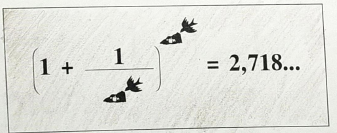
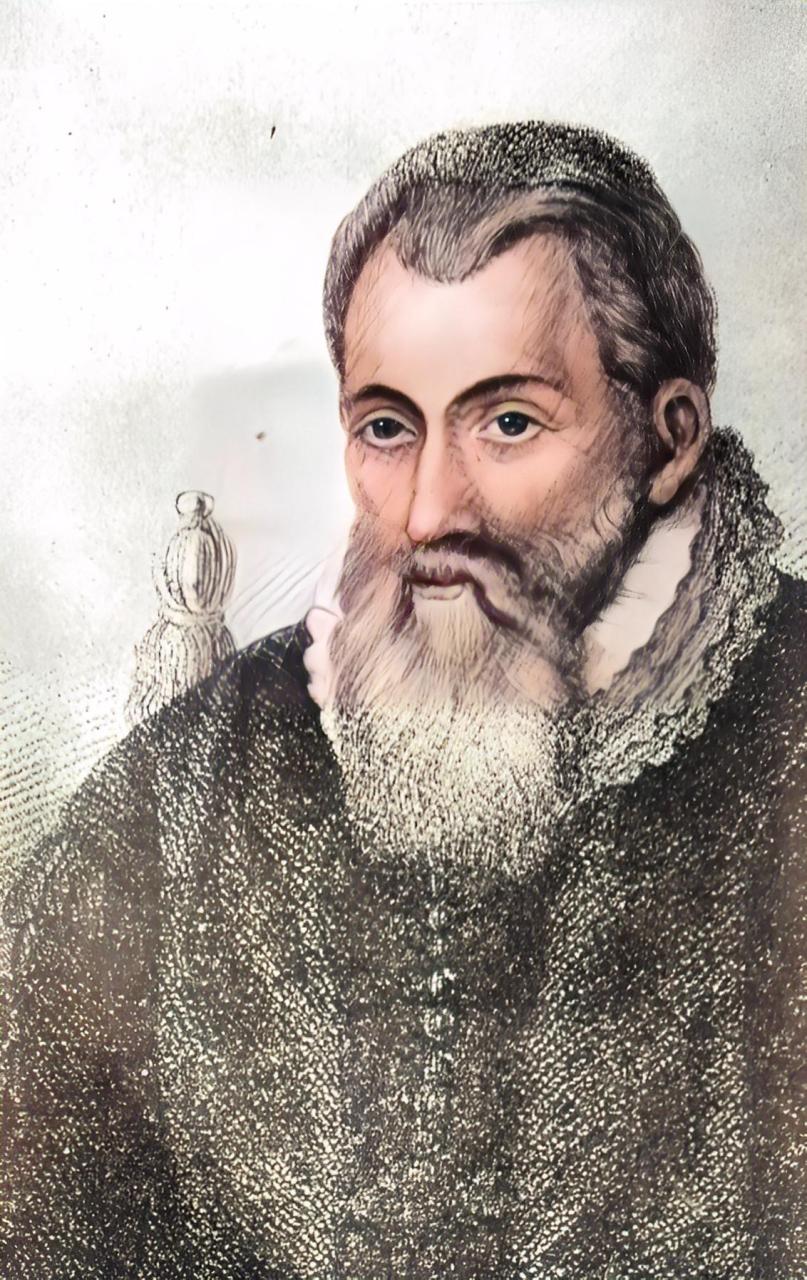
Jakob Bernoulli had already studied this limit in 1683, without giving it a name. Euler named it $e$ and showed that it is also the sum of a series:
In Introductio (1748), Euler calculated the 23 first decimal places of $e$.
Scribatur pro numero whose logarithmus is unitas, e, qui est 2,7182817… (Write e for the number whose logarithm is the unit.)
— Leonhard Euler, manuscript of 1727–1728
The path to the letter $e$:
- 1614John Napier publishes Mirifici Logarithmorum Canonis Descriptio, the first table of logarithms.
- 1618An appendix to the English translation of Napier’s work, made by Edward Wright, contains logarithms in the base that we today call $e$.
- 1647Grégoire de Saint-Vincent shows that the area under the hyperbola grows as a logarithm.
- 1668Nicolau Mercator gives the name logarithmus naturalis (natural logarithm) in Logarithmotechnia.
- 1683Jakob Bernoulli studies the limit of compound interest.
- 1727Euler uses the letter $e$ in a manuscript, published only in 1862.
- 1748In the Introductio, Euler writes $e$ as a series and calculates 23 decimal places.
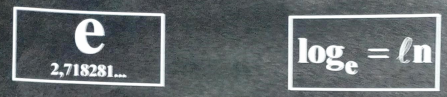
Why “natural”? Because it is the logarithm with the simplest derivative. Using the limit that defines $e$ (with $n = x/\Delta x$, which goes to infinity when $\Delta x$ goes to zero):
And then comes the most famous property of $e^x$. As $\ln(e^x) = x$, deriving both sides:
$e^x$ is the function that is equal to the derivative itself. This property is the key to the discovery 4, about the differential equations.
All topics by Leonhard Euler · ← The Basel problem · Euler’s formula and the “most beautiful equation” →