
Euler's Eyes
2026-10-14
Lagrange's legacy
Lagrange is the lofty pyramid of the mathematical sciences.
— Napoleon Bonaparte, according to his contemporaries
Lagrange left no anecdotes of precocious genius like Pascal, nor a body of work the size of Euler’s. He left something else: a way of doing mathematics. Where others drew, he calculated; where others found a trick for each problem, he looked for the rule that explained all the tricks. Almost everything he did is still in the textbooks under his name: the Euler–Lagrange equation, the Lagrangian, the Lagrange points, Lagrange’s theorem, the Lagrange remainder, Lagrange multipliers.
On Newton
Lagrange admired Newton above all others, but with a touch of envy he did not hide. His biographer Delambre recorded what he used to say:
Newton was the greatest genius who ever lived, and also the most fortunate, for a system of the world can be found only once.
— Joseph-Louis Lagrange, according to Delambre (1814)
The metre and base 10
On the commission that created the metric system, from 1790 onwards, Lagrange defended the decimal division of all measures, against those who preferred base 12, which has more divisors. It is said that, to show that the many divisors of 12 were not so important, he even suggested, half in jest, base 11, which is a prime number. The metre, the litre and the gram, all divided by 10, are also partly his work.
The polynomial through the points
In his 1795 lectures at the École Normale in Paris, Lagrange showed a formula for finding the polynomial that passes through given points. For three points $(x_0,y_0)$, $(x_1,y_1)$ and $(x_2,y_2)$, it is
$$\begin{aligned}P(x)={}&y_0\,\frac{(x-x_1)(x-x_2)}{(x_0-x_1)(x_0-x_2)}\\&+y_1\,\frac{(x-x_0)(x-x_2)}{(x_1-x_0)(x_1-x_2)}\\&+y_2\,\frac{(x-x_0)(x-x_1)}{(x_2-x_0)(x_2-x_1)}.\end{aligned}$$The idea is simple: each fraction equals $1$ at its own point and $0$ at the other two, so $P(x_0)=y_0$, $P(x_1)=y_1$ and $P(x_2)=y_2$. The Englishman Edward Waring had already published the same formula in 1779, and Euler knew it, but it kept the name Lagrange interpolation. Today it is in the numerical methods of calculators and computers, and even in a cryptographic method for splitting a secret among several people.
What remained
- Physics. The Analytical Mechanics turned mechanics into a branch of analysis. The Lagrangian $L=T-V$ is the form in which relativity, quantum mechanics and the Standard Model are still written today.
- Calculus of variations. With Euler, Lagrange created the mathematics of choosing the best curve, used from optics to rocket control.
- Astronomy. The Lagrange points host space telescopes and shelter thousands of Trojan asteroids.
- Number theory. The four-square theorem opened the way to Waring’s problem and to the study of quadratic forms, continued by Legendre and Gauss.
- Algebra. The reflections on the permutations of roots prepared the work of Ruffini, Abel and Galois and group theory.
- Analysis. The notation $f'(x)$, the word derivative, the mean value theorem and the Lagrange remainder are in every calculus course.
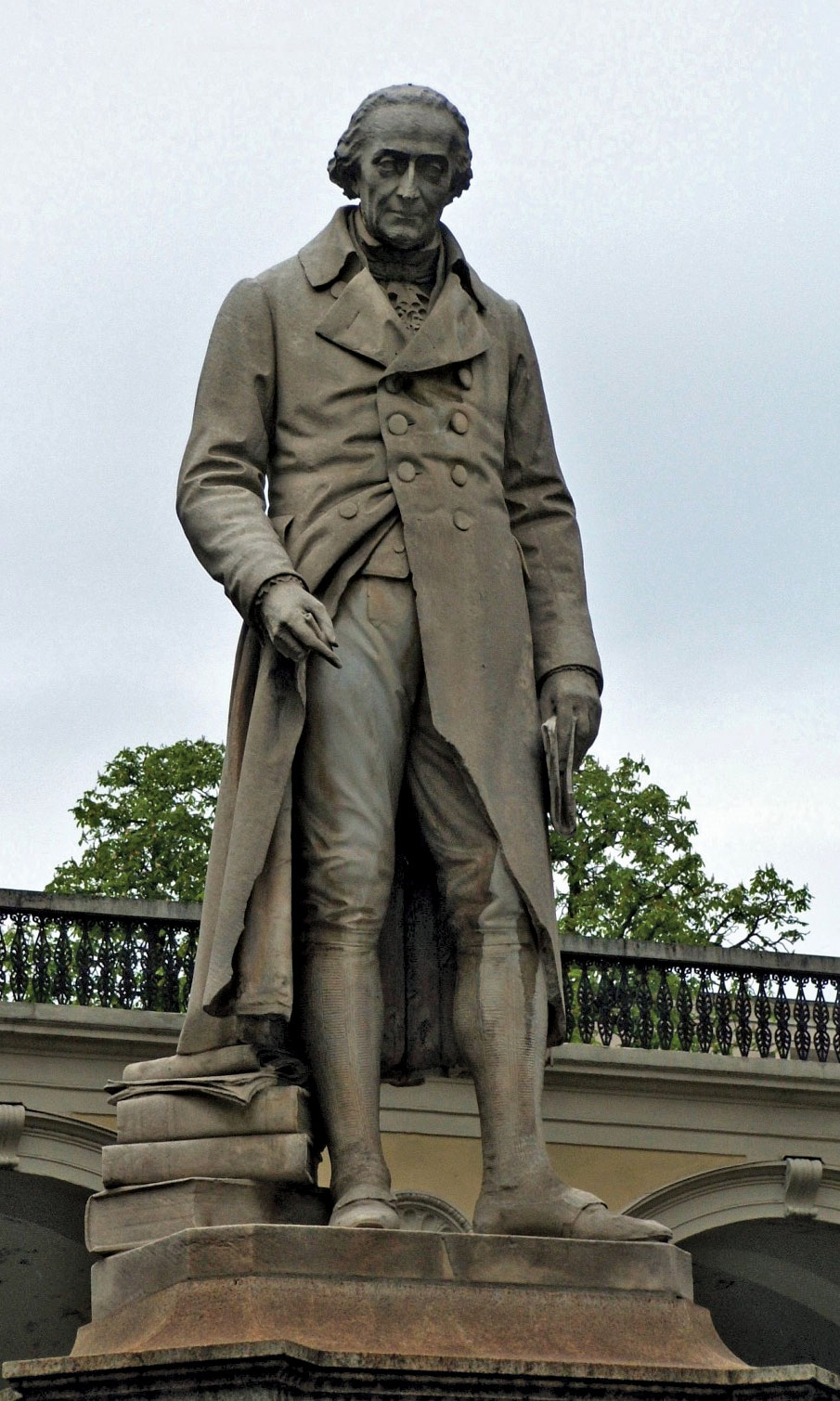
A name in many places
Lagrange is buried in the Panthéon in Paris, and his name is one of the 72 engraved on the Eiffel Tower. Turin has a square, a street and a statue of him, and Italy and France still argue over whether he was an Italian or a French mathematician. There is a crater Lagrange on the Moon, the same Moon whose libration he explained at 28, and an asteroid called 1006 Lagrangea.
To remember
- Lagrange lived from 1736 to 1813: Turin, Berlin and Paris. He became a professor at 19 and succeeded Euler in Berlin in 1766.
- The calculus of variations looks for the curve that minimises an integral. The answer satisfies the Euler–Lagrange equation.
- In Lagrange’s mechanics, everything comes from the function $L=T-V$, without figures and without constraint forces.
- The five Lagrange points are the places where a small body rotates together with two large ones. L2 of the Sun–Earth system is 1.5 million km away.
- Every positive whole number is a sum of four squares.
- The number of values an expression in $n$ letters takes, when the letters are shuffled, divides $n!$.
- $f'(x)$ is Lagrange’s notation. The mean value theorem guarantees a point where the tangent is parallel to the secant.
- To optimise under a constraint, set the derivatives of $f$ equal to $\lambda$ times those of $g$. The $\lambda$ measures what loosening the constraint is worth.
Exercise: find the polynomial through (0, 1), (1, 3) and (2, 7)
By Lagrange’s formula,
$$\begin{aligned}P(x)={}&1\cdot\frac{(x-1)(x-2)}{2}+3\cdot\frac{x(x-2)}{-1}\\&+7\cdot\frac{x(x-1)}{2}.\end{aligned}$$Expanding: $\frac{x^2-3x+2}{2}-3x^2+6x+\frac{7x^2-7x}{2}=x^2+x+1$. Check: $P(0)=1$, $P(1)=3$ and $P(2)=7$.
Exercise: how many values does x₁x₂x₃ take when four roots are shuffled?
The product of three of the four roots is determined by the root left out, so there are $4$ values: $x_1x_2x_3$, $x_1x_2x_4$, $x_1x_3x_4$ and $x_2x_3x_4$. As Lagrange’s theorem requires, 4 divides 24, and the swaps that do not change the expression number $24\div4=6$: all those that shuffle only $x_1, x_2, x_3$.
Sources: biography of Lagrange, MacTutor · Jean-Baptiste Delambre, Notice sur la vie et les ouvrages de M. le comte J.-L. Lagrange (1814) · Ken Alder, The Measure of All Things (2002).
All Lagrange topics · ← Lagrange multipliers: optimising under a constraint · Image credits →