
Euler's Eyes
2026-11-03
The legacy of Adrien-Marie Legendre
Legendre had the bad luck to work among giants. In number theory he was overtaken by Gauss; in elliptic integrals, by Abel and Jacobi; in celestial mechanics he stood in Laplace’s shadow. Many times he asked the right question and organised the ground, and someone else came later with the decisive idea. But the number of things that bear his name shows that questions and organisation count too.
What bears his name
- The Legendre polynomials, from the attraction of spheroids, and the associated Legendre functions, which make up the spherical harmonics.
- The Legendre symbol $\left(\frac{a}{p}\right)$, from quadratic reciprocity.
- Legendre’s theorem on spherical triangles and the Saccheri–Legendre theorem on the angle sum of a triangle.
- Legendre’s three-square theorem and Legendre’s formula for the exponent of a prime in $n!$.
- Legendre’s conjecture, on primes between consecutive squares, still open.
- Legendre’s relation between the complete elliptic integrals and the Legendre normal form of those integrals.
- The Legendre transform and Gauss–Legendre quadrature, discussed below.
- Legendre’s duplication formula for the gamma function.
The Legendre transform
In 1787, in a paper on minimal surfaces, Legendre used a change of variables that exchanges a function for its derivative. For a convex function $f(x)$, the transform is
$$f^*(p) = \max_x\,\bigl[\,p\,x - f(x)\,\bigr].$$Geometrically, instead of describing a curve by its points, one describes it by its tangent lines: $p$ is the slope of a tangent and $-f^*(p)$ is where it crosses the vertical axis. The idea lay dormant for half a century, until Hamilton used it to pass from Lagrange’s mechanics, written with velocities, to the one that now bears his own name, written with momenta. In thermodynamics, it is the Legendre transform that leads from the internal energy to the enthalpy and to the Helmholtz and Gibbs free energies.
Gauss–Legendre quadrature
In 1814 Gauss showed how to compute integrals with very few points: to integrate a function from $-1$ to $1$, instead of using equally spaced points, use as nodes the roots of the Legendre polynomial $P_n$. With the right weights, the sum of $n$ terms gives the exact value of the integral for every polynomial of degree up to $2n - 1$. With two points, the roots of $P_2 = \frac{1}{2}(3x^2 - 1)$ are $\pm\frac{1}{\sqrt 3}$, the weights are $1$, and
$$\int_{-1}^{1} f(x)\,dx \approx f\!\left(-\tfrac{1}{\sqrt 3}\right) + f\!\left(\tfrac{1}{\sqrt 3}\right).$$It is one of the most widely used methods of numerical integration in engineering, and it sits inside almost every finite element program.
The letter Γ
It was Legendre who gave the name Eulerian integrals to Euler’s integrals
$$B(a, b) = \int_0^1 x^{a-1}(1 - x)^{b-1}\,dx, \qquad \Gamma(a) = \int_0^\infty x^{a-1}e^{-x}\,dx,$$and who introduced, in 1811, the letter $\Gamma$ for the second one, the gamma function, which generalises the factorial: $\Gamma(n + 1) = n!$. The notation caught on, and it is the one used to this day.
The wrong portrait
For almost two centuries, books on the history of mathematics, encyclopedias and websites illustrated Legendre with a portrait in profile, with curly hair and a dark coat. In 2005, students at the University of Strasbourg noticed that the man was someone else: Louis Legendre (1752–1797), a butcher who became a deputy of the Convention during the Revolution. The two had the same surname and were born in the same year, and someone, at some forgotten moment in the nineteenth century, swapped one for the other.
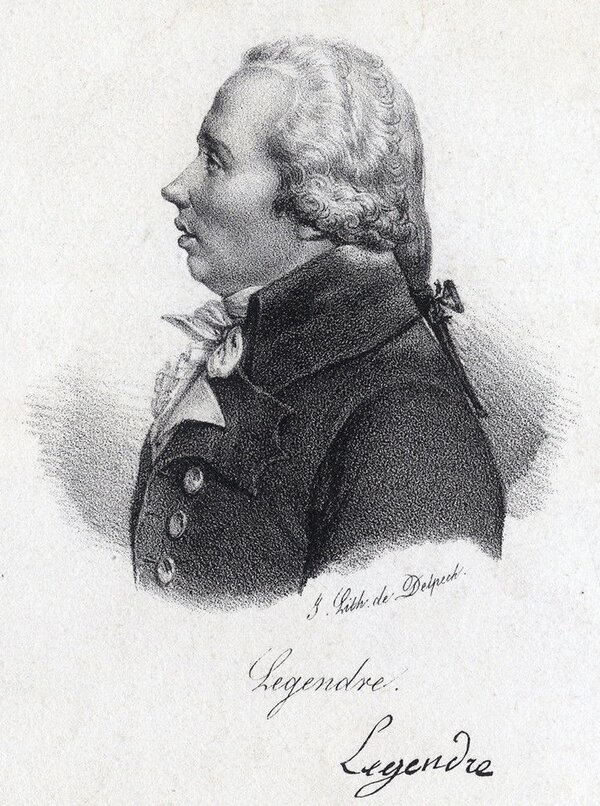
The only known genuine portrait of the mathematician is the watercolour caricature by Julien-Léopold Boilly, reproduced in the biography, which was identified in 2008 in an album of portraits of the members of the Institute. It shows an old man with dishevelled white hair and a cross expression, next to a smiling Fourier. The historian Peter Duren told the story in a 2009 article whose title says it all: “Changing faces”.
Exercise: the transform of x²
Compute the Legendre transform of $f(x) = x^2$ and then the transform of the result.
For each $p$ we maximise $px - x^2$. The derivative $p - 2x$ vanishes at $x = \frac{p}{2}$, and the maximum is $\frac{p^2}{2} - \frac{p^2}{4} = \frac{p^2}{4}$. So $f^*(p) = \frac{p^2}{4}$. Applying it again: maximising $xp - \frac{p^2}{4}$ gives $p = 2x$ and the value $2x^2 - x^2 = x^2$. The transform applied twice gives back the original function, a general property for convex functions.
Exercise: two points worth four
Check that two-point Gauss–Legendre quadrature is exact for $f(x) = x^3 + x^2$, but not for $f(x) = x^4$.
The exact value is $\int_{-1}^1 (x^3 + x^2)\,dx = 0 + \frac{2}{3} = \frac{2}{3}$. The formula gives $f\!\left(-\frac{1}{\sqrt 3}\right) + f\!\left(\frac{1}{\sqrt 3}\right)$: the terms in $x^3$ cancel and what remains is $\frac{1}{3} + \frac{1}{3} = \frac{2}{3}$. Exact. For $x^4$, the formula gives $\frac{1}{9} + \frac{1}{9} = \frac{2}{9}$, but the integral is $\frac{2}{5}$. With two points, exactness goes up to degree $3 = 2 \cdot 2 - 1$, and no further.
Sources: Jean Itard, “Legendre, Adrien-Marie”, Dictionary of Scientific Biography · Legendre biography, MacTutor · Peter Duren, “Changing faces: the mistaken portrait of Legendre”, Notices of the American Mathematical Society 56 (2009) · Carl Friedrich Gauss, “Methodus nova integralium valores per approximationem inveniendi” (1814).
All topics on Adrien-Marie Legendre · ← Forty years of elliptic integrals · Image credits →