
Euler's Eyes
2022-11-06
Equivalence Relations
One of the most important relations in modern mathematics are equivalence relations. By the way, they appear in a large part of mathematics studies.

Equivalence Relation
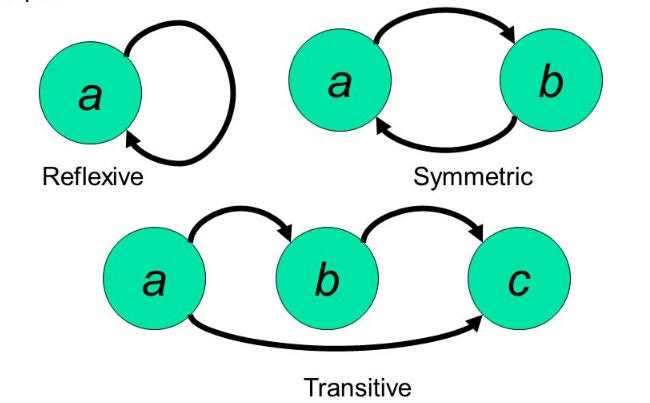
In the previous post, we showed some properties such as:
- reflective;
- symmetrical;
- transitive;
- anti-symmetric.
Some of them are necessary to be an equivalence relation.

Definition (Equivalence Relations): A relation $\mathcal{R}$ on a set $A$ is said to be an equivalence relation on $A$ if $\mathcal{R}$ is reflexive, symmetric and transitive.
Examples
To illustrate, look at the following example:

Example 1: The diagonal relation defined as $\Delta = \\{(x,x); x\in A\\}$, is an equivalence relation over $A.$ This is the “smallest” equivalence relation over $A$
Example 2: The relation $A\times A$ over $A$ is the “largest” equivalence relation over $A.$
Example 3: Let $A=\mathbb{Z}$. The relationship:
$$\mathcal{R} = \\{(x,y)\in \mathbb{N}\times \mathbb{N}; ~x-y \text{ é múltiplo de } 3\\}$$is an equivalence relation over the set of integers.
Equivalence Class module R
Definition Let $\mathcal{R}$ be an equivalence relation over a non-empty set $A.$ For each $a \in A,$ the subset of $A$ defined by
$$\overline{a} = \\{x \in A;\quad x \mathcal{R} a\\},$$is said to be the equivalence class determined by the element a module $\mathcal{R}$.

Note that if $\mathcal{R}$ is an equivalence relation over a non-empty set $A,$ then for all $a \in A,$ we have $a \in a,$ that is, each equivalence class is a non-empty subset of $A.$
Example 3: Let $A=\mathbb{Z}$. The relationship:
$$\mathcal{R} = \\{(x,y)\in \mathbb{N}\times \mathbb{N}; ~x-y \text{ é múltiplo de } 3\\}$$
- For $0\in \mathbb{Z}$
- For $1 \in \mathbb{Z},$ we have
- For $2 \in \mathbb{Z},$ we have
- For $3 \in \mathbb{Z},$ we have
Result for equivalence relation
Next we will see an important result for the equivalence relationship for $\mathbb{Z}/\mathcal{R} = \\{\overline{0}, \overline{1}, \overline{2}\\}.$

Theorem Let $\mathcal{R}$ be an equivalence relation on a non-empty set $A$ and $a, b \in A.$ The following propositions are equivalent:
- (a) $a\mathcal{R} b$
- (b) $a \in b$
- (c) $b \in a$
- (d) $a = b.$
Demo:
- (a) $\Longleftrightarrow$ (b)
It follows immediately from the definition of equivalence class.
-
(b) $\Longrightarrow$ (c)
- $a \in b$ implies $a\mathcal{R} b$ by class definition.
- Just as $a\mathcal{R} b$ implies $b\mathcal{R} a$ due to the symmetry of $\mathcal{R}$.
- Consequently, $b\mathcal{R} a$ implies $b\mathcal{R} \overline{a}$ by the class definition.
-
(c) $\Longrightarrow$ (d)
Note that $\overline{a}$ and $\overline{b}$ are two sets. In this way, showing that $\overline{a} = \overline{b}$ is equivalent to showing that:
- (1) $\overline{a} \subseteq \overline{b}$
- (2) $\overline{b} \subseteq \overline{a}$
- Let us show that $\overline{a} \subseteq \overline{b}$.
For $x \in \overline{a},$ we have $x\mathcal{R} a$ and, as per hypothesis, $b \in \overline{a},$ we also have $b\mathcal{R} a.$
Since $\mathcal{R}$ is symmetric, we obtain $x\mathcal{R} a$ and $a\mathcal{R} b$. This fact implies the transitivity of $\mathcal{R}$ than $x\mathcal{R} b$. Consequently,$x \in b$.
- Analogous.
- (d) $\Longrightarrow$ (a)
Let $x \in \overline{a} = \overline{b}.$ Then, by class definition, we have $x\mathcal{R} a$ and $x\mathcal{R} b$.
Now, from the symmetric and transitive property of $\mathcal{R}$, we obtain $a\mathcal{R} b$.
$\square$
Application of the result
Let us now show the statement $\mathbb{Z}/\mathcal{R} = \\{\overline{0}, \overline{1}, \overline{2}\\}.$

For $A = \mathbb{Z}$ and $\mathcal{R} = \\{(x, y) \in Z × Z; ~ x − y \text{ é múltiplo de } 3\\}$
Note that $\mathbb{Z}/\mathcal{R} \supseteq \\{\overline{0}, \overline{1}, \overline{2}\\}.$
If $a \in \mathbb{Z}/\mathcal{R},$ then when we divide $a$ by $3,$ we obtain than $a = 3q + r,$ with $r = 0, 1$ or $2.$
In this case, we have $r \in a$. By the previous theorem, we have $a = r$
Therefore $\mathbb{Z}/\mathcal{R} \subseteq \\{\overline{0}, \overline{1}, \overline{2}\\}$.
This is the summary of Equivalence Relations. Wait for the next posts.