
Euler's Eyes
2026-10-11
Fermat's legacy
The father of number theory
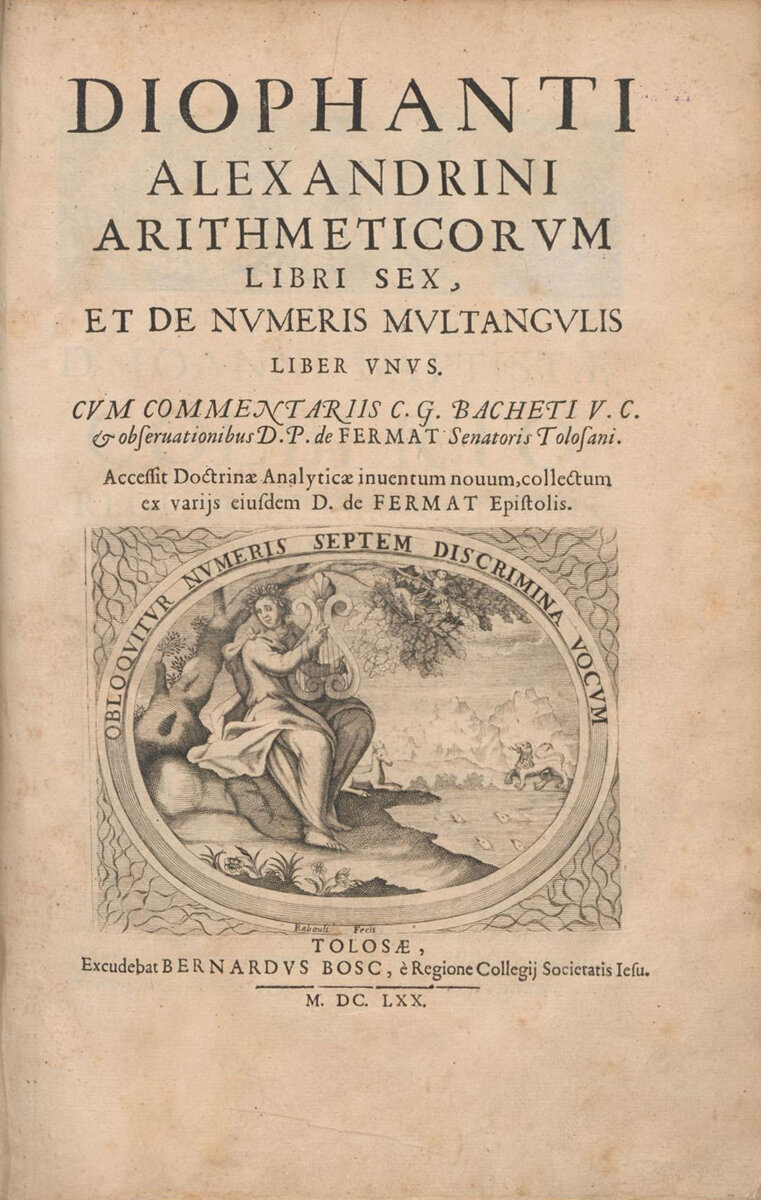
Before Fermat, problems about whole numbers were seen as riddles, Diophantus’s puzzles. Fermat turned them into an area of mathematics, with deep questions and methods of its own. For almost a century hardly anyone followed him. It was Euler, from 1730 onwards, who read Fermat’s notes, proved many of them and made number theory a central branch of mathematics. Then came Lagrange, Legendre and Gauss.
Other discoveries
The complete list would be long. Some highlights:
- Sums of two squares: an odd prime is a sum of two squares exactly when it leaves remainder 1 on division by 4. For example, $13=4+9$ and $29=4+25$, but $7$ and $11$ are not. Fermat announced it in 1640; Euler proved it in 1749.
- Pell’s equation: the equation $x^2-Ny^2=1$, with which Fermat challenged the English, always has infinitely many solutions when $N$ is not a square.
- Polygonal numbers: every positive whole number is a sum of at most three triangular numbers, four squares, five pentagonal numbers, and so on. Lagrange proved the case of squares in 1770; Gauss, the triangular case in 1796.
- Rectification of curves: Fermat computed the length of some arcs of curves, another problem that paved the way for calculus.
The road to calculus
Fermat’s analytic geometry made it possible to write curves as equations. His method of maxima and minima found tangents and extrema with a calculation that is, in essence, the derivative. He also computed areas under curves of the form $y=x^n$. All that was missing was the realization that tangents and areas are inverse operations, the step Newton and Leibniz would take.
In physics, the principle of least time explains the reflection and refraction studied at school, and opened the way to the optimization principles of modern physics.
A wrong conjecture also teaches
Fermat was wrong to suppose that all numbers $2^{2^n}+1$ are prime. Even so, the question led Euler to new techniques and reappeared, unexpectedly, in Gauss’s 17-sided polygon. In mathematics, a good question is worth a great deal, even when the answer contradicts the hunch.
And the last theorem, with or without Fermat’s “marvellous” proof, forced mathematicians to create whole theories to solve it. Wiles’s proof united two areas that seemed far apart, and those tools are now used far beyond the original problem.
Key points
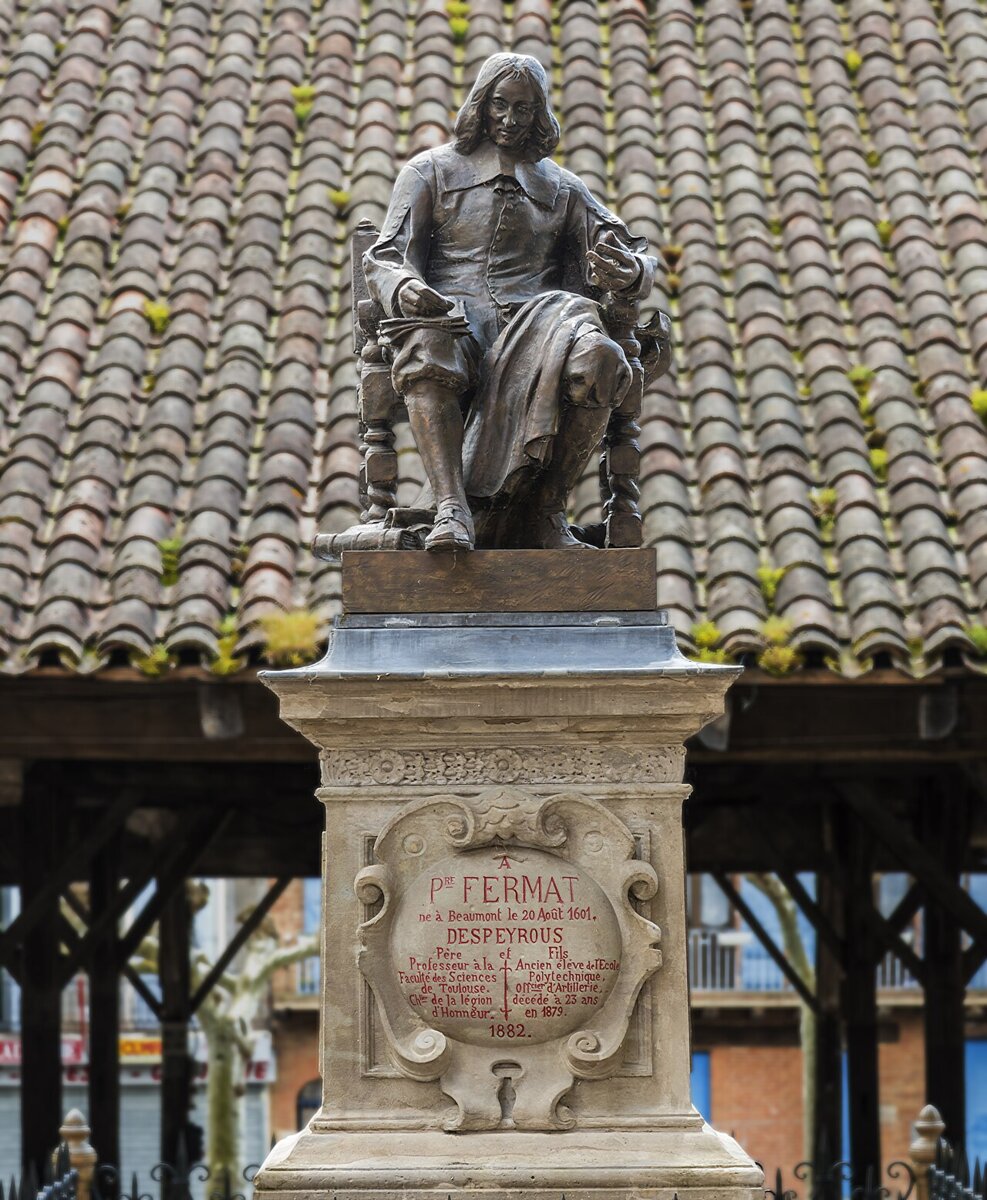
- Fermat was a judge in Toulouse and did mathematics for pleasure; he published almost nothing in his lifetime.
- His birth is given as 1601 or 1607, because he had a half-brother of the same name.
- He created analytic geometry independently of Descartes.
- His method of adequality found maxima and minima before the calculus of Newton and Leibniz.
- The little theorem says that $a^{p-1}\equiv1\pmod p$ for a prime $p$ that does not divide $a$.
- He conjectured that all $2^{2^n}+1$ are prime; Euler showed that $F_5$ is a multiple of 641.
- With Pascal, in 1654, he founded probability theory with the problem of points.
- The principle of least time explains the law of refraction.
- Infinite descent proves that certain equations have no integer solutions.
- The last theorem waited 358 years and was proved by Andrew Wiles in 1995.
Sources: life and contributions of Fermat, MacTutor.
All Fermat topics · ← Fermat’s last theorem: from the margin to Wiles’s proof · Image credits →