
Euler's Eyes
2026-11-03
EJU 2019 (1st session) – Mathematics Course 1 solved
Source: JASSO – Mathematics paper in English, in Japanese and official answer key. Files on the page for the 1st session of 2019.
Course 1 is the basic mathematics paper of the EJU. Each letter $\boxed{\text{A}}$, $\boxed{\text{B}}$, … is a digit from 0 to 9 or the minus sign; in some blanks the answer is the number of a choice. The statements below are summarized from the official English version.
Answer key
| Question | Topic | Answers |
|---|---|---|
| I Q1 | Coefficients from the graph | A=9, B=7, C=7, D=8, E=9, F=9, G=7, H=6, I=4, J=0, K=4 |
| I Q2 | A loaded die | L=2, M=1, NO=17, PQRS=2549, TUVW=2449, X=4, Y=1 |
| II Q1 | Inequality with an absolute value | A=4, BC=15, D=7, E=7, F=2, G=8, H=5, I=6, J=8 |
| II Q2 | Two parabolas | K=2, L=4, M=2, N=2, O=5, P=4, Q=3, R=4, S=4, T=4, U=2, V=1 |
| III | Approximating $\sqrt2$ | A=7, B=3, CD=21, EFG=882, HIJ=841, KL=29, MN=29, O=7, P=3, Q=3, R=2, S=5 |
| IV | Inscribed quadrilateral | A=3, BC=21, D=7, E=3, F=3, GH=14, I=3, J=4, K=3, L=2, M=3, NO=21, P=7, Q=9, R=3, ST=14, U=6, V=3, W=7 |
Question I
Q1: the signs of the coefficients from the graph
Statement. In blanks $\boxed{\text{A}}$ to $\boxed{\text{K}}$, choose from ⓪ $0$, ① $1$, ② $2$, ③ $3$, ④ $4$, ⑤ $-2$, ⑥ $-4$, ⑦ $>$, ⑧ $=$, ⑨ $<$.
- The graph of $y = ax^2 + bx + c$ is a downward parabola that meets the $y$-axis above the origin, has its vertex slightly to the right of the $y$-axis, meets the $x$-axis exactly at $x = 1$ and, on the other side, at a point between $-1$ and $0$. Then: (i) $a\ \boxed{\text{A}}\ 0$, $b\ \boxed{\text{B}}\ 0$, $c\ \boxed{\text{C}}\ 0$; (ii) $a + b + c\ \boxed{\text{D}}\ 0$; (iii) $a - b + c\ \boxed{\text{E}}\ 0$; (iv) $4a + 2b + c\ \boxed{\text{F}}\ 0$; (v) $b^2 - 4ac\ \boxed{\text{G}}\ 0$.
- With $a, b, c$ satisfying (i) and (ii), consider the case in which $a^2 - 8b - 8c$ is smallest. Then $a = \boxed{\text{H}}$, $y = \boxed{\text{H}}\,x^2 + bx - b + \boxed{\text{I}}$ and $\boxed{\text{J}} < b < \boxed{\text{K}}$.
Solution.
1. Reading the graph. Each sign comes from a value of the function or a feature of the graph:
- downward: $a < 0$;
- vertex at $x = -\frac{b}{2a} > 0$ with $a < 0$: $b > 0$;
- $c = y(0) > 0$;
- $a + b + c = y(1) = 0$ (root at $x = 1$);
- $a - b + c = y(-1) < 0$ (at $x = -1$ the graph is already below the axis);
- $4a + 2b + c = y(2) < 0$;
- two distinct real roots: $b^2 - 4ac > 0$.
2. The minimum. From (ii), $b + c = -a$, so $a^2 - 8(b + c) = a^2 + 8a = (a + 4)^2 - 16$, smallest at $a = -4$. With $c = 4 - b$: $y = -4x^2 + bx - b + 4$. The conditions $b > 0$ and $c = 4 - b > 0$ give $0 < b < 4$.
Answers: A=9 ($<$), B=7 ($>$), C=7 ($>$), D=8 ($=$), E=9, F=9, G=7, H=6 ($-4$), I=4, J=0, K=4.
Q2: a loaded die
Statement. Die X has the following property: the numbers 1 to 5 come up with equal probability, and 6 comes up with twice the probability of each of the others.
- Let $p$ be the probability of a particular number from 1 to 5. A 6 comes up with probability $\boxed{\text{L}}\,p$. Since the total probability is $\boxed{\text{M}}$, $p = \dfrac{\boxed{\text{N}}}{\boxed{\text{O}}}$.
- The die is rolled twice. Let $A$ be the event “both rolls give 1 to 5” and $B$ the event “a 6 comes up at least once”. Then $P(A) = \dfrac{\boxed{\text{PQ}}}{\boxed{\text{RS}}}$, $P(B) = \dfrac{\boxed{\text{TU}}}{\boxed{\text{VW}}}$, and $\boxed{\text{X}}$ holds: ⓪ $P(A) < P(B)$ and the difference is at least $\frac{1}{36}$; ① $P(A) < P(B)$ and the difference is less than $\frac{1}{36}$; ② $P(A) = P(B)$; ③ $P(A) > P(B)$ and the difference is at least $\frac{1}{36}$; ④ $P(A) > P(B)$ and the difference is less than $\frac{1}{36}$.
- The die is rolled three times. Let $C$ be the event “all three rolls give 1 to 5” and $D$ the event “a 6 comes up at least once”. $\boxed{\text{Y}}$ holds: ⓪ $P(C) < P(D)$ and $P(D) \ge 2P(C)$; ① $P(C) < P(D)$ and $P(D) < 2P(C)$; ② $P(C) = P(D)$; ③ $P(C) > P(D)$ and $P(C) \ge 2P(D)$; ④ $P(C) > P(D)$ and $P(C) < 2P(D)$.
Solution.
1. $5p + 2p = 1$, so $p = \frac17$ and a 6 comes up with probability $\frac27$.
2. In one roll, 1 to 5 comes up with probability $\frac57$. So $P(A) = \frac{25}{49}$ and $P(B) = 1 - P(A) = \frac{24}{49}$ ($B$ is the complement of $A$). The difference is $\frac{1}{49} < \frac{1}{36}$: choice ④.
3. $P(C) = \frac{125}{343}$ and $P(D) = \frac{218}{343}$. So $P(C) < P(D)$, and $2P(C) = \frac{250}{343} > P(D)$: choice ①.
Answers: L=2, M=1, NO=17, PQRS=2549, TUVW=2449, X=4, Y=1.
Question II
Q1: an inequality with an absolute value
Statement. Let $a = \sqrt5 + \sqrt3$ and $b = \sqrt5 - \sqrt3$. We want the integers $x$ with
$$2\left|x - \frac ab\right| + x < 10.$$- $\frac ab = \boxed{\text{A}} + \sqrt{\boxed{\text{BC}}}$, and the largest integer less than $\frac ab$ is $\boxed{\text{D}}$.
- For integer $x$: if $x \le \boxed{\text{E}}$, the left-hand side equals $\boxed{\text{F}}$; if $x \ge \boxed{\text{G}}$, it equals $\boxed{\text{H}}$ (choose $\boxed{\text{F}}$ and $\boxed{\text{H}}$ from ⓪ $x - 6 - 2\sqrt{10}$, ① $x + 8 + 2\sqrt{15}$, ② $-x + 8 + 2\sqrt{15}$, ③ $-x + 6 + 2\sqrt{10}$, ④ $3x - 6 - 2\sqrt{10}$, ⑤ $3x - 8 - 2\sqrt{15}$, ⑥ $-3x + 8 + 2\sqrt{15}$, ⑦ $-3x + 6 + 2\sqrt{10}$).
- The integers satisfying the inequality run from $\boxed{\text{I}}$ to $\boxed{\text{J}}$.
Solution.
1. $\frac ab = \frac{(\sqrt5 + \sqrt3)^2}{5 - 3} = \frac{8 + 2\sqrt{15}}{2} = 4 + \sqrt{15}$. Since $3 < \sqrt{15} < 4$ (in fact $\approx 3.873$), $7 < \frac ab < 8$.
2. For $x \le 7$, $x < \frac ab$ and the left-hand side is $2(4 + \sqrt{15} - x) + x = -x + 8 + 2\sqrt{15}$ (②). For $x \ge 8$, it is $2(x - 4 - \sqrt{15}) + x = 3x - 8 - 2\sqrt{15}$ (⑤).
3. With $x \le 7$: $-x + 8 + 2\sqrt{15} < 10$ gives $x > 2\sqrt{15} - 2 \approx 5.75$, that is, $x \in \{6, 7\}$. With $x \ge 8$: $3x < 18 + 2\sqrt{15} \approx 25.7$ gives $x < 8.6$, that is, $x = 8$. Together: $6 \le x \le 8$.
Answers: A=4, BC=15, D=7, E=7, F=2, G=8, H=5, I=6, J=8.
Q2: two parabolas meeting above the x-axis
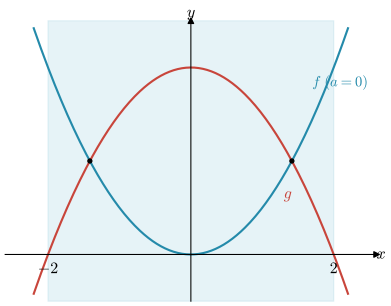
Statement. For real $a$, let $f(x) = x^2 + 2ax + a^2 - a$ and $g(x) = 4 - x^2$.
- The equation $f(x) = g(x)$ has two distinct solutions when $-\boxed{\text{K}} < a < \boxed{\text{L}}$ ①.
- In that case, the parabolas meet at two points. We want the $y$-coordinates of both points to be positive. Let $h(x) = f(x) - g(x)$. The solutions of $h(x) = 0$ must lie between $-\boxed{\text{M}}$ and $\boxed{\text{N}}$. So $h(-\boxed{\text{M}}) = a^2 - \boxed{\text{O}}\,a + \boxed{\text{P}} > 0$ ② and $h(\boxed{\text{N}}) = a^2 + \boxed{\text{Q}}\,a + \boxed{\text{R}} > 0$ ③. From the position of the axis of $y = h(x)$, $-\boxed{\text{S}} < a < \boxed{\text{T}}$ ④. From ① to ④, $-\boxed{\text{U}} < a < \boxed{\text{V}}$.
Solution.
1. $h(x) = 2x^2 + 2ax + a^2 - a - 4$. Two distinct roots: $\frac{\Delta}{4} = a^2 - 2(a^2 - a - 4) = -a^2 + 2a + 8 > 0$, that is, $(a - 4)(a + 2) < 0$, or $-2 < a < 4$.
2. Translating the condition. The intersection points lie on $y = g(x) = 4 - x^2$, which is positive exactly for $-2 < x < 2$. So both roots of $h$ must lie in $(-2, 2)$. For an upward parabola this is equivalent to: positive discriminant, $h(-2) > 0$, $h(2) > 0$ and the axis inside the interval.
- $h(-2) = 8 - 4a + a^2 - a - 4 = a^2 - 5a + 4 = (a - 1)(a - 4) > 0$: $a < 1$ or $a > 4$.
- $h(2) = a^2 + 3a + 4 > 0$: always true (discriminant $9 - 16 < 0$).
- Axis $x = -\frac a2$ in $(-2, 2)$: $-4 < a < 4$.
3. The intersection with $-2 < a < 4$ is $-2 < a < 1$.
Answers: K=2, L=4, M=2, N=2, O=5, P=4, Q=3, R=4, S=4, T=4, U=2, V=1.
Question III: approximating √2 by m/3 + n/7
Statement. For positive integers $m, n$, consider $r = \frac m3 + \frac n7$. We want $m$ and $n$ such that, among all $r < \sqrt2$, $r$ is the closest to $\sqrt2$.
It suffices to find, among the $m, n$ with $\boxed{\text{A}}\,m + \boxed{\text{B}}\,n < \boxed{\text{CD}}\sqrt2$ ①, those with $\boxed{\text{A}}\,m + \boxed{\text{B}}\,n$ closest to $\boxed{\text{CD}}\sqrt2$. Squaring ①, $(\boxed{\text{A}}\,m + \boxed{\text{B}}\,n)^2 < \boxed{\text{EFG}}$. The largest perfect square less than $\boxed{\text{EFG}}$ is $\boxed{\text{HIJ}} = \boxed{\text{KL}}^2$. So consider $\boxed{\text{A}}\,m + \boxed{\text{B}}\,n = \boxed{\text{KL}}$, or $n = \dfrac{\boxed{\text{MN}} - \boxed{\text{O}}\,m}{\boxed{\text{P}}}$. Since $n$ is an integer, $\boxed{\text{MN}} - \boxed{\text{O}}\,m$ is a multiple of $\boxed{\text{Q}}$, and $m = \boxed{\text{R}}$, $n = \boxed{\text{S}}$.
Solution.
1. Multiplying by 21: $r < \sqrt2 \iff 7m + 3n < 21\sqrt2$, and $r$ gets closer to $\sqrt2$ when the integer $7m + 3n$ gets closer to $21\sqrt2 \approx 29.7$.
2. Squaring: $(7m + 3n)^2 < 441\cdot2 = 882$. The largest square below 882 is $841 = 29^2$ ($30^2 = 900$). So the best we can hope for is $7m + 3n = 29$.
3. $n = \frac{29 - 7m}{3}$ requires $29 - 7m \equiv 0 \pmod 3$, that is, $m \equiv 2 \pmod 3$. With $n > 0$, $7m < 29$: only $m = 2$, and $n = 5$.
So $r = \frac23 + \frac57 = \frac{29}{21} \approx 1.381$.
Answers: A=7, B=3, CD=21, EFG=882, HIJ=841, KL=29, MN=29, O=7, P=3, Q=3, R=2, S=5.
Question IV: a quadrilateral inscribed in a circle of radius 1
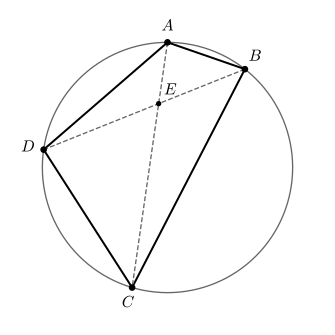
Statement. The quadrilateral $ABCD$ is inscribed in a circle of radius 1, with $AB : AD = 1 : 2$ and $\angle BAD = 120^\circ$. The diagonals $BD$ and $AC$ meet at $E$, with $BE : ED = 3 : 4$. We want the area of $ABCD$, adding $\triangle ABD$ and $\triangle BCD$.
Since $BD = \sqrt{\boxed{\text{A}}}$ and $AB = \dfrac{\sqrt{\boxed{\text{BC}}}}{\boxed{\text{D}}}$, $\triangle ABD = \dfrac{\boxed{\text{E}}\sqrt{\boxed{\text{F}}}}{\boxed{\text{GH}}}$ ①. Since $\triangle ABC : \triangle ACD = \boxed{\text{I}} : \boxed{\text{J}}$, $BC : CD = \boxed{\text{K}} : \boxed{\text{L}}$ (simplest ratio). So $BC = \dfrac{\boxed{\text{M}}\sqrt{\boxed{\text{NO}}}}{\boxed{\text{P}}}$ and $\triangle BCD = \dfrac{\boxed{\text{Q}}\sqrt{\boxed{\text{R}}}}{\boxed{\text{ST}}}$ ②. From ① and ②, the area of $ABCD$ is $\dfrac{\boxed{\text{U}}\sqrt{\boxed{\text{V}}}}{\boxed{\text{W}}}$.
Solution.
1. $BD$. By the law of sines, $BD = 2R\sin120^\circ = \sqrt3$.
2. $AB$. With $AB = x$ and $AD = 2x$, the law of cosines gives $3 = x^2 + 4x^2 - 2\cdot x\cdot2x\cos120^\circ = 7x^2$, so $x = \sqrt{\frac37} = \frac{\sqrt{21}}{7}$.
3. $\triangle ABD$. $\frac12\cdot x\cdot 2x\sin120^\circ = \frac37\cdot\frac{\sqrt3}{2} = \frac{3\sqrt3}{14}$.
4. The ratio $BC : CD$. Triangles $ABC$ and $ACD$ share base $AC$, and their heights are in the ratio $BE : ED = 3 : 4$. On the other hand, since $\angle B + \angle D = 180^\circ$,
$$\frac{\triangle ABC}{\triangle ACD} = \frac{\frac12\,AB\cdot BC\sin B}{\frac12\,AD\cdot DC\sin D} = \frac{BC}{2\,CD} = \frac34 \implies BC : CD = 3 : 2.$$5. $\triangle BCD$. $\angle BCD = 180^\circ - 120^\circ = 60^\circ$. With $BC = 3t$ and $CD = 2t$: $3 = 9t^2 + 4t^2 - 6t^2 = 7t^2$, $t = \sqrt{\frac37}$, $BC = \frac{3\sqrt{21}}{7}$ and
$$\triangle BCD = \frac12\cdot 3t\cdot 2t\sin60^\circ = \frac97\cdot\frac{\sqrt3}{2} = \frac{9\sqrt3}{14}.$$6. The area. $\frac{3\sqrt3}{14} + \frac{9\sqrt3}{14} = \frac{12\sqrt3}{14} = \frac{6\sqrt3}{7}$.
Answers: A=3, BC=21, D=7, E=3, F=3, GH=14, I=3, J=4, K=3, L=2, M=3, NO=21, P=7, Q=9, R=3, ST=14, U=6, V=3, W=7.