
Euler's Eyes
2026-11-01
MEXT 2024 – Mathematics (B) solved
Source: MEXT / Study in Japan – Mathematics (B) exam and official answer key. Files on the past-exam page.
Mathematics (B) is the exam for undergraduate applicants in science and engineering. It has three fill-in-the-blank questions; each box is worth 5 points. The statements below follow the original English.
Answer key
| Item | Topic | Answer |
|---|---|---|
| 1 (1) | Limit | $8$ |
| 1 (2) | $\alpha = \sqrt2 + \sqrt3$ | $5 + 2\sqrt6$; $10$ |
| 1 (3) | $\sin x\cos x = -\frac14$ | $-\frac{\pi}{12}$; $-\frac{5\pi}{12}$ |
| 1 (4) | Two tangent circles | $2\sqrt2$; $3\sqrt2$ |
| 1 (5) | Homogeneous system | $5$ |
| 1 (6) | Mean and standard deviation | $60$; $125$ |
| 2 (1) | A root that does not depend on $a$ | $-1$ |
| 2 (2) | Number of solutions | $\frac32$; $-\frac12$ |
| 2 (3) | A cubic with the same roots | $\frac13$; $\frac83$ |
| 3 (1) | From the end of the minor axis to the focus | $5$; $13$ |
| 3 (2) | Major axes | $10$; $26$ |
| 3 (3) | $\lvert F_1P - F_2P\rvert$ | $16$ |
Question 1: six short items
Item (1)
Statement. Compute $\displaystyle\lim_{t\to5}\frac{t - 5}{t^2 - 2t - 15} = \frac{1}{\boxed{\phantom{0}}}$.
Solution. $t^2 - 2t - 15 = (t - 5)(t + 3)$. Cancelling $t - 5$, the limit is $\frac{1}{5 + 3} = \frac18$.
Answer: $8$.
Item (2)
Statement. Let $\alpha = \sqrt2 + \sqrt3$. Then $\alpha^2 =$ ①, and $\alpha$ is a solution of the equation with integer coefficients $x^4 - $ ② $x^2 + 1 = 0$.
Solution. $\alpha^2 = 2 + 2\sqrt6 + 3 = 5 + 2\sqrt6$. Isolating the radical and squaring: $(\alpha^2 - 5)^2 = 24$, that is, $\alpha^4 - 10\alpha^2 + 1 = 0$.
Answer: ① $5 + 2\sqrt6$; ② $10$.
Item (3)
Statement. The solutions of $\sin x\cos x = -\frac14$ in $-\frac\pi2 \le x \le \frac\pi2$ are $x =$ ①, ②.
Solution. $\sin x\cos x = \frac12\sin 2x$, so $\sin 2x = -\frac12$ with $2x \in [-\pi, \pi]$. Hence $2x = -\frac\pi6$ or $2x = -\frac{5\pi}{6}$.
Answer: $x = -\frac{\pi}{12}$ and $x = -\frac{5\pi}{12}$ (in either order).
Item (4)
Statement. The absolute value of the complex number $x + yi$ is $|x + yi| = \sqrt{x^2 + y^2}$, with $i = \sqrt{-1}$. Let $\beta = a + ai$ for a positive real number $a$. If $a$ is ① or ②, there is a unique complex number $z$ with $|z| = 1$ and $|z - \beta| = 5$.
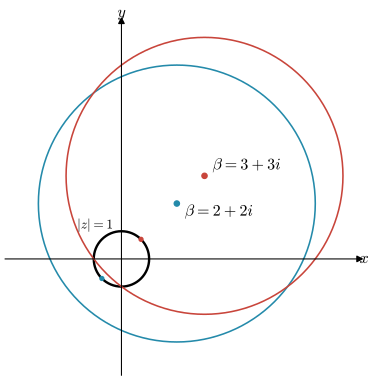
Solution. $|z| = 1$ is the circle with center $0$ and radius $1$; $|z - \beta| = 5$ is the circle with center $\beta$ and radius $5$. They have a single common point when they are tangent: $|\beta| = 5 + 1 = 6$ (externally) or $|\beta| = 5 - 1 = 4$ (internally). Since $|\beta| = a\sqrt2$, $a = 3\sqrt2$ or $a = 2\sqrt2$.
Answer: $2\sqrt2$ and $3\sqrt2$ (in either order).
Item (5)
Statement. The product of the two real values of $a$ for which the system
$$\begin{cases} ax + y + z = 3x \\ x + ay + 2z = 2y \\ ax + ay + 4z = 2x + y \end{cases}$$has non-trivial solutions, that is, with $(x, y, z) \ne (0, 0, 0)$, is $\boxed{\phantom{0}}$.
Solution. Moving everything to the left-hand side, the system is homogeneous:
$$\begin{cases} (a - 3)x + y + z = 0 \\ x + (a - 2)y + 2z = 0 \\ (a - 2)x + (a - 1)y + 4z = 0 \end{cases}$$It has a non-trivial solution exactly when the determinant vanishes. Expanding along the first row,
$$\begin{aligned} \det &= (a - 3)\big[4(a - 2) - 2(a - 1)\big] - \big[4 - 2(a - 2)\big] + \big[(a - 1) - (a - 2)^2\big] \\ &= 2(a - 3)^2 - (8 - 2a) + (-a^2 + 5a - 5) \\ &= a^2 - 5a + 5. \end{aligned}$$The discriminant is $25 - 20 = 5 > 0$, so there are two real roots, and by Vieta’s formulas their product is $5$.
Answer: $5$.
Item (6)
Statement. Consider the data:
| Value | 45 | 55 | 65 | 75 | 85 |
|---|---|---|---|---|---|
| Frequency | 3 | 6 | 4 | 2 | 1 |
The mean is ① and the population standard deviation is $\sqrt{\text{②}}$.
Solution. There are $16$ data. The mean is
$$\bar x = \frac{3\cdot45 + 6\cdot55 + 4\cdot65 + 2\cdot75 + 85}{16} = \frac{960}{16} = 60.$$The deviations are $-15, -5, 5, 15, 25$, and the population variance is
$$\sigma^2 = \frac{3\cdot225 + 6\cdot25 + 4\cdot25 + 2\cdot225 + 625}{16} = \frac{2000}{16} = 125.$$Answer: ① $60$; ② $125$.
Question 2: a cubic with a fixed root
Statement
For a real number $a$, let $f_a(x) = x^3 + 2ax^2 + 2ax + 1$.
- $f_a(x) = 0$ has the integer solution $x = \boxed{\phantom{0}}$ regardless of $a$.
- Counting complex solutions too, $f_a(x) = 0$ has a unique solution if $a =$ ①, two solutions if $a =$ ②, and three otherwise.
- Let $\alpha$ and $\beta$ be the non-integer solutions of $f_{-1}(x) = 0$. If the equation with rational coefficients $bx^3 - cx + 1 = 0$ has the solutions $\alpha$ and $\beta$, then $b =$ ① and $c =$ ②.
Solution
1. The fixed root. $f_a(-1) = -1 + 2a - 2a + 1 = 0$ for every $a$. Dividing by $x + 1$:
$$f_a(x) = (x + 1)\big(x^2 + (2a - 1)x + 1\big).$$2. Counting distinct solutions. The number of solutions drops when the quadratic factor has a double root or has $-1$ as a root.
- Double root: $(2a - 1)^2 = 4$, that is, $a = \frac32$ (double root $x = -1$) or $a = -\frac12$ (double root $x = 1$).
- Root $-1$: $1 - (2a - 1) + 1 = 0$, again $a = \frac32$.
With $a = \frac32$, $f_a(x) = (x + 1)^3$: a single solution. With $a = -\frac12$, $f_a(x) = (x + 1)(x - 1)^2$: two solutions.
3. The other cubic. With $a = -1$, $\alpha$ and $\beta$ are the roots of $x^2 - 3x + 1 = 0$, which are irrational ($\frac{3 \pm \sqrt5}{2}$). Since $bx^3 - cx + 1$ has rational coefficients and vanishes at $\alpha$ and $\beta$, it is a multiple of $x^2 - 3x + 1$:
$$bx^3 - cx + 1 = (x^2 - 3x + 1)(bx + d) = bx^3 + (d - 3b)x^2 + (b - 3d)x + d.$$Comparing: $d = 1$; $d - 3b = 0$, so $b = \frac13$; $b - 3d = -c$, so $c = 3 - \frac13 = \frac83$.
Answer
- $-1$.
- ① $\frac32$; ② $-\frac12$.
- ① $\frac13$; ② $\frac83$.
Question 3: two ellipses with a common focus
Statement
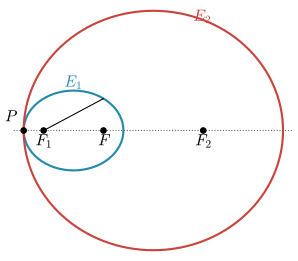
The ellipses $E_1$ and $E_2$ share the focus $F$; the other focus of $E_1$ is $F_1$ and that of $E_2$ is $F_2$. $E_1$ and $E_2$ meet at only one point $P$. The minor axes of $E_1$ and $E_2$ measure $8$ and $24$, and $\overline{F_1F} = 6$, $\overline{F_2F} = 10$.
- If $Q_1$ is an end of the minor axis of $E_1$ and $Q_2$ an end of the minor axis of $E_2$, then $\overline{Q_1F} =$ ① and $\overline{Q_2F} =$ ②.
- The major axis of $E_1$ is ① and that of $E_2$ is ②.
- $\left|\overline{F_1P} - \overline{F_2P}\right| = \boxed{\phantom{0}}$.
Solution
In an ellipse with semi-axes $a > b$ and half focal distance $c$, $a^2 = b^2 + c^2$, and an end of the minor axis lies at distance $a$ from each focus (it is equidistant from the two foci and the distances add up to $2a$).
1. $E_1$. $b_1 = 4$ and $c_1 = 3$, so $a_1 = 5$ and $\overline{Q_1F} = 5$.
2. $E_2$. $b_2 = 12$ and $c_2 = 5$, so $a_2 = 13$ and $\overline{Q_2F} = 13$.
3. Major axes. $2a_1 = 10$ and $2a_2 = 26$.
4. The common point. $P$ lies on both ellipses:
$$PF + PF_1 = 10, \qquad PF + PF_2 = 26.$$Subtracting, $PF_2 - PF_1 = 16$. The fact that the common point is unique is not needed for this computation; it only guarantees that the point $P$ is well defined.
Answer
- ① $5$; ② $13$.
- ① $10$; ② $26$.
- $16$.