
Euler's Eyes
2026-09-26
ENEM 2024 – Solved mathematics: questions 151 to 165
Source: INEP – proof and template of the 2nd day, Notebook 5 – Yellow.
The ENEM Mathematics and Technologies test 2024 was administered on the 2nd day and will from question 136 to 180. This post addresses questions 151 to 165. The numbering used here is that of the Notebook 5 – Yellow; us In other notebooks the same questions appear in a different order.
Template
| Question | Subject | Template |
|---|---|---|
| 151 | Cylinder volume | D |
| 152 | Affine function: trend line | B |
| 153 | Reading Charts: Tank Filling | B |
| 154 | Statistics: arithmetic mean | C |
| 155 | Circular sector area | E |
| 156 | Related function: price modeling | B |
| 157 | Flow and percentage | D |
| 158 | Proportional quantities: units | C |
| 159 | Cost optimization | C |
| 160 | 1st degree equation | C |
| 161 | Bar chart and percentage | A |
| 162 | Orthogonal projection | C |
| 163 | Scales and magnification | A |
| 164 | Arithmetic mean | B |
| 165 | Fundamental counting principle | B |
Question 151: Larger volume of cylindrical packaging
Statement
An industry forms a partnership with a juice distributor to launch market two types of packaging. To manufacture these packaging, the industry has rectangular aluminum sheets, with dimensions 10 cm per 20 cm. Each of these sheets is used to form the lateral surface of the packaging, in the shape of a straight circular cylinder, which subsequently receives circular bottom and lid. The figure illustrates, depending on which of the two extensions will be used as height, the two options to form the possible packaging.
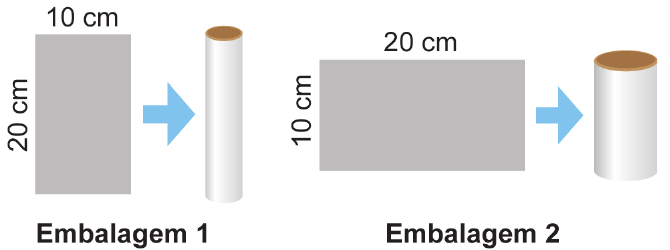
Among these two packages, the one with the largest capacity will have volume, in cubic centimeter, equal to
- A) $4\thinspace 000\pi$
- B) $2\thinspace 000\pi$
- C) $\dfrac{4\thinspace 000}{\pi}$
- D) $\dfrac{1\thinspace 000}{\pi}$
- E) $\dfrac{500}{\pi}$
Resolution
When rolling the sheet, one side becomes the height of the cylinder and the other becomes the circumference length of base: $2\pi r$.
1. Packaging 1 (height 20 cm, circumference 10 cm):
$$2\pi r = 10 \quad\Rightarrow\quad r = \frac{5}{\pi}$$$$V_1 = \pi r^2 h = \pi \cdot \frac{25}{\pi^2} \cdot 20 = \frac{500}{\pi}$$2. Packaging 2 (height 10 cm, circumference 20 cm):
$$2\pi r = 20 \quad\Rightarrow\quad r = \frac{10}{\pi}$$$$V_2 = \pi \cdot \frac{100}{\pi^2} \cdot 10 = \frac{1\thinspace 000}{\pi}$$3. Compare. $\frac{1\thinspace 000}{\pi} > \frac{500}{\pi}$, then the package 2 has the largest capacity.
Answer: alternative D ($\frac{1\thinspace 000}{\pi}$ cm³).
Be careful with the catch: the side of the sheet is the length of the circumference, not the radius or diameter. Whoever uses 10 as lightning finds $\pi \cdot 100 \cdot 20 = 2\thinspace 000\pi$ (alternative B). Alternative E is the volume of the smallest package.
To review, see Circle Area.
Question 152: Estimate of revenue using the trend line
Statement
The annual revenues obtained by an industry in the period from 2014 to 2021, in million reais, were recorded, by points, on a graph. In it, too The straight line that describes the trend of revenue evolution is represented. This straight line can be used to estimate revenues for the following years.
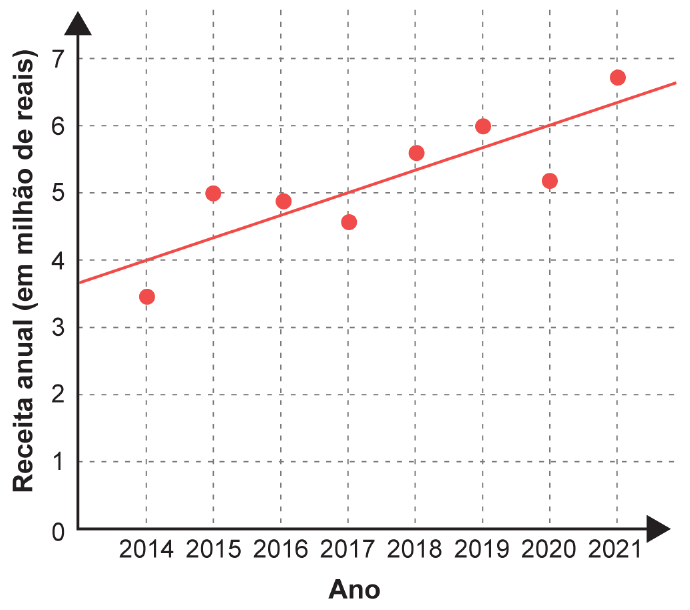
The estimated revenue, in million reais, of this industry, for the year 2026, obtained from this trend line, is
- A) 7.
- B) 8.
- C) 9.
- D) 10.
- E) 11.
Resolution
The red dots are the actual revenues; the question uses only the straight line.
1. Find two points on the line that fall on the grid. Looking at the graph, the line passes exactly through:
- $(2014, \ 4)$;
- $(2017, \ 5)$.
2. Rate of change (how much the estimated revenue increases per year):
$$a = \frac{5 - 4}{2017 - 2014} = \frac{1}{3} \text{ milhão por ano}$$(Check the graph: in 2020 the line passes through 6, because $5 + 3 \cdot \frac{1}{3} = 6$.)
3. Estimate 2026. From 2014 to 2026 are 12 years:
$$R(2026) = 4 + 12 \cdot \frac{1}{3} = 4 + 4 = 8$$Answer: alternative B (8 million reais).
Be careful with the catch: do not use the red dots (real recipes) to chart the trend. For example, connecting 2014 (about 3,5) to 2021 (about of 6,7) gives another slope and another estimate.
To review, see First Degree Functions.
Question 153: Filling a tank with bulkheads
Statement
A tank, in the shape of a straight rectangle parallelepiped, has inside two vertical bulkheads, fixed to its base and to two opposing walls, with perpendicular to them, as shown in the figure.
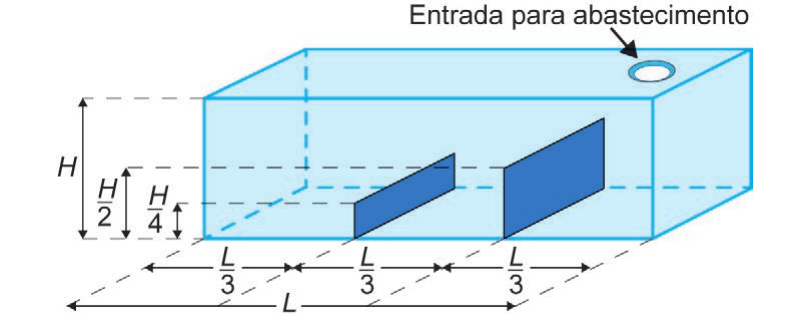
These bulkheads, of negligible thickness, are installed in such a way as to divide the base of the tank into three congruent rectangles, having their heights equal to half and a quarter of the height of the tank. The tank is filled by an inlet located on the ceiling, through a duct that discharges water at a flow rate constant, requiring 12 hours to complete filling.
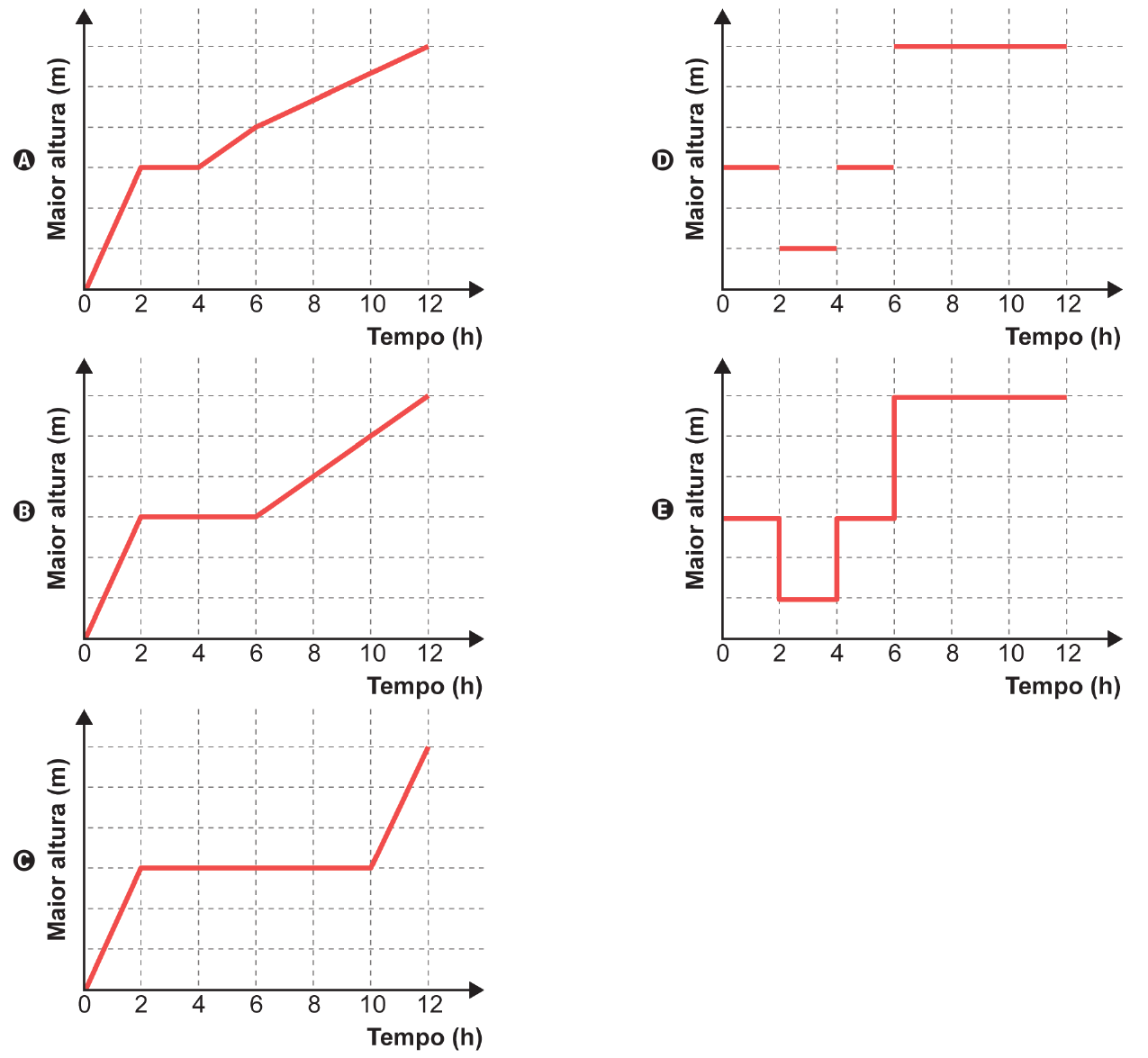
The graph that describes, at each instant, the greatest height of the water column, among those that are formed throughout the filling of the tank, is
Resolution
Name the compartments, from left to right, 1, 2, and 3. From the figure, the bulkhead between 1 and 2 has height $\frac{H}{4}$, the bulkhead between 2 and 3 has height height $\frac{H}{2}$, and the water inlet is above the compartment 3.
1. Time per “slice”. A full tank takes 12 h. Each compartment is $\frac{1}{3}$ from the base, then fill an entire compartment (height $H$) takes 4 h. Filling a compartment up to $\frac{H}{2}$ takes 2 h, and up to $\frac{H}{4}$ takes 1 h.
2. Monitor filling:
| Interval | What happens | Greater height |
|---|---|---|
| 0 a 2 h | compartment 3 fills from 0 to $\frac{H}{2}$ | goes up from 0 to $\frac{H}{2}$ |
| 2 a 3 h | water overflows into 2, which fills up to $\frac{H}{4}$ | is at $\frac{H}{2}$ |
| 3 a 4 h | water overflows into 1, which fills up to $\frac{H}{4}$ | is at $\frac{H}{2}$ |
| 4 a 6 h | 1 and 2 rise together from $\frac{H}{4}$ to $\frac{H}{2}$ (2 slots × 1 h) | is at $\frac{H}{2}$ |
| 6 a 12 h | the three rise together from $\frac{H}{2}$ to $H$ (3 compartments × 2 h) | goes up from $\frac{H}{2}$ to $H$ |
3. The graph. The greatest height rises quickly to $\frac{H}{2}$ at 2 h, it becomes stop from 2 h to 6 h and then climb more slowly (in a straight line) to $H$ at 12 h. It’s graph B.
Answer: alternative B.
Be careful with the catch: the question is the largest height between the columns, not the height of a specific compartment. Graphs D and E “go down”, which cannot happen: the water never leaves the compartment 3. And from 6 h to 12 h the rise is slower than at the beginning, because now the water spreads across the entire base.
Question 154: Average contract reading time
Statement
Contracts for various services available on the internet present a quantity excessive information. This makes the time required for reading of these contracts may be long.
The table presents a sample of the time considered necessary for reading complete contract for some digital services.
| Type of service | Time required to read the contract completely (in minutes) |
|---|---|
| A | 36 |
| B | 17 |
| C | 27 |
| D | 13 |
| E | 13 |
| F | 13 |
ROMERO, L. I haven’t read it and I agree. Super interesting, no. 307, Aug. 2012 (adapted).
The average time, in minutes, required to completely read a contract service among those listed in the table is, to one decimal place, approximately,
- A) 13,0.
- B) 15,0.
- C) 19,8.
- D) 20,0.
- E) 23,3.
Resolution
The arithmetic mean is the sum of the values divided by the number of values.
1. Add the times:
$$36 + 17 + 27 + 13 + 13 + 13 = 119$$2. Divide by the number of services (6):
$$\bar{x} = \frac{119}{6} = 19{,}833\ldots \approx 19{,}8$$Answer: alternative C (19,8 minutes).
Be careful with the catch: 13,0 (alternative A) is the mode (the value that is repeated), and 15,0 (alternative B) is the median ($\frac{13 + 17}{2}$). The question asks for the average.
To review, see Position Measurements.
Question 155: Area of the circular sector of a sensor
Statement
An owner wants to install a presence sensor to protect his property. The sensor must detect movements of objects and people in a certain flat region. The figure illustrates the top view of the coverage (blue circular sector) of a sensor placed at point $S$. This area depends on the measurement of the angle $\alpha$, in degrees, and the radius $R$, in meters.
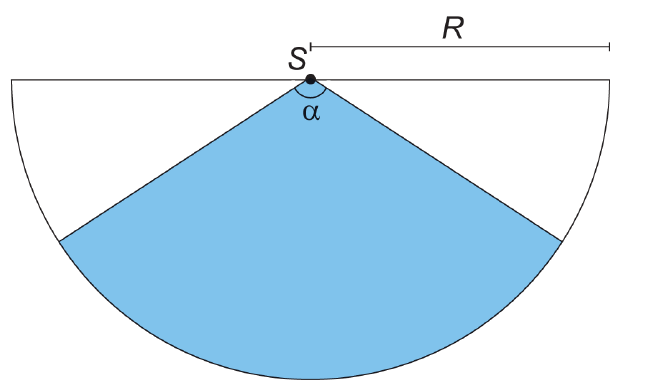
By increasing the angle $\alpha$ or the radius $R$ the coverage area of the sensor. However, the larger this area, the higher the price of the sensor.
For this purpose, there are five types of sensors available on the market, each with the following features:
- type I: $\alpha = 15°$ and $R = 20$ m;
- type II: $\alpha = 30°$ and $R = 22$ m;
- type III: $\alpha = 40°$ and $R = 12$ m;
- type IV: $\alpha = 60°$ and $R = 16$ m;
- type V: $\alpha = 90°$ and $R = 10$ m.
This owner intends to purchase one of these sensors that is capable of cover at least an area measuring 70 m², at the lowest possible price.
Use 3 as an approximate value for $\pi$.
The property owner must purchase the type sensor
- A) I.
- B) II.
- C) III.
- D) IV.
- E) V.
Resolution
1. Area of circular sector. A sector of angle $\alpha$ is the fraction $\frac{\alpha}{360°}$ of the entire circle:
$$A = \frac{\alpha}{360} \cdot \pi R^2 = \frac{\alpha}{360} \cdot 3 R^2$$2. Calculate for each type:
| Type | Calculation | Area (m²) | Covers 70 m²? |
|---|---|---|---|
| I | $\frac{15}{360} \cdot 3 \cdot 400$ | 50 | no |
| II | $\frac{30}{360} \cdot 3 \cdot 484$ | 121 | Yes |
| III | $\frac{40}{360} \cdot 3 \cdot 144$ | 48 | no |
| IV | $\frac{60}{360} \cdot 3 \cdot 256$ | 128 | Yes |
| V | $\frac{90}{360} \cdot 3 \cdot 100$ | 75 | Yes |
3. Choose the cheapest. Among those that cover at least 70 m² (II, IV and V), the price grows with the area. The one with the smallest area is type V (75 m²).
Answer: alternative E (type V).
Beware of the catch: type IV has the largest area, but the owner wants the lowest price among those that meet the minimum of 70 m².
To review, see Circle Area.
Question 156: Value of one ride per application (function)
Statement
The use of transport applications has been an alternative for the population that look for more competitive prices to get around, especially in large cities. The ways used to determine the amount charged for each trip vary from one application to another, but in general, the amount $V$ to be paid, in real, varies depending on:
- base fare $F$: fixed amount, in reais, charged at the beginning of the trip;
- time $T$: time, in minutes, of the trip;
- distance $D$: distance traveled, in kilometers.
One of these applications charges R$ 2,00 in fixed amount, plus R$ 0,26 per minute of travel and R$ 1,40 per kilometer traveled.
Under these conditions, the expression that provides the amount $V$ to be paid for a trip of this application is
- A) $2{,}00F + 0{,}26T + 1{,}40D$
- B) $2{,}00 + 0{,}26T + 1{,}40D$
- C) $2{,}00 + 0{,}26T + D$
- D) $0{,}26T + 1{,}40D$
- E) $F + T + D$
Resolution
We set the value part by part:
1. Fixed fee: R$ 2,00, charged once. It’s a number, it doesn’t depend on nothing: $2{,}00$.
2. Time: R$ 0,26 per minute, for $T$ minutes: $0{,}26T$.
3. Distance: R$ 1,40 per kilometer, during $D$ kilometers: $1{,}40D$.
4. Adding:
$$V = 2{,}00 + 0{,}26T + 1{,}40D$$Answer: alternative B.
Be careful with the catch: in alternative A, the term $2{,}00F$ multiplies the base rate for 2. But the base rate is already R$ 2,00; the correct term is only $2{,}00$ (i.e. $F = 2{,}00$).
To review, see First Degree Functions.
Question 157: Flow rate to fill a swimming pool
Statement
A swimming pool has a capacity of 2 500 000 liters. Your supply system was regulated to have a constant flow rate of 6 000 liters of water per minute.
The same system was installed in a second pool, with capacity for 2 750 000 liters, and regulated to have a flow rate, also constant, capable of fill it in a time 20% longer than it took to fill the first pool.
The flow rate of the second pool supply system, in liters per minute, is
- A) 8 250.
- B) 7 920.
- C) 6 545.
- D) 5 500.
- E) 5 280.
Resolution
Remember: $\text{tempo} = \dfrac{\text{volume}}{\text{vazão}}$ and $\text{vazão} = \dfrac{\text{volume}}{\text{tempo}}$.
1. First pool time:
$$t_1 = \frac{2\thinspace 500\thinspace 000}{6\thinspace 000} = \frac{1\thinspace 250}{3} \text{ minutos}$$2. Second pool time(20% greater, i.e. $1{,}2$ times):
$$t_2 = 1{,}2 \cdot \frac{1\thinspace 250}{3} = \frac{1\thinspace 500}{3} = 500 \text{ minutos}$$3. Flow rate of the second pool:
$$\text{vazão}_2 = \frac{2\thinspace 750\thinspace 000}{500} = 5\thinspace 500 \text{ L/min}$$Answer: alternative D (5 500 L/min).
Be careful with the catch: higher 20% time no means lower 20% flow. Doing $0{,}8 \cdot 6\thinspace 000 \cdot 1{,}1$ gives 5 280 (alternative E). Calculate the time first, then the flow rate.
To review, see Rule of 3.
Question 158: Flow measurement unit (proportional quantities)
Statement
A pipe always delivers the same volume of water per unit of time in a water tank, which means that the water flow in this pipe is constant. At the junction of this pipe with the water tank, a filtration membrane whose objective is to filter any impurities present in the water, combined with a good water flow. The flow ($\phi$) of water through the surface of the membrane is directly proportional to the water flow rate in the piping, measured in milliliters per second, and inversely proportional to the area of the membrane surface, measured in square centimeters.
The appropriate unit of measurement to describe the flow ($\phi$) of water that crosses the surface of the membrane
- A) $\text{mL} \cdot \text{s} \cdot \text{cm}^2$
- B) $\dfrac{\text{mL}}{\text{s}} \cdot \text{cm}^2$
- C) $\dfrac{\text{mL}}{\text{cm}^2 \cdot \text{s}}$
- D) $\dfrac{\text{cm}^2 \cdot \text{s}}{\text{mL}}$
- E) $\dfrac{\text{cm}^2}{\text{mL} \cdot \text{s}}$
Resolution
1. Build the relationship. Directly proportional to the flow rate $Q$ (it is in numerator) and inversely proportional to the area $A$ (it is in the denominator):
$$\phi = \frac{Q}{A}$$2. Place the units. The flow rate is at $\frac{\text{mL}}{\text{s}}$ and the area in $\text{cm}^2$:
$$\frac{\ \frac{\text{mL}}{\text{s}}\ }{\text{cm}^2} = \frac{\text{mL}}{\text{s}} \cdot \frac{1}{\text{cm}^2} = \frac{\text{mL}}{\text{cm}^2 \cdot \text{s}}$$Answer: alternative C.
Be careful with the catch: alternative B multiplies by the area, which it would be “directly proportional” to the area. Inversely proportional means divide by the area.
To review, see Quantity Analysis.
Question 159: Lower cost when purchasing pesticides
Statement
In an agricultural pesticide store, the prices of some products were published on a poster.
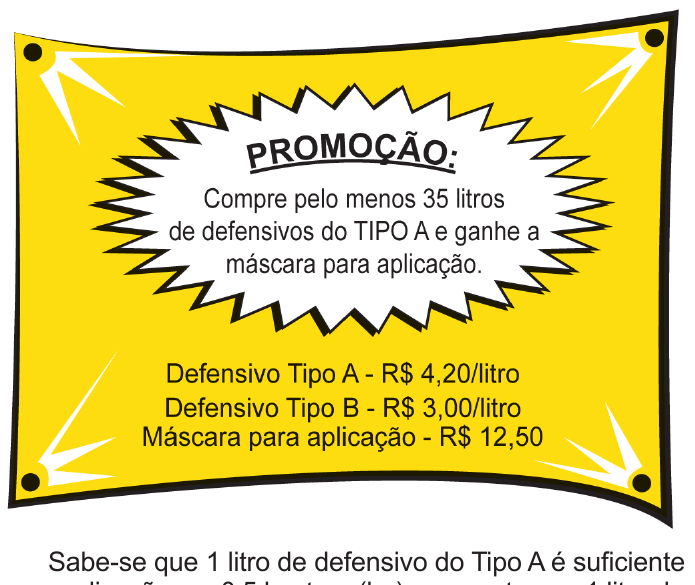
It is known that 1 liter of Type A pesticide is sufficient for application in 0,5 hectare (ha), while 1 liter of Type B pesticide is sufficient to application in 0,4 ha. A farmer needs to buy, in this store, a quantity of liters of pesticide sufficient to apply in an area of 20 ha, in addition to Bring a mask for application.
The minimum amount, in reais, to be spent by the farmer is
- A) 147,00.
- B) 150,00.
- C) 162,50.
- D) 165,75.
- E) 168,00.
Resolution
According to the poster: Type A costs R$ 4,20/liter, Type B costs R$ 3,00/liter, mask costs R$ 12,50, and whoever buys at least 35 liters of Type A gets the mask.
1. Cost per hectare of each type:
- Type A: 1 liter covers 0,5 ha, so 1 ha costs $\frac{4{,}20}{0{,}5} = 8{,}40$ reais;
- Type B: 1 liter covers 0,4 ha, so 1 ha costs $\frac{3{,}00}{0{,}4} = 7{,}50$ reais.
Type B is cheaper per hectare; A’s advantage is just the free mask.
2. Option only with Type B: $\frac{20}{0{,}4} = 50$ liters.
$$50 \cdot 3{,}00 + 12{,}50 = 150{,}00 + 12{,}50 = 162{,}50$$3. Option only with Type A: $\frac{20}{0{,}5} = 40$ liters (wins the mask).
$$40 \cdot 4{,}20 = 168{,}00$$4. Mixed option (35 L of A to win the mask + B for the rest): 35 L of A cover $35 \cdot 0{,}5 = 17{,}5$ ha; missing 2,5 ha, who ask $\frac{2{,}5}{0{,}4} = 6{,}25$ L of B.
$$35 \cdot 4{,}20 + 6{,}25 \cdot 3{,}00 = 147{,}00 + 18{,}75 = 165{,}75$$5. Compare: 162,50 < 165,75 < 168,00. The lowest price is to buy only Type B and pay for the mask.
Answer: alternative C (R$ 162,50).
Beware of the catch: the promotion seems advantageous, but Type A is more expensive per hectare, and the difference exceeds the price of the mask. Alternatives A (147,00) and B (150,00) are just part of the accounts (35 L of A; 50 L of B without the mask).
Question 160: New price for the portion of sweets
Statement
A sweet shop sells and delivers, in your neighborhood, portions of 100 g of sweets birthday. Currently, the single delivery fee is R$ 10,00, and the amount charged for one portion is R$ 25,00. For a sales strategy, from the next week, the single delivery fee will be R$ 15,00, and a new amount will be charged per a portion, so that the total amount to be paid by a customer when purchasing 5 portions remain the same.
Starting next week, what will be the new amount charged, in reais, for a portion?
- A) 12,50
- B) 20,00
- C) 24,00
- D) 30,00
- E) 37,50
Resolution
1. Current total for 5 servings:
$$10 + 5 \cdot 25 = 10 + 125 = 135 \text{ reais}$$2. New total, with $x$ = new portion price, must be equal:
$$15 + 5x = 135$$3. Solve:
$$5x = 120 \quad\Rightarrow\quad x = 24$$Answer: alternative C (R$ 24,00).
Be careful with the catch: the delivery fee is unique: it goes up to R$ 5,00 one only once. This increase is divided between the 5 portions, and each one gets R$ 1,00 cheaper.
To review, see First Degree Equations.
Question 161: Most likely age group in a draw
Statement
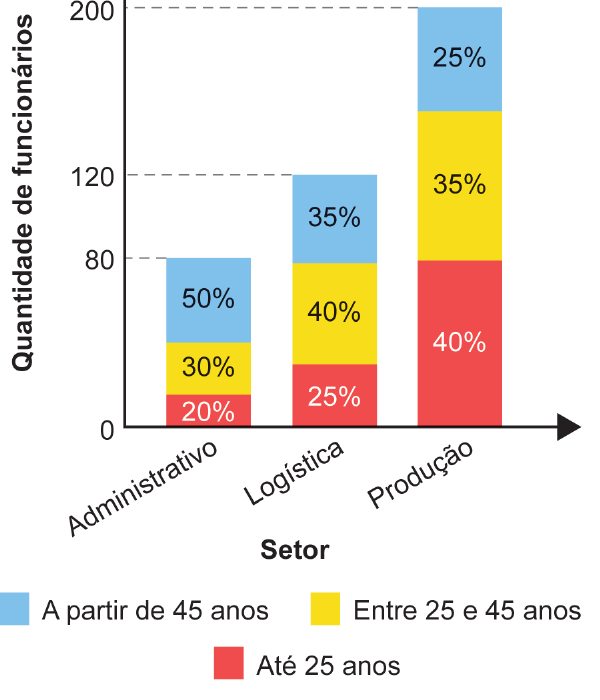
A company has 400 employees, distributed across three sectors: administrative, logistics and production. The graph shows the distribution number of these employees, by sector and by age group.
A vacation trip will be drawn among these employees, so that everyone will have an equal chance of being drawn.
The greatest probability is that the drawn employee will be in the age group
- A) between 25 and 45 years, as this is the age group with the largest number of employees.
- B) between 25 and 45 years, as it is the only age group whose percentages are higher than the minimum percentages for each sector.
- C) up to 25 years, as it is the only age group whose percentages associated with sectors increase with the increase in the number of employees per sector.
- D) up to 25 years, as it is the age group that has the largest number of employees in the production sector, which is the sector that employs half of the company’s employees.
- E) from 45 years, as the sum of the percentages associated with this age group is 110%, which is greater than the respective sums associated with the other age groups, which are 105% and 85%.
Resolution
As everyone has the same chance, the most likely range is the one with the most ** employees**. The percentages are for sectors with different sizes (80, 120 and 200), then we need to transform them into quantities.
1. Quantity in each range and sector:
| Age range | Administrative (80) | Logistics (120) | Production (200) | Total |
|---|---|---|---|---|
| Up to 25 years | 20% → 16 | 25% → 30 | 40% → 80 | 126 |
| Between 25 and 45 years | 30% → 24 | 40% → 48 | 35% → 70 | 142 |
| From 45 years | 50% → 40 | 35% → 42 | 25% → 50 | 132 |
(Checking: $126 + 142 + 132 = 400$.)
2. Conclusion. The range between 25 and 45 years has the largest number (142), so the highest probability: $\frac{142}{400} = 35{,}5$ percent.
Answer: alternative A.
Be careful with the trick: add the percentages of the sectors (alternative E) It doesn’t make sense because each percentage is a different total. The 50% of administrative are only 40 people, while 35% of production is 70.
To review, see Introduction to Probability and Basic Percentage.
Question 162: Orthogonal projection of a trajectory
Statement
In a virtual mobile game, a character can travel trajectories straight lines flying or moving along walls. Consider that the character describes the trajectory $ABCDEF$, where the points $A$, $D$ and $E$ are in a plane parallel to that containing the points $B$ and $C$, these two being planes orthogonal to the base plane that contains the point $F$, as shown in the figure.
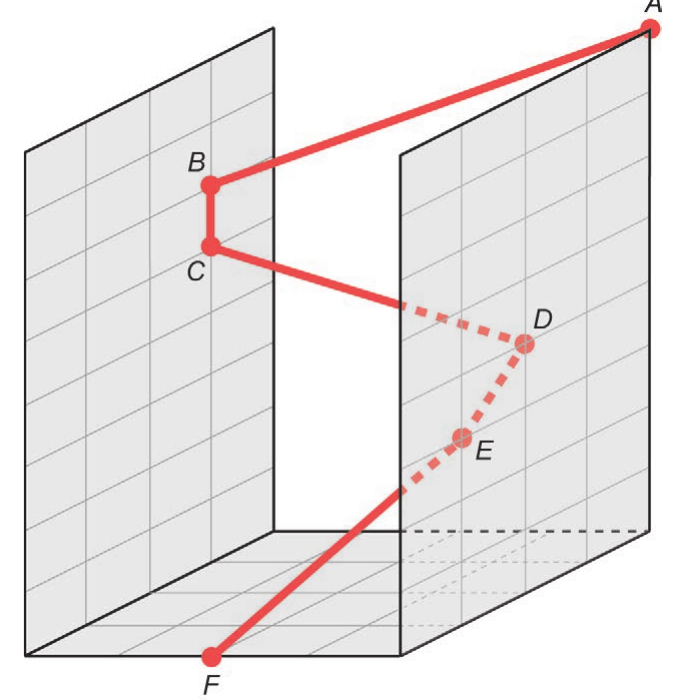
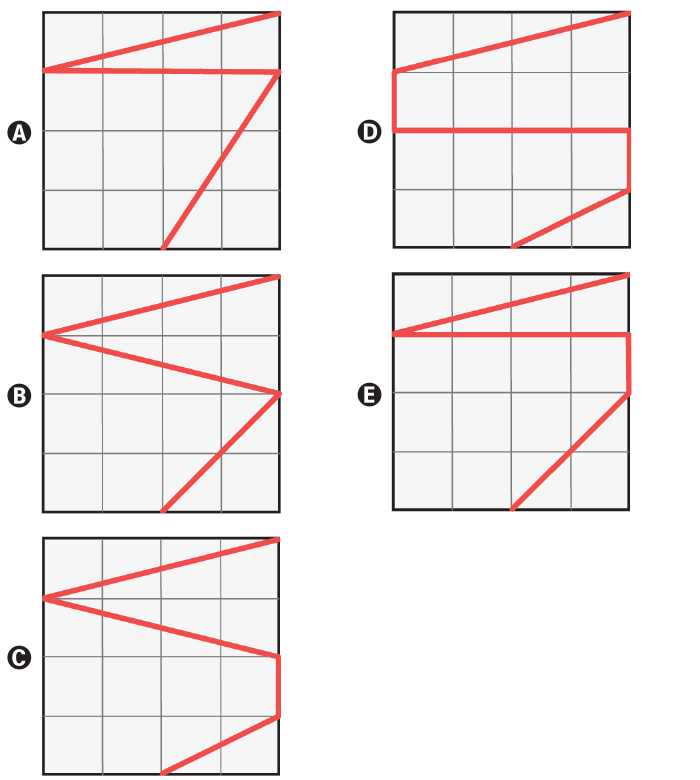
The orthogonal projection, onto the base plane, of the trajectory $ABCDEF$ described by the character is
Resolution
Projecting orthogonally onto the base is “looking from above”: each point descends on the vertical to the floor. Call $A'$, $B'$, … the projections. In the alternatives, the left side of the square is the base of the wall of $B$ and $C$, the right side is the base of the wall of $A$, $D$, and $E$, and the bottom side is the front.
1. Points on the right wall. As this wall is perpendicular to the base, $A$, $D$ and $E$ project onto the right side of the square. $A$ is in bottom, so $A'$ is the top right corner.
2. $B$ and $C$. They are on the left wall, one exactly above the other (the segment $BC$ is vertical). So $B'$ and $C'$ are the same point on the side left, and the section $BC$ becomes a single point.
3. $D$ and $E$. They are on the right wall, but not on the same vertical: $E$ is lower and further forward than $D$. So $D'$ and $E'$ are points different on the right side, and the section $DE$ becomes a segment on the right side right.
4. $F$ is already at the base, on the front edge.
5. The projected figure: $A'$ (back corner, right) → $B' = C'$ (side left) → $D'$ (right side) → $E'$ (front right) → $F$ (front). Only alternative C has this shape: a lying “V”, a vertical section on the right side and then a segment to the front.
Answer: alternative C.
Be careful with the catch: alternative B joins $D'$ and $E'$ at a single point, as if $DE$ were vertical (this is the case for $BC$, not $DE$). To the alternatives D and E draw horizontal sections crossing the square, which do not exist on the trajectory.
Question 163: Lens to view red blood cells under the microscope
Statement
The minimum size that human vision is capable of viewing without the use of auxiliary equipment is equivalent to 100 micrometers (1 micrometer = $10^{-3}$ millimeters). A student intends to visualize and analyze red blood cells from human blood, which measure 0,007 mm in diameter. She acquired a microscope optic that has an ocular lens that magnifies the image of the object by 10 times observation, and a set of objective lenses with these observation capabilities magnification:
- lens I: 2 times;
- lens II: 10 times;
- lens III: 15 times;
- IR lens: 1,1 time;
- lens V: 1,4 time.
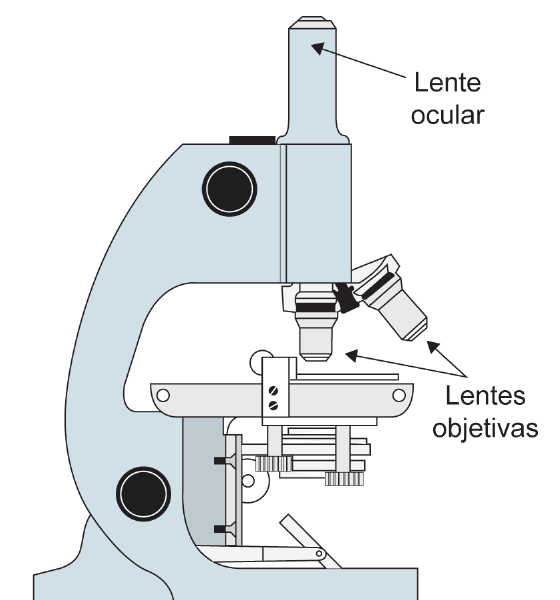
The operation of this microscope allows the use of the ocular lens alone or combination of it with one of its objective lenses, providing, in this case, an increase in its final expansion capacity, which is given by the product between the magnification capabilities of the eyepiece and objective.
This student intends to select the objective lens with the lowest magnification that allows, in combination with the eyepiece, to visualize red blood cells human blood.
The objective lens to be selected by the student is the
- A) I.
- B) II.
- C) III.
- D) IV.
- E) V.
Resolution
1. Same unit. The limit of vision is
$$100 \text{ micrômetros} = 100 \cdot 10^{-3} \text{ mm} = 0{,}1 \text{ mm}$$2. Magnification required. The image of the red blood cell (0,007 mm) needs to reach at least 0,1 mm:
$$\text{ampliação} \geq \frac{0{,}1}{0{,}007} = \frac{100}{7} \approx 14{,}3 \text{ vezes}$$**3. Test combinations with the eyepiece (10 times)**of the smallest objective enlargement to largest:
| Objective | Full magnification | Image size (mm) | Can you see? |
|---|---|---|---|
| IV (1,1) | 11 | 0,077 | no |
| V (1,4) | 14 | 0,098 | no |
| I (2) | 20 | 0,14 | Yes |
The one with the lowest magnification that works is lens I.
Answer: alternative A (lens I).
Be careful with the trick: with the V lens the image is 0,098 mm, very close to 0,1 mm, but still below the minimum. Whoever rounds chooses V (option E) by mistake.
Question 164: Average calculated with the wrong divisor
Statement
When calculating the average of his grades in 4 tests, a student divided, by mistake, the sum of the notes by 5. As a result, the average obtained was 1 a unit smaller than the it should be if it were calculated correctly.
The correct value of this student’s grade point average is
- A) 4.
- B) 5.
- C) 6.
- D) 19.
- E) 21.
Resolution
1. Call the sum of the scores $S$. The correct average is $\frac{S}{4}$; the wrong one is $\frac{S}{5}$.
2. The wrong one is 1 smaller unit:
$$\frac{S}{4} - \frac{S}{5} = 1$$3. Solve(the MMC of 4 and 5 is 20):
$$\frac{5S - 4S}{20} = 1 \quad\Rightarrow\quad \frac{S}{20} = 1 \quad\Rightarrow\quad S = 20$$4. Correct average:
$$\frac{S}{4} = \frac{20}{4} = 5$$(Check: the wrong average would be $\frac{20}{5} = 4$, which is 1 less than 5.)
Answer: alternative B (5).
Be careful with the catch: 4 (alternative A) is the mean wrong, and 20 is the sum of grades; the question is the correct average.
To review, see Position Measurements.
Question 165: Passwords with numbers and letters (counting)
Statement
To open a company’s door, each employee must register a password using an alphanumeric keyboard like the one shown in the figure.
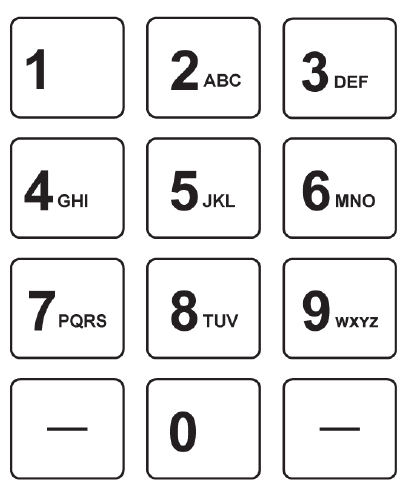
For example: the key containing the number 2 has the corresponding letters A, B and C. Each touch of this key sequentially shows the following characters: 2, A, B and C. For the next rings, this sequence is repeated. The rest keys work the same way.
Passwords to be registered by employees must contain 5 characters, 2 being different numbers followed by 3 different letters, in that order. One employee will register their first password, being able to choose between the keys that display the numbers 1, 2, 5, 7 and 0 and their respective letters correlated, if any.
The number of different possibilities this employee has to register your password is
- A) 11 520.
- B) 14 400.
- C) 18 000.
- D) 312 000.
- E) 390 000.
Resolution
1. Available characters.
- Digits: 1, 2, 5, 7 and 0 → 5 digits.
- Letters: the 1 and 0 keys do not have letters; a 2 has A, B, C; a 5 has J, K, L; the 7 has P, Q, R, S → $3 + 3 + 4 =$ 10 letters.
2. The two digits (distinct, order matters):
$$5 \times 4 = 20$$3. The three letters (different, order matters):
$$10 \times 9 \times 8 = 720$$4. Multiplicative principle (digits and letters):
$$20 \times 720 = 14\thinspace 400$$Answer: alternative B (14 400).
Be careful with the trick: who allows you to repeat letters and numbers finds $5 \cdot 5 \cdot 10 \cdot 10 \cdot 10 = 25\thinspace 000$, which doesn’t even is among the alternatives. Read “distinct” and “different” carefully: a With each choice, one less option remains.