
Euler's Eyes
2026-10-19
Proofs without words
In 1993 the Mathematical Association of America published a curious book, edited by Roger Nelsen: Proofs Without Words. Each page carries a drawing and, sometimes, a formula underneath. Not one sentence. The idea is that the reader looks, understands and is convinced without anyone explaining anything. The book was so successful that it gained two more volumes, and the journal Mathematics Magazine still publishes such proofs today.
The staircase that becomes a rectangle
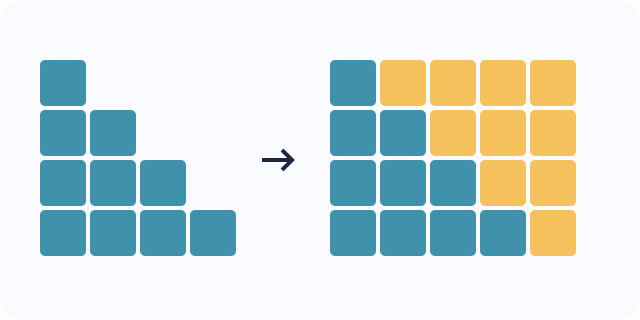
What is $1+2+3+4$? Draw a staircase with those rows of small squares. Now make a copy, turn it round and fit it alongside: the two staircases form a $4$ by $5$ rectangle, with $20$ small squares. Each staircase is half:
$$1+2+3+4=\frac{4\cdot5}{2}=10.$$And the drawing does not depend on the $4$. With a staircase of $n$ steps, the two copies form an $n\times(n+1)$ rectangle, and
$$1+2+\cdots+n=\frac{n(n+1)}{2}.$$Chapter 4 proved this formula by induction, with algebra. The drawing proves the same thing another way: instead of following steps, one sees why half a rectangle appears.
“Behold!”
The most famous proof without words is the one of Pythagoras’ theorem attributed to the Indian Bhaskara, in the twelfth century. Four copies of a right triangle with legs $a$ and $b$ and hypotenuse $c$ are arranged inside a square of side $c$, leaving in the middle a small square of side $b-a$. According to tradition, Bhaskara wrote a single word underneath: “Behold!”. The areas give
$$c^2=4\cdot\frac{ab}{2}+(b-a)^2=2ab+b^2-2ab+a^2=a^2+b^2.$$The curious thing is that the “proof without words” needs a line of algebra to be checked. The drawing shows the pieces; the calculation guarantees that they fit.
When the drawing proves and when it deceives
Chapter 1 told of the Greeks’ distrust of figures. It has good reason. The missing square puzzle, popularised by the amateur magician Paul Curry in 1953, builds a triangle from four pieces and, by swapping the pieces around, builds another triangle of the same size with one small square missing. Where did the area go?
The secret is that neither “triangle” is a triangle. The two triangular pieces have different slopes, $\frac25=0.4$ and $\frac38=0.375$, and the “hypotenuse” is actually a broken line, slightly inwards in one arrangement and slightly outwards in the other. The difference between the two is exactly one small square, spread over a strip too thin for the eye to see.
A proof without words is only a proof when every relation the eye relies on, “these lines are parallel”, “these points are aligned”, “these pieces fit”, can be guaranteed by an argument. When the eye assumes more than the drawing guarantees, the diagram becomes an optical illusion.
Exercise: the sum of odd numbers
Chapter 4 showed a drawing in which each odd number is an L-shaped layer. Use the idea to calculate $1+3+5+\cdots+19$ without adding.
The odd numbers from $1$ to $19$ are $10$ layers, and $10$ layers form a square of side $10$. The sum is $10^2=100$.
Exercise: the slopes of the missing square
In Curry’s puzzle, one triangular piece has legs $2$ and $5$, the other $3$ and $8$, and the whole figure has legs $5$ and $13$. Compare the slopes and explain the small square.
The slopes are $\frac25=0.4$, $\frac38=0.375$ and, for the whole figure, $\frac5{13}\approx0.385$. Since the pieces do not have the same slope, the “hypotenuses” do not form a straight line. The area of a true triangle with legs $5$ and $13$ would be $32.5$; the pieces add up to $32$ in one arrangement, and the gap plus the pieces to $33$ in the other. The difference of one unit lies in the two thin strips between the broken line and the straight one.
Chapter index · ← Graphs and maps: the drawing in which only connections matter · The fourth dimension: drawing what cannot be seen →