
Euler's Eyes
2026-10-31
The legacy of Augustin-Louis Cauchy
Cauchy is mad, and there is nothing to be done with him; and yet he is, at present, the one who knows how mathematics ought to be done.
— Niels Henrik Abel, letter to Holmboe (1826)
Cauchy published about 800 papers and seven books. His Œuvres complètes, edited by the Academy of Sciences, came out between 1882 and 1974 in 27 thick volumes. Among mathematicians, only Euler and very few others left a body of work comparable in size.
What bears his name
- The Cauchy sequence and Cauchy’s criterion for convergence, the basis of Cantor’s definition of the real numbers.
- The root test, the condensation test and the Cauchy product of two series.
- The Cauchy–Schwarz inequality and Cauchy’s proof of the inequality of the means.
- Cauchy’s mean value theorem, which justifies l’Hôpital’s rule.
- The Cauchy–Riemann equations, Cauchy’s integral theorem, Cauchy’s integral formula and the residue theorem.
- The Cauchy principal value, which gives meaning to integrals such as $\int_{-1}^{1} \frac{dx}{x}$ by cutting out the troublesome point symmetrically.
- The Cauchy problem for differential equations, which asks whether the initial values determine the solution, and the Cauchy–Kovalevskaya theorem, which answers it for analytic functions.
- The Cauchy stress tensor in solid mechanics and Cauchy’s dispersion formula in optics.
- The Cauchy–Binet formula for determinants and Cauchy’s theorem on finite groups.
- Cauchy’s rigidity theorem for convex polyhedra.
- Cauchy’s functional equation, $f(x + y) = f(x) + f(y)$, studied in the Cours d’analyse.
- The Cauchy distribution in probability, which has the shape of the curve of Agnesi and has no mean.
Rigour
What weighed most was the change of attitude. After Cauchy, a result in analysis counts only if it is proved from clear definitions, and the definitions are his: limit, convergence, continuity, derivative, integral. The next generation, of Weierstrass, Dedekind and Cantor, completed the work, correcting the points where Cauchy had trusted intuition too much, as with uniform convergence. But the building they renovated was Cauchy’s.
The man
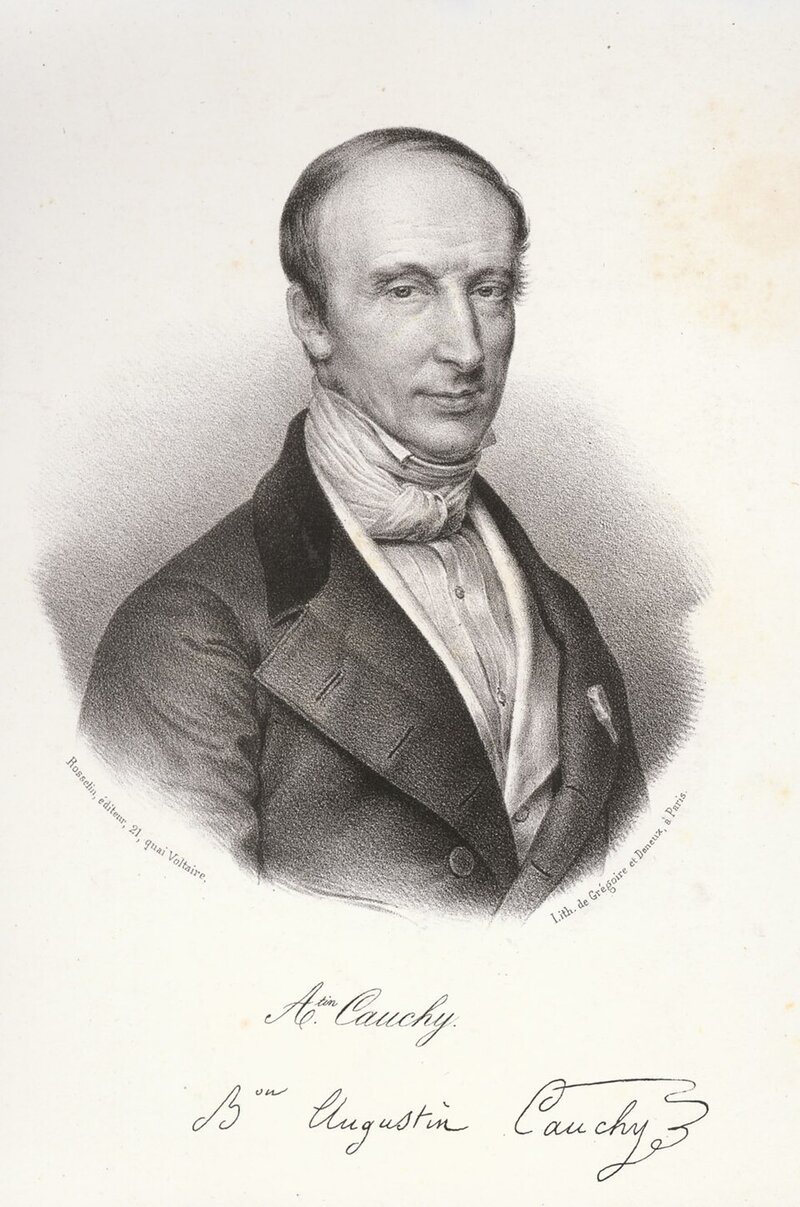
His contemporaries described him as pious, generous to the poor, tireless and almost impossible to live with. He was uncompromising in politics and religion, tried to convert his colleagues, fought hard over priority for discoveries and had a heavy hand as a referee for the Academy. Abel and Galois had reason to complain of him, and the engineer Jean-Victor Poncelet accused him of appropriating his ideas on projective geometry. At the same time, he put his career at risk out of loyalty to an oath and spent eight years away from Paris rather than betray his convictions. In Cauchy’s life, it is hard to separate the scientist from the man of faith and party.
Places
Cauchy is one of the 72 French scientists and engineers whose names Gustave Eiffel had engraved on the Eiffel Tower in 1889. There is a crater Cauchy on the Moon, in the Sea of Tranquillity, and streets bearing his name in Paris, in Sceaux and in several other French towns.

Exercise: Cauchy's functional equation
In the Cours d’analyse, Cauchy proved that the only continuous functions with $f(x + y) = f(x) + f(y)$ for all $x, y$ are those of the form $f(x) = cx$. Redo the argument.
Let $c = f(1)$. With $x = y = 0$, $f(0) = 2f(0)$, so $f(0) = 0$. Adding repeatedly, $f(n) = nf(1) = cn$ for every positive integer $n$, and since $f(x) + f(-x) = f(0) = 0$ this also holds for negative integers. For a positive integer $q$, $c = f(1) = f\!\left(q \cdot \frac{1}{q}\right) = q\,f\!\left(\frac{1}{q}\right)$, so $f\!\left(\frac{1}{q}\right) = \frac{c}{q}$ and $f\!\left(\frac{p}{q}\right) = c\,\frac{p}{q}$. The formula holds at every rational. Every real number is a limit of rationals, and since $f$ is continuous, $f(x) = cx$ for every $x$.
Exercise: a paper every three weeks
Cauchy published about 800 papers between 1811 and 1857. How many papers a year is that, on average? And one every how many days?
That is $1857 - 1811 = 46$ years. $\frac{800}{46} \approx 17$ papers a year, or one paper every $\frac{365}{17} \approx 21$ days: three weeks, for almost half a century, interrupted by revolutions and exile.
Sources: Bruno Belhoste, Augustin-Louis Cauchy: A Biography (1991) · Académie des sciences, Œuvres complètes d’Augustin Cauchy (1882–1974) · Judith V. Grabiner, The Origins of Cauchy’s Rigorous Calculus (1981) · Hans Freudenthal, “Cauchy, Augustin-Louis”, Dictionary of Scientific Biography, vol. 3 (1971).
All topics on Augustin-Louis Cauchy · ← Stress in elastic solids · Image credits →