
Euler's Eyes
2026-10-14
The speeds of molecules: the Maxwell distribution
I have been occupied lately with some questions about the motions and collisions of perfectly elastic spheres, as an exercise in mechanics.
— James Clerk Maxwell, letter to George Stokes (30 May 1859)
A litre of air contains about $2.5\times10^{22}$ molecules, all moving and colliding billions of times a second. Following each one is impossible. In 1859 Maxwell had an idea that changed physics: not to ask what each molecule does, but what fraction of them has each speed. It was the first time probabilities had been used in a law of physics. He presented the result at a meeting in Aberdeen in 1859 and published it in 1860.
The symmetry argument
Maxwell’s reasoning is short and ingenious. Call $p(v_x)$ the probability density of the $x$ component of a molecule’s velocity, and the same for $y$ and $z$. He assumed two things:
- The three components are independent. Knowing $v_x$ tells you nothing about $v_y$. So the joint density is the product $p(v_x)\,p(v_y)\,p(v_z)$.
- No direction is special. The joint density can only depend on the size of the velocity, $v^2=v_x^2+v_y^2+v_z^2$, not on its direction.
Putting the two together, we need a function such that
$$p(v_x)\,p(v_y)\,p(v_z)=\Phi(v_x^2+v_y^2+v_z^2).$$A product that becomes a function of a sum: that is the property of the exponential, $e^ae^be^c=e^{a+b+c}$. The only reasonable solution is
$$p(v_x)=A\,e^{-\beta v_x^2},$$a bell curve, Gauss’s normal curve. The constant $\beta$ depends on the temperature and the mass of the molecule; today it is written $\beta=\frac{m}{2k_BT}$, where $k_B$ is Boltzmann’s constant and $T$ is the absolute temperature.
The distribution of speeds
The bell curve holds for each component, which may be positive or negative. But what about the speed, the size $v$ of the velocity? Velocities with size between $v$ and $v+dv$ form a spherical shell of radius $v$ and thickness $dv$, of volume $4\pi v^2\,dv$. Multiplying:
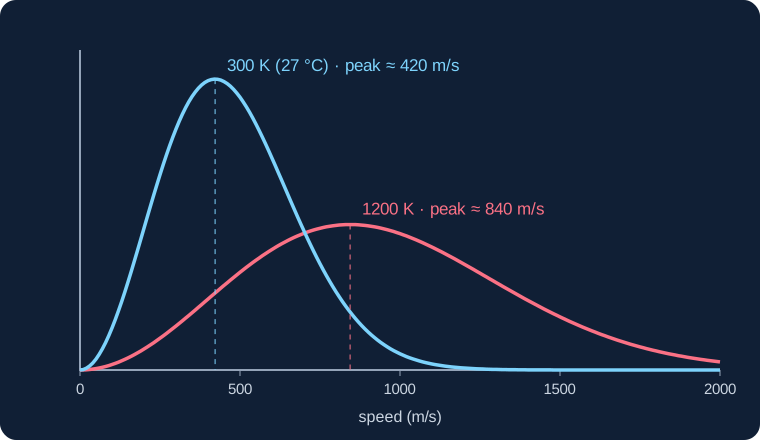
$$\boxed{f(v)=4\pi\left(\frac m{2\pi k_BT}\right)^{3/2}v^2\,e^{-mv^2/(2k_BT)}.}$$This is the Maxwell distribution. The factor $v^2$ makes the curve start at zero: almost no molecule is at rest. The exponential makes it fall quickly: almost none is very fast. In between there is a peak.
How fast does air move?
The peak of the curve is where the derivative is zero. Differentiating the logarithm of $f$:
$$\frac{d}{dv}\ln f=\frac2v-\frac{mv}{k_BT}=0\quad\Longrightarrow\quad v_p=\sqrt{\frac{2k_BT}m}.$$For nitrogen, $m=28\times1.66\times10^{-27}$ kg, at 300 K:
$$v_p=\sqrt{\frac{2\cdot1.38\times10^{-23}\cdot300}{4.65\times10^{-26}}}\approx420\ \text{m/s}.$$More than 1,500 km/h, faster than sound. The mean speed is a little higher, $\sqrt{8k_BT/(\pi m)}\approx480$ m/s, and the root-mean-square speed is $\sqrt{3k_BT/m}\approx520$ m/s. The molecules of the air you breathe move at these speeds, only in random directions and colliding every tenth of a micrometre.
All these speeds grow as $\sqrt{T/m}$. Light molecules are faster: hydrogen, 14 times lighter than nitrogen, is $\sqrt{14}\approx3.7$ times faster. That is why the Earth has lost almost all the hydrogen in its atmosphere: a fraction of its molecules exceeds the escape speed, 11.2 km/s, and flies off into space.
The experiment in the attic
The theory led Maxwell to a strange prediction: the viscosity of a gas, its “resistance to motion”, does not depend on pressure. A rarefied gas slows an object as much as a dense one. It seemed absurd, and he himself doubted it. In 1866, at his house in London, he and his wife Katherine set up an apparatus with discs oscillating inside a chamber of gas, and measured the viscosity at various pressures. Katherine looked after the temperature, keeping the fire going for days. The prediction was right.
Exercise: how much does the typical speed of the molecules change when air goes from 300 K to 1,200 K?
The characteristic speeds are proportional to $\sqrt T$, so the factor is $\sqrt{1\,200/300}=\sqrt4=2$: the peak goes from about 420 m/s to about 840 m/s, as the figure shows. The temperature must be in kelvin: going from 27 °C to 927 °C, you cannot use the ratio $927/27$.
Exercise: is oxygen, of molecular mass 32, faster or slower than nitrogen, of mass 28? By how much?
Speeds go as $\frac1{\sqrt m}$, so the ratio is $\sqrt{28/32}\approx0.935$. Oxygen is about 6.5% slower: at 300 K, its peak is around $420\cdot0.935\approx395$ m/s.
Sources: James Clerk Maxwell, “Illustrations of the dynamical theory of gases”, Philosophical Magazine 19 and 20 (1860) · Stephen G. Brush, The Kind of Motion We Call Heat (North-Holland, 1976) · The Feynman Lectures on Physics, volume I, chapter 40.
All topics on James Clerk Maxwell · ← Saturn’s rings cannot be solid · Maxwell’s equations: from Faraday’s lines of force to vectors →