
Euler's Eyes
2026-10-14
Brownian motion: counting the atoms
If the motion discussed here can actually be observed, then classical thermodynamics can no longer be looked upon as strictly valid for spaces distinguishable under the microscope, and an exact determination of actual atomic dimensions is then possible.
— Albert Einstein, Annalen der Physik (May 1905)
In 1905 many physicists and chemists still doubted that atoms existed. Chemistry worked very well with the hypothesis, but nobody had seen an atom, and important scientists, such as the Austrian physicist Ernst Mach and the German chemist Wilhelm Ostwald, thought atoms were just a convenient way of doing calculations. Einstein found a way to see them, or almost: through their effect on things big enough to show up under a microscope.
The pollen that never stops
In 1827 the Scottish botanist Robert Brown looked through a microscope at tiny grains released from the pollen of a plant, suspended in water. They never stopped moving, zigzagging aimlessly. Brown first thought it was life, but saw the same with powdered glass and stone, which were certainly not alive. The motion never ceased. Nobody could explain it.
Einstein proposed the explanation: each grain is bombarded all the time, from every side, by water molecules. There are trillions of collisions per second, and they almost balance. But not exactly: by chance, at a given instant, there are more collisions on one side than on the other, and the grain makes a little jump. It is like a beach ball pushed about by an invisible crowd.
The random walk
Let us simplify. Imagine a grain that, in each time interval $\delta t$, takes a step of size $a$ to the right or to the left, with a chance of one half each way, each step independent of the previous ones. After $N$ steps, the position is the sum
$$x_N=\xi_1+\xi_2+\cdots+\xi_N,\qquad \xi_i=\pm a.$$On average, the grain goes nowhere: steps to the right and to the left cancel out, and $\langle x_N\rangle=0$. But that does not mean it stands still! The right question is how far it usually gets, and for that we look at the square of the position:
$$x_N^2=\sum_i\xi_i^2+\sum_{i\neq j}\xi_i\xi_j.$$Each $\xi_i^2$ equals $a^2$. Each product $\xi_i\xi_j$ of different steps is $+a^2$ or $-a^2$ with equal chance, so on average it is zero. What is left is
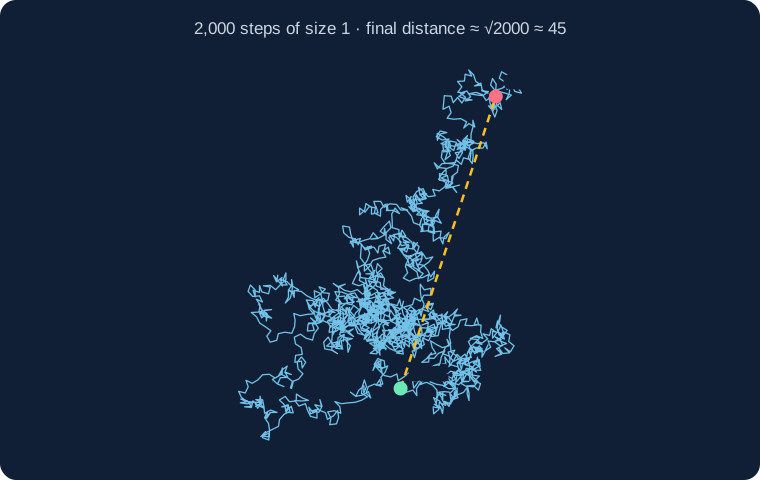
$$\langle x_N^2\rangle=Na^2.$$The typical distance, the square root of this value, is $a\sqrt N$. After 100 steps the grain is typically 10 steps from the start; after 10,000 steps, 100. Writing $N=t/\delta t$ and calling $D=\frac{a^2}{2\,\delta t}$ the diffusion coefficient,
$$\boxed{\langle x^2\rangle=2Dt.}$$The distance grows as the square root of time. To go twice as far, you have to wait four times as long. That is why a sugar cube takes so long to sweeten a glass of tea left unstirred.
Einstein’s formula
Einstein’s decisive step was to connect $D$, which is measured under the microscope, with the properties of the liquid and the molecules. For a sphere of radius $r$ in a liquid of viscosity $\eta$, at absolute temperature $T$, he showed that
$$D=\frac{RT}{N_A}\cdot\frac{1}{6\pi\eta r}.$$Here $R$ is the gas constant, known for a long time, and $N_A$ is Avogadro’s number, the number of molecules in a mole, which nobody knew how to measure properly. Everything else can be measured: the temperature, the viscosity, the size of the grain and, with patience, the displacement $\langle x^2\rangle$. So the formula gives $N_A$. By watching pollen grains, one counts how many molecules there are in a glass of water.
To get an idea, a grain 1 micrometre across in water at room temperature has $D\approx4\times10^{-13}$ m²/s. In one second it typically moves $\sqrt{2Dt}\approx0.9$ micrometre in one direction; in one minute, about 7 micrometres. That is not much, but it is visible under a microscope.
Perrin counts the atoms
In 1908 and 1909 the French physicist Jean Perrin made the measurements. He prepared grains of a yellow resin, gamboge, all of the same size, followed them under the microscope every 30 seconds and drew their paths on squared paper. With Einstein’s formula he obtained $N_A\approx6\times10^{23}$, very close to the value accepted today, $6.022\times10^{23}$. Other, completely different methods gave the same number.
Faced with this, even Ostwald was convinced that atoms exist. Perrin won the 1926 Nobel Prize in Physics.
Exercise: a grain moves on average 2 micrometres in 10 seconds. How long does it take to move 20 micrometres?
The distance is proportional to $\sqrt t$. To multiply the distance by 10, you must multiply the time by $10^2=100$: that is 1,000 seconds, almost 17 minutes. That is why diffusion is fast over small distances, as inside a cell, and extremely slow over large ones.
Exercise: in a straight-line walk of 4 steps of size 1, what is the mean of x²? Check by counting the 16 cases.
The formula gives $\langle x^2\rangle=Na^2=4$. Counting: the final position is $4$, $2$, $0$, $-2$ or $-4$, with $1$, $4$, $6$, $4$ and $1$ paths respectively, the numbers of Pascal’s triangle. So
$$\langle x^2\rangle=\frac{1\cdot16+4\cdot4+6\cdot0+4\cdot4+1\cdot16}{16}=\frac{64}{16}=4.$$The mean of $x$ is zero, but that of $x^2$ is not.
Sources: Albert Einstein, “On the motion of small particles suspended in liquids at rest”, Annalen der Physik 17 (1905), in Einstein’s Miraculous Year, ed. John Stachel (Princeton, 1998) · Jean Perrin, Atoms (1913) · 1926 Nobel Prize in Physics, Nobel Foundation.
All topics on Albert Einstein · ← The photoelectric effect: light comes in packets · Special relativity: a clock made of light →