
Euler's Eyes
2026-10-28
Spherical triangles and the measurement of the Earth
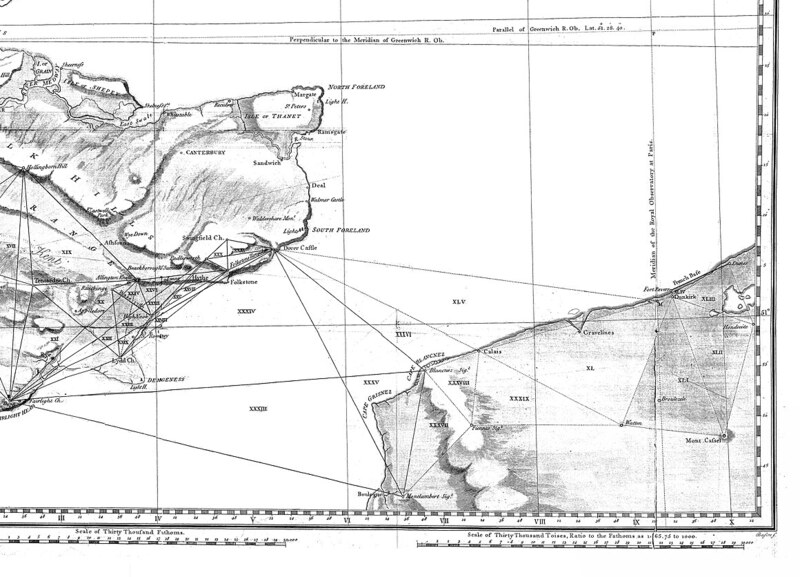
In 1783 César-François Cassini de Thury, director of the Paris Observatory, wrote to the Royal Society proposing to settle an old question: what, exactly, was the difference in longitude between the observatories of Paris and Greenwich? The astronomical measurements disagreed by several seconds of time. The proposed solution was triangulation: cover the ground between the two observatories with a chain of triangles, measure a single side and all the angles with great care, and compute the rest.
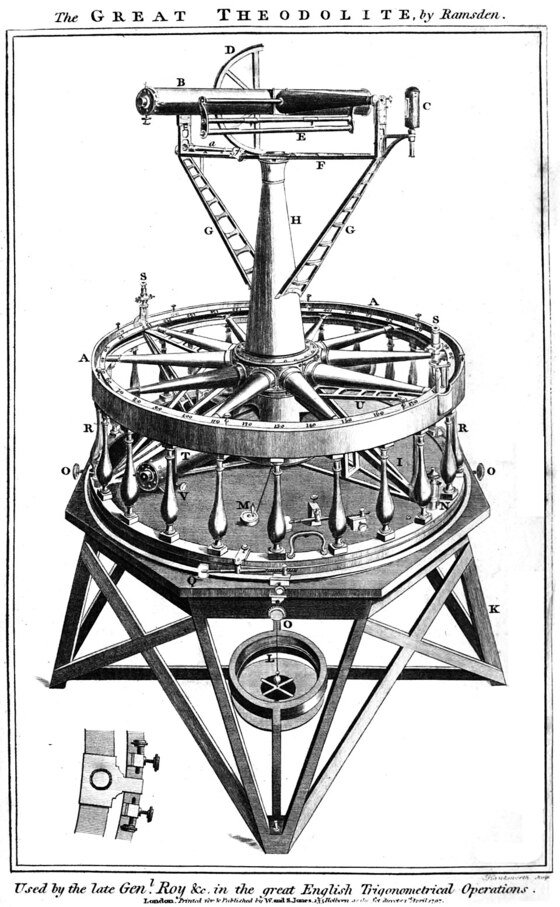
On the English side, General William Roy ordered from Jesse Ramsden a new theodolite, with a circle three feet across, able to read angles to one second. On the French side, Cassini, Méchain and Legendre used a new instrument by Borda, the repeating circle. In 1787 the two teams met in Dover and joined their chains across the Channel, with lights burning at night on both shores.
The Earth is not flat
When a triangle is fifty kilometres across, the curvature of the Earth already shows up in the measurements. The three angles of a triangle drawn on a sphere add up to more than $180^\circ$. The difference is called the spherical excess, and it is proportional to the area of the triangle:
$$\varepsilon = A + B + C - 180^\circ = \frac{\text{area}}{R^2} \quad (\text{in radians}).$$For an equilateral triangle with sides of $50$ km, the area is about $\frac{\sqrt{3}}{4}\cdot 50^2 \approx 1{,}083$ km², and with $R = 6{,}371$ km,
$$\varepsilon \approx \frac{1{,}083}{6{,}371^2} \approx 2.67 \times 10^{-5} \text{ rad} \approx 5.5''.$$Five and a half seconds seems little, but Ramsden’s theodolite read to one second. Ignoring the excess would ruin the whole precision of the operation. The correct route would be to solve each triangle with the formulas of spherical trigonometry, such as
$$\cos a = \cos b\,\cos c + \sin b\,\sin c\,\cos A,$$where the sides $a, b, c$ are angles seen from the centre of the Earth. With sides of a few hundredths of a radian, these formulas force one to work with cosines very close to $1$, and call for tables with many decimal places.
Legendre’s theorem
In his memoir of 1787 on trigonometric operations, Legendre showed a shortcut. Expanding the spherical formulas in powers of the sides, he proved that:
Legendre’s theorem. A small spherical triangle can be solved as a plane triangle with sides of the same length, provided each of its angles is reduced by one third of the spherical excess.
In formulas: if $A', B', C'$ are the angles of the plane triangle with sides of the same length,
$$A \approx A' + \frac{\varepsilon}{3}, \qquad B \approx B' + \frac{\varepsilon}{3}, \qquad C \approx C' + \frac{\varepsilon}{3},$$with an error of the order of the fourth power of the sides divided by the radius. In practice, the surveyor measures the angles in the field, computes the approximate area, subtracts $\varepsilon/3$ from each angle and solves the triangle with school plane trigonometry. In the $50$ km triangle, the correction is $1.83''$ per angle.
In the figure, change the sides and compare the exact spherical angles with those of the corrected plane triangle:
The theorem was used soon afterwards in the greatest triangulation of the century: the measurement of the arc of meridian between Dunkirk and Barcelona, carried out by Delambre and Méchain from 1792 to 1798, which fixed the length of the metre as one ten-millionth of the distance from the pole to the equator. Legendre sat on the committee that directed the work.
Exercise: one eighth of the Earth
The triangle with vertices at the north pole and at two points on the equator $90^\circ$ of longitude apart has three right angles. Check the formula $\varepsilon = \text{area}/R^2$.
The angles add up to $270^\circ$, so $\varepsilon = 90^\circ = \frac{\pi}{2}$. The triangle covers one eighth of the surface of the sphere, that is, an area of $\frac{4\pi R^2}{8} = \frac{\pi R^2}{2}$. Dividing by $R^2$ gives $\frac{\pi}{2}$, as it should. Notice that in an equilateral triangle Legendre’s rule is always exact, by symmetry: the three angles are equal, each is $60^\circ + \frac{\varepsilon}{3}$, and here $60^\circ + 30^\circ = 90^\circ$. To see the error of the theorem one needs a large, unequal triangle; try sides of $3{,}000$, $2{,}000$ and $1{,}500$ km in the figure.
Exercise: a 100 km triangle
What is Legendre’s correction for each angle of an equilateral triangle with sides of $100$ km on the Earth?
The area is $\frac{\sqrt{3}}{4}\cdot 100^2 \approx 4{,}330$ km². The excess is
$$\varepsilon \approx \frac{4{,}330}{6{,}371^2} \approx 1.067 \times 10^{-4} \text{ rad}.$$Since $1$ rad $\approx 206{,}265''$, this gives $\varepsilon \approx 22.0''$, and each angle is $60^\circ + 7.3''$. Quadrupling the area quadrupled the correction.
Sources: Adrien-Marie Legendre, “Mémoire sur les opérations trigonométriques dont les résultats dépendent de la figure de la Terre”, Mémoires de l’Académie royale des sciences (1787) · William Roy, “An account of the trigonometrical operation, whereby the distance between the meridians of the Royal Observatories of Greenwich and Paris has been determined”, Philosophical Transactions 80 (1790) · Ken Alder, The Measure of All Things (2002).
All topics on Adrien-Marie Legendre · ← The attraction of spheroids · The Elements of Geometry →