
Euler's Eyes
2026-10-11
Chapter exercises 10 — Circumference and circle
Exercises and resolutions
Determine the radius of the center circle $O$, given $AB = 3x - 3$ and $OA = x + 3$.
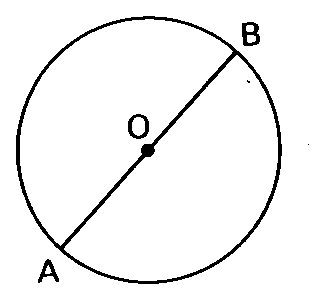
Ver resposta
$r = 12$
The circle has a radius of 16 cm and the point $P$ is 7 cm from the center. Determine the distance between $P$ and the circumference.
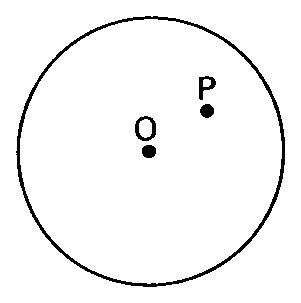
Ver resposta
9 cm
Determine the value of $x$ in the cases: a) $s$ is perpendicular to $\overline{AB}$; b) $\overline{PA}$ and $\overline{PB}$ are tangents to the circle.
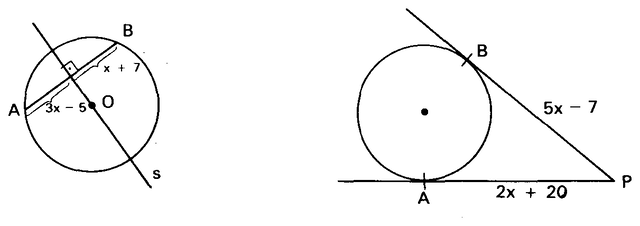
Ver resposta
a) $x = 6$ · b) $x = 9$
Determine the value of $x$, with $O$ being the center of the circle, in the following cases:
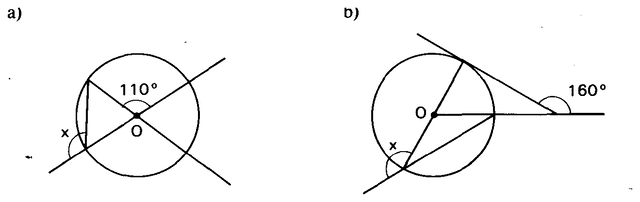
Ver resposta
a) $125^{\circ}$ · b) $145^{\circ}$
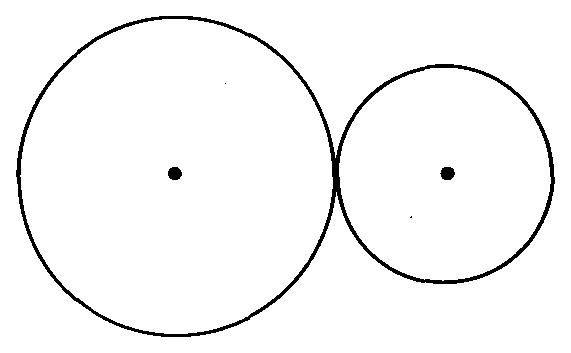
The circumferences of the figure are externally tangent. If the distance between the centers is 28 cm and the difference between the radii is 8 cm, determine the radii.
Ver resposta
18 cm and 10 cm
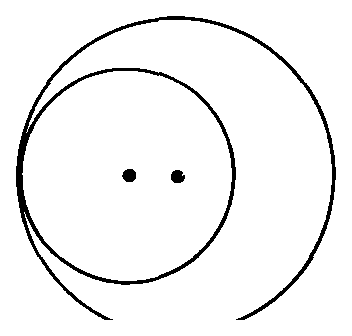
Two circles are internally tangent and the sum of their radii is 30 cm. If the distance between the centers is 6 cm, determine the radii.
Ver resposta
18 cm and 12 cm
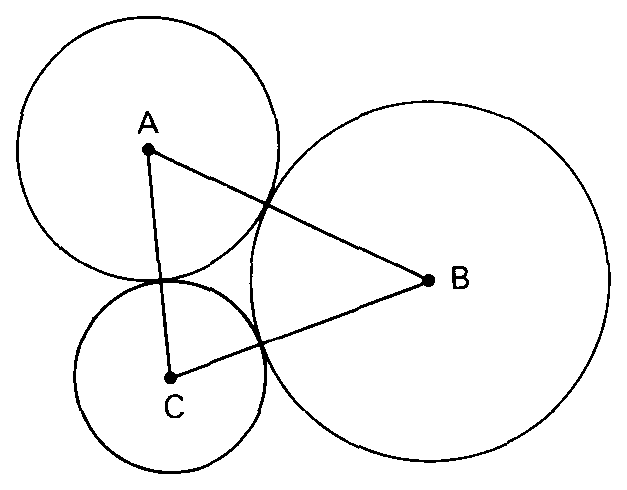
In the figure, the circles are tangents two by two and the centers are the vertices of the triangle $ABC$. Being $AB = 7$ cm, $AC = 5$ cm and $BC = 6$ cm, determine the radii of the circles.
Ver resposta
2 cm, 3 cm and 4 cm
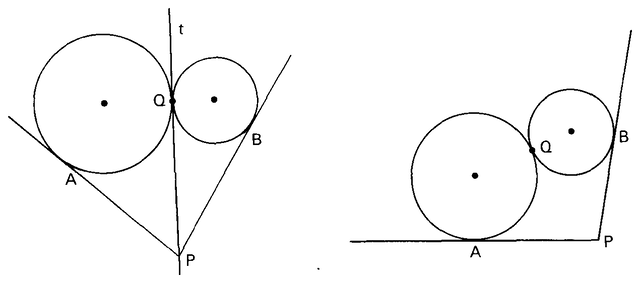
The circles are externally tangent to $Q$, and $\overrightarrow{PA}$ and $\overrightarrow{PB}$ are tangents to the circles. Determine the measure of the angle $A\hat{Q}B$ in the cases: a) where $t$ is a common tangent and $A\hat{P}B = 80^{\circ}$; b) with $A\hat{P}B = 100^{\circ}$.
Ver resposta
a) $140^{\circ}$ ($\triangle PAQ$ and $\triangle PBQ$ are isosceles; use the sum of the angles) · b) $130^{\circ}$ (consider the common tangent through $Q$ and extend $\overline{BP}$, obtaining two isosceles triangles)
State the number of straight lines that pass through the point $P$ and touch the circle $\lambda$ in the following cases: a) $P$ belongs to $\lambda$; b) $P$ is inside $\lambda$; c) $P$ is external to $\lambda$.
Ver resposta
a) 1 · b) 0 · c) 2
Determine the number of common tangent lines that we can draw to two circles in the cases: a) different concentric; b) exterior; c) drying agents; d) tangents externally; e) tangents internally.
Ver resposta
a) none · b) 4 · c) 2 · d) 3 · e) 1
Can a circular sector coincide with a circular segment? Name the case.
Ver resposta
Can: when the string is one diameter (both are semicircles).
In which case is a circular sector a semicircle?
Ver resposta
When the radii are on the same straight line (they form a diameter).
What can we say about the line that passes through the point of tangency of two circles tangent to each other, knowing that this line is perpendicular to the line that passes through the centers?
Ver resposta
It is tangent to both circles.
Is it possible to obtain a chord that passes through the midpoint of the diameter of a circle?
Ver resposta
Yes, when that string is the diameter itself.
Give the position of two circles with radii $r$ and $R$, with $d$ being the distance between their centers, in the cases: a) $r = 2$ cm, $R = 5$ cm, $d = 10$ cm; b) $r = 5$ cm, $R = 10$ cm, $d = 15$ cm; c) $r = 3$ cm, $R = 7$ cm, $d = 4$ cm; d) $r = 6$ cm, $R = 10$ cm, $d = 0$ cm; e) $r = 6$ cm, $R = 8$ cm, $d = 10$ cm.
Ver resposta
a) exterior · b) tangents outside · c) tangents inside · d) concentric · e) secants
The distance between the centers of two outwardly tangent circles is 33 cm. Determine their diameters, knowing that the ratio between their radii is $\dfrac{4}{7}$.
Ver resposta
24 cm and 42 cm
The distance between the centers of two internally tangent circles is 5 cm. If the sum of the radii is 11 cm, determine the radii.
Ver resposta
8 cm and 3 cm
Two circles are secants, with 20 cm being the distance between their centers. Knowing that the radius of the smallest circle measures 11 cm, determine the radius of the largest, which is a multiple of 6.
Ver resposta
12 cm, 18 cm, 24 cm or 30 cm
Two circles with centers $A$ and $B$ are externally tangent and internally tangent to a circle with center $C$. With $AB = 12$ m, $AC = 17$ m and $BC = 13$ m, determine the radii of these circles.
Ver resposta
4 m, 8 m e 21 m
Let $P$ be the point of tangency of the circle inscribed in the triangle $ABC$ with the side $\overline{AB}$. If $AB = 7$, $BC = 6$ and $AC = 8$, how much is $AP$ worth?
Ver resposta
$AP = 4{,}5$
Consider a triangle $ABC$ with sides $AB = c$, $AC = b$ and $BC = a$, and let $P$, $Q$ and $R$ be the points at which the sides $\overline{BC}$, $\overline{AC}$ and $\overline{AB}$ touch the inscribed circle. Calculate the segments $AR = x$, $BP = y$ and $CQ = z$.
See the resolution of the book
By the tangent segments, $AQ = x$, $BR = y$ and $CP = z$. Then
$$x + y = c \ (1), \qquad x + z = b \ (2), \qquad y + z = a \ (3).$$Adding, $2(x + y + z) = a + b + c = 2p$, where $p$ is the semiperimeter: $x + y + z = p$ (4). Hence:
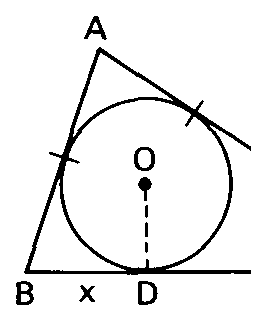
$$(4) - (3):\ x = p - a; \qquad (4) - (2):\ y = p - b; \qquad (4) - (1):\ z = p - c.$$In the figure, determine the measurement of the segment $\overline{BD}$, knowing that the circle with center $O$ is inscribed in the triangle $ABC$ and that the sides $\overline{AB}$, $\overline{BC}$ and $\overline{AC}$ measure 6 cm, 8 cm and 10 cm, respectively.
Ver resposta
$BD = 2$ cm
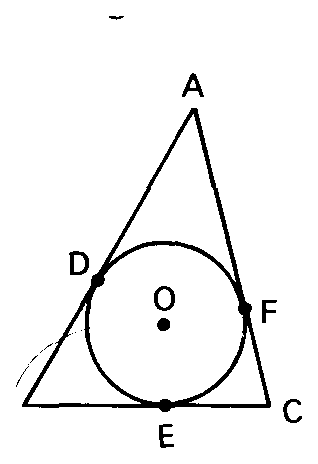
In the figure, the center circle $O$ is inscribed in the triangle $ABC$, with $BD = 4$, $AF = 3$ and $EC = 5$. What is the perimeter of triangle $ABC$?
Ver resposta
24
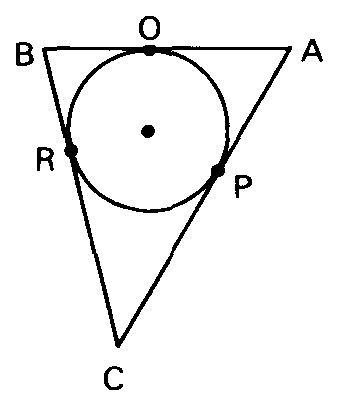
In the figure, knowing that $AB = c$, $BC = a$, $AC = b$ and $p$ is the semiperimeter of the triangle, prove that $AP$ is equal to $p - a$.
Ver resposta
See exercise 356.
A circle is inscribed in a triangle $ABC$ and touches the sides $\overline{BC}$, $\overline{AC}$ and $\overline{AB}$, respectively, in $P$, $Q$ and $R$. If $AB = c$, $AC = b$, $BC = a$ and the semiperimeter is $p$, calculate $AR$, $BP$ and $CQ$.
Ver resposta
$AR = p - a$, $BP = p - b$ e $CQ = p - c$
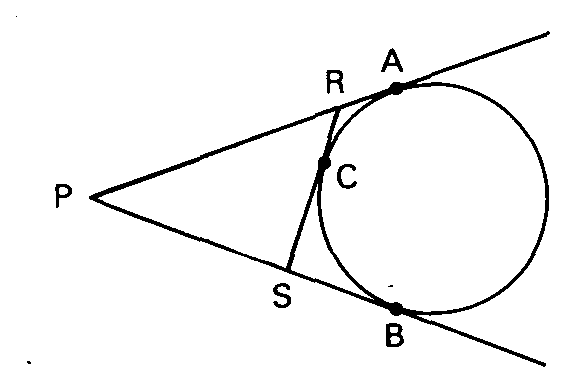
In the figure, $PA = 10$ cm. Calculate the perimeter of the triangle $PRS$.
Ver resposta
20 cm
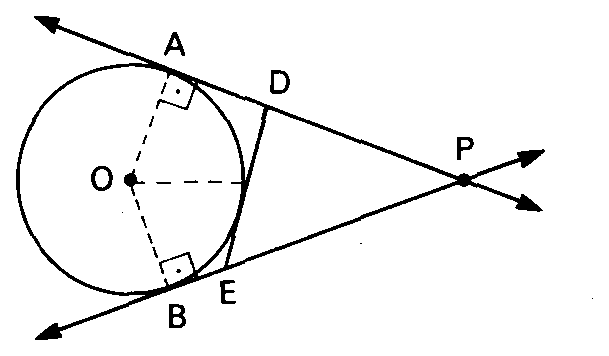
In the figure, $\overline{PA}$ is equal to three times the diameter of the circle. Determine the measurement of the perimeter of the triangle $PDE$ as a function of the radius $r$ of that circle.
Ver resposta
$12r$
The hypotenuse of a right-angled triangle measures 10 cm and the radius of the inscribed circle measures 1 cm. Calculate the perimeter of the triangle.
See the resolution of the book
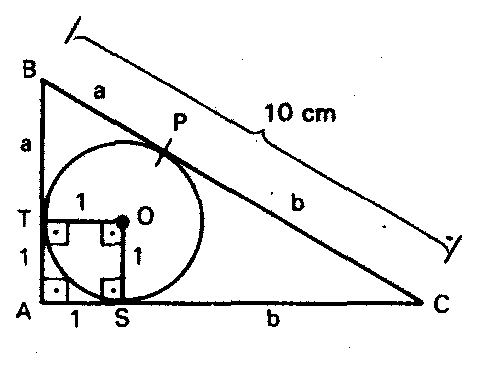
The quadrilateral $SATO$ is a square with side 1 cm. Indicating $BP = BT = a$ and $CP = CS = b$:
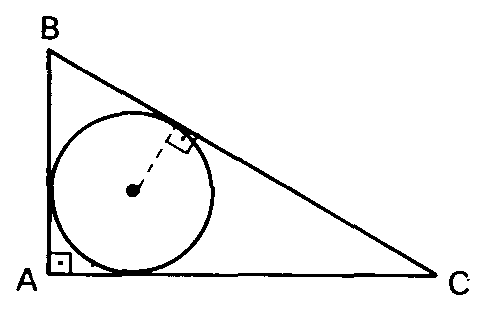
$$2p = (a + 1) + (b + 1) + (a + b) = 2(a + b) + 2 = 2 \cdot 10 + 2 = 22 \text{ cm}.$$In the figure, calculate the measurement of the radius $r$ of the circle inscribed in the right-angled triangle $ABC$, being $AB = 10$ cm, $AC = 24$ cm and $BC = 26$ cm.
Ver resposta
$r = 4$ cm
Determine the diameter of a circle inscribed in a right-angled triangle whose sides measure 9 cm, 12 cm and 15 cm.
Ver resposta
6 cm
Determine the radius of a circle inscribed in a right-angled triangle with legs $b$ and $c$ and hypotenuse $a$.
Ver resposta
$r = \dfrac{b + c - a}{2}$
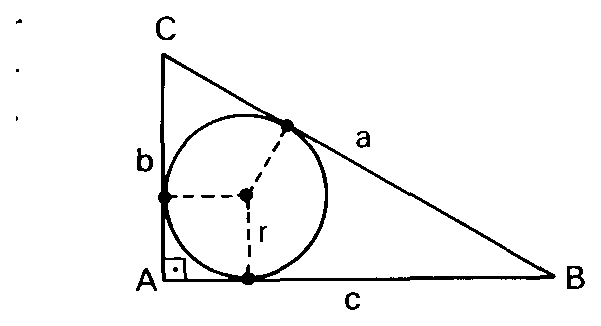
In the figure, with $2p = a + b + c$ and $r$ being the radius of the inscribed circle, calculate the measure of the hypotenuse $a$ as a function of $p$ and $r$.
Ver resposta
$a = p - r$
Determine the perimeter of the circumscribed quadrilateral $ABCD$ of the figure, with $AB = 3x + 1$, $BC = 2x$, $CD = x + 1$ and $DA = 3x$.
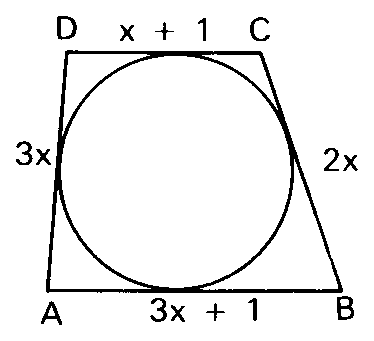
See the resolution of the book
Since $ABCD$ is circumscribed, $AB + CD = BC + AD$: $(3x + 1) + (x + 1) = 2x + 3x \Rightarrow x = 2$. The perimeter is $2p = (3x + 1) + 2x + (x + 1) + 3x = 9x + 2 = 20$.
$ABCD$ is a circumscriptible quadrilateral whose sides measure $AD = 12$ cm, $DC = 9$ cm, $BC = x + 7$ and $AB = 2x + 1$. Determine the perimeter of this quadrilateral.
Ver resposta
56 cm
Calculate the value of the radius $r$ of the circle inscribed in the rectangular trapezoid in the figure.
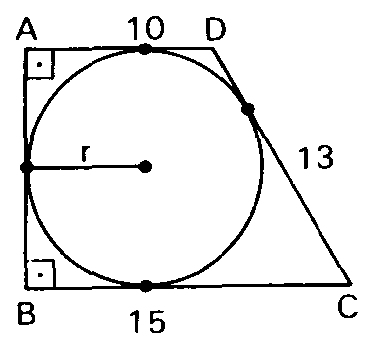
Ver resposta
$r = 6$
The difference of two opposite sides of a circumscribable quadrilateral is equal to 8 cm, and the difference of the other two sides is 4 cm. Determine the sides of the quadrilateral, with 56 cm being their sum.
Ver resposta
18 cm, 16 cm, 10 cm and 12 cm
In the figure, determine the perimeter of the triangle $ADE$, knowing that the perimeter of the triangle $ABC$ is worth 10 cm, the base $\overline{BC}$ measures 4 cm and the circle is inscribed in the quadrilateral $BCDE$.
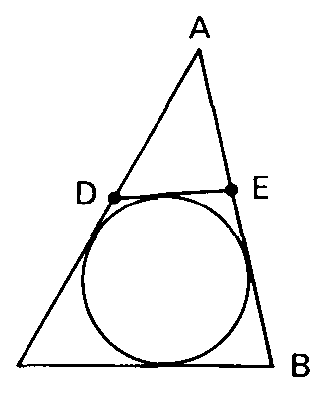
Ver resposta
2 cm
Determine the measurement of one of the non-parallel sides of an isosceles trapezoid circumscribed by a circle, knowing that its bases measure 30 cm and 10 cm.
Ver resposta
20 cm
Prove that any parallelogram circumscribed by a circle is a rhombus.
Ver resposta
In the parallelogram, $AB = CD$ and $BC = AD$; with Pitot, $AB + CD = BC + AD$ gives $2AB = 2BC$: the four sides are equal.
Prove that the diameter is the largest chord of a circle.
Ver resposta
For a chord $\overline{AB}$, the triangular inequality in $\triangle OAB$ gives $AB \leq OA + OB = 2r$, with equality only when $O \in \overline{AB}$ (diameter).
Prove that if two chords on a circle are the same distance from the center, then they are congruent.
Ver resposta
The perpendiculars from the center to the chords are the same length and fall at the midpoints; For congruent right triangles (leg and hypotenuse = radius), the halves of the chords are equal.