
Euler's Eyes
2022-09-28
Introduction to Probability
In this post we are going to talk a little about probability, for this we must bear in mind that working with this theory it is essential to evaluate:
- human intuition
- phenomena of nature (physis or physics)
- among others
Over the years, mathematics has also been based on these concepts.
- Years 0 to 1637 - Drawing nature;
- Years 1637 to 1830 - Decode nature;
- Years 1830 to 1890 - Imitate and engineer nature;
- Years 1890 to 1980 - Control nature;
- Years 1980 to today - Creating nature.
Initial notions of Probability
Probability is based on human learning principles. For this, we use experiment concepts.
These experiments are classified into two types:
- Random (casual)
- Non-random (deterministic)
Deterministic experiments: are those in which the result is known before the occurrence and we cannot intervene anything.
For example, when we put ice to melt, the result is known. From solid to liquid.

Random experiments: are those in which the result is not known, that is, we cannot predict the result.
For example, when a coin is tossed, we don’t know if it will come up heads or tails.
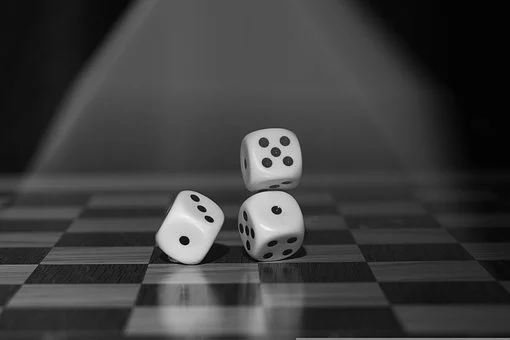
| Coin Launch | Dice release |
|---|---|

|

|
Sample Space
Definition 1 (Sample Space): is the set established by all possible results of an experiment. It is represented by the Greek letter omega $(\Omega)$ or S.
Example 1: In a coin toss the sample space is given by:
$$\Omega = \\{\text{cara},~ \text{coroa}\\}$$
Example 2: In a roll of a die with 6 sides, the sample space is given by:
$$\Omega = \\{1,2,3,4,5,6\\}$$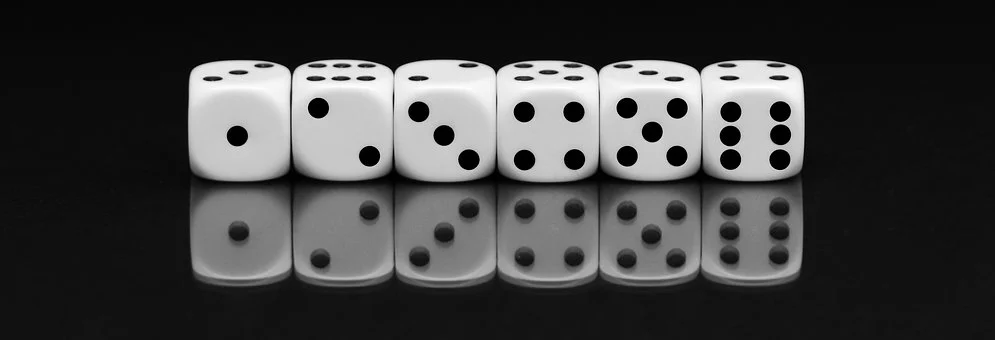
Example 3: When we produce a product we can classify it as defect or non-defect, the sample space is given by:
$$\Omega = \\{\text{defeito},~ \text{não defeito}\\}$$
Events
The questions that we can ask associated with the sample space are defined below:
Definition 2 (Events): is a subset of the sample space, of possible results of an experiment.
From the example 2, we can formulate some events:
- $A= \\{\text{sair número par}\\} = \\{2,4,6\\}$
- $B= \\{\text{sair número ímpar}\\} = \\{1,3,5\\}$
- among others
It is worth remembering that:
- the sample space itself is an event, also known as a certain event
- the empty set $\varnothing$ is called an impossible event.
Event Operations and Venn-Euler Diagram
When we work with events, it is necessary to use logical relationships with events. The main event operations are:
- Unity
- Intersection
- Complementary
Venn-Euler diagram definition: is a methodology for graphically representing a set.

Union: is the union of all elements of the defined sets. The symbol for the union of sets is given by $\bigcup$
For example, if we have two sets $A$ and $B$, the union is given by $A\bigcup B$. Let the sets be:
$$\Omega = \mathbb{N} = \\{0,1,2,3, \dots\\}$$$$A = \\{1,2,3\\}$$
$$B = \\{3, 4, 5\\}$$

$$\Omega = \mathbb{N} = \\{0,1,2,3, \dots\\}$$Intersection: are all common elements of the defined sets. The symbol for the union of sets is given by $\bigcap$
$$A = \\{8,9,10\\}$$
$$B = \\{10, 20, 30\\}$$
 $$A\bigcap B = \\{10\\}$$
$$\Omega = \\{1,2,3, 4,5\\}$$Complementary: are all elements that are not in the defined sets. The symbol for the union of sets is given by $\complement$.
$$A = \\{1,2,3\\}$$
$$\complement A = \Omega - A = \\{4,5\\}$$

These are the initial concepts for probabilities. Wait for the next posts.