No figures will be found in this work. The methods I set out in it require neither constructions nor geometrical or mechanical reasoning, but only algebraic operations, subject to a regular and uniform procedure.
— Joseph-Louis Lagrange, preface to the Analytical Mechanics (1788)
Joseph-Louis Lagrange (1736–1813) was born Italian, in Turin, became a professor at 19, succeeded Euler in Berlin and died French, a count of the Empire, buried in the Panthéon in Paris. He wrote an entire book on mechanics without a single drawing, proved that every whole number is a sum of four squares and found, in the middle of an astronomy problem, five points in space where a small body can stay put between two large ones. The James Webb Space Telescope sits at one of them today.
In this trail we tell Lagrange’s life and redo, with the calculations in full, seven of his discoveries. Almost all of them bear the same mark: trading a clever drawing for a rule of calculation that anyone can follow.
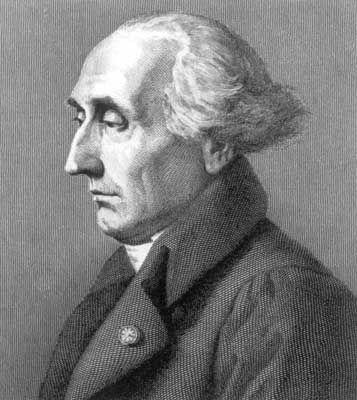
Who he was
Joseph-Louis Lagrange
- Nascimento
- 25 January 1736, Turin
- Morte
- 10 April 1813, Paris
- Origem
- Kingdom of Sardinia (now Italy) and France
- Áreas
- Analysis, mechanics, astronomy, number theory and algebra
Reading guide
Biography
Discovery and proof
- The calculus of variations: a letter from a 19-year-old
- The Analytical Mechanics: a book without figures
- The Lagrange points: where gravity balances
- Four squares are enough
- Shuffling the roots: Lagrange’s theorem
- The derivative without infinitesimals and the mean value theorem
- Lagrange multipliers: optimising under a constraint