
Euler's Eyes
2026-10-11
The life of Gottfried Wilhelm Leibniz
Timeline
- 1646Born on 1 July in Leipzig, in the Holy Roman Empire.
- 1661Enters the University of Leipzig, aged 14.
- 1666Publishes De arte combinatoria. Leipzig refuses him a doctorate in law; Altdorf awards it the following year.
- 1672Goes to Paris on a diplomatic mission. Begins to study mathematics seriously with Christiaan Huygens.
- 1673Presents his calculating machine in London and is elected to the Royal Society.
- 1675In manuscripts of October and November, creates the symbols $\int$ and $d$.
- 1676Moves to Hanover, where he will work as librarian and counsellor for 40 years.
- 1684Publishes the first paper on differential calculus in the journal Acta Eruditorum.
- 1700Founds the Berlin Academy of Sciences and becomes its first president.
- 1703Publishes his explanation of binary arithmetic.
- 1716Dies on 14 November in Hanover.
- He is born and studies in Leipzig. The university refuses him a doctorate in law, saying he is too young.
- He obtains his doctorate within a few months, near Nuremberg, and turns down the professorship he is offered.
- He enters the service of the Prince-Archbishop of Mainz as a jurist and adviser.
- He arrives on a diplomatic mission and learns mathematics from Christiaan Huygens. In 1675 he creates the symbols $\int$ and $d$.
- He shows his calculating machine at the Royal Society and is elected a fellow.
- On his way to Hanover he visits the philosopher Baruch Spinoza.
- Librarian and adviser to the dukes for forty years. He publishes the calculus (1684) and binary arithmetic (1703). He dies in 1716.
- He travels for three years through archives in Germany, Austria and Italy to write the history of the ducal family.
- He founds the Berlin Academy of Sciences and becomes its first president.
- 1646–1666 · Leipzig
- 1666–1667 · Altdorf
- 1668–1672 · Mainz
- 1672–1676 · Paris
- 1673 · London
- 1676 · The Hague
- 1676–1716 · Hanover
- 1687–1690 · Rome
- 1700 · Berlin
Leibniz’s life
The boy in the library
Leibniz was born in Leipzig two years before the end of the Thirty Years’ War, which devastated the German lands. His father, Friedrich, was professor of moral philosophy at the university and died when his son was six. He left a large library.
At eight the boy was allowed in. The books were in Latin, which he could not yet read. Using an illustrated edition of the Roman historian Livy, he guessed words from the pictures and the context until he had taught himself the language. By twelve he read Latin easily and was starting on Greek.
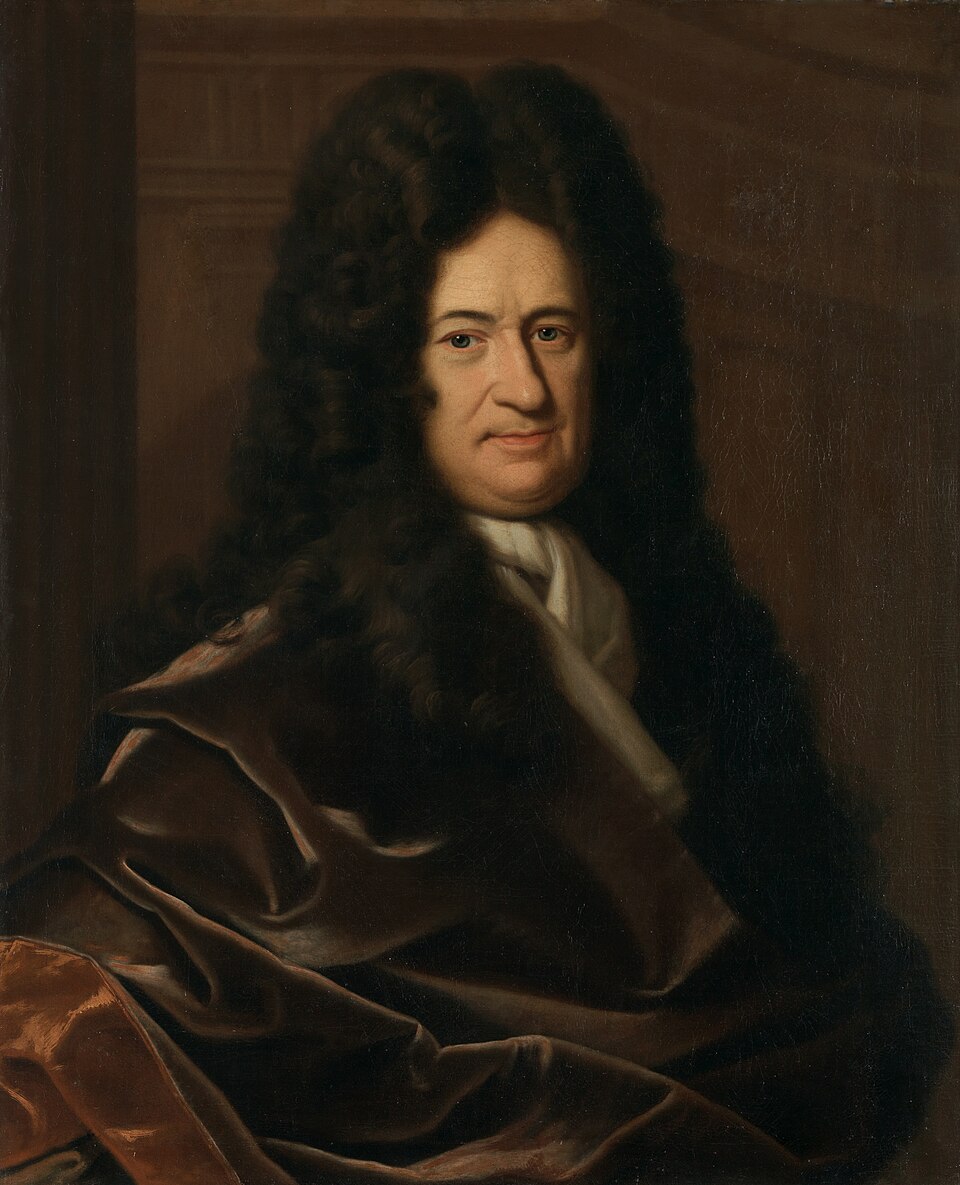
Too young to be a doctor
He entered the University of Leipzig at 14 and studied philosophy and law. At 20 he published De arte combinatoria, a book about combining simple ideas to form complex ones. There already was the dream that would follow him all his life: an alphabet of thought, which you will meet in the post on logic.
That same year he applied for a doctorate in law. The University of Leipzig refused, officially because he was too young. Leibniz went to the University of Altdorf, near Nuremberg, and obtained the degree within months. He was immediately offered a professorship. He declined: he wanted a more active life than the academic one.
Paris: a diplomat learns mathematics
Leibniz entered the service of the Archbishop-Elector of Mainz. In 1672 he was sent to Paris on a bold mission: to persuade King Louis XIV to invade Egypt instead of attacking Holland and the German lands. The king never received him. More than a century later, in 1798, Napoleon invaded Egypt, and some historians noticed the resemblance to Leibniz’s plan.
The mission failed, but Paris changed Leibniz’s life. He met Christiaan Huygens, the greatest scientist on the Continent, and admitted he knew little mathematics. Huygens set him a problem to test him: what is the sum of the reciprocals of the triangular numbers?
$$1+\frac13+\frac16+\frac1{10}+\frac1{15}+\cdots$$Leibniz noticed that each term is a difference:
$$\frac{2}{n(n+1)}=2\left(\frac1n-\frac1{n+1}\right).$$Adding up, almost everything cancels, like a telescope folding shut:
$$2\left(1-\frac12+\frac12-\frac13+\frac13-\cdots\right)=2.$$The idea that sums undo differences is the heart of calculus. Leibniz was three years away from inventing it.
In October and November 1675, in his notebooks, Leibniz wrote the symbols $\int$ and $d$ for the first time. Calculus had been born, for the second time: Newton had reached the same ideas ten years earlier, but almost nobody knew.
Hanover: forty years of service
In 1676 Leibniz accepted the post of librarian and counsellor to the Dukes of Brunswick-Lüneburg in Hanover. On the way he visited the philosopher Baruch Spinoza in The Hague. He would stay in Hanover until his death.
The dukes gave him all kinds of tasks. Between 1680 and 1686 he tried to drain the silver mines of the Harz mountains with windmills. The miners were suspicious, the wind was irregular, and the project failed. Then he was charged with writing the history of the ducal family. He spent three years travelling through archives in Germany, Austria and Italy, and discovered that the family descended from the Italian house of Este. The history was never finished.
In the middle of all this, he published calculus in 1684, founded the Berlin Academy of Sciences in 1700, advised Tsar Peter the Great on creating an academy in St Petersburg, which would later be Euler’s home, and wrote some 15,000 letters to more than a thousand correspondents. His papers are now in UNESCO’s Memory of the World register.
The best of all possible worlds
As a philosopher, Leibniz argued that God, being good and wise, chose to create the best of all possible worlds, and that evil exists because a world without it would be worse overall. Voltaire found the idea ridiculous and in 1759 satirized it in the novel Candide, in which Professor Pangloss repeats that “all is for the best in the best of all possible worlds” while suffering one disaster after another.
A lonely end
His last years were bitter. The quarrel with Newton over the invention of calculus left him isolated. In 1714 his employer, Duke George Louis, became King of Great Britain as George I and moved to London. Leibniz asked to go with him and was refused: he was to stay in Hanover and finish the family history.
He died on 14 November 1716, aged 70. He never married. It is said that only his secretary attended the burial. The Royal Society, of which he was a Fellow, did not mark his death. The Paris Academy was the only one to deliver a eulogy.
Today his tomb in the Neustädter Church in Hanover bears just two Latin words: Ossa Leibnitii, “the bones of Leibniz”.
Sources: life and work, MacTutor · Leibniz collection at the Gottfried Wilhelm Leibniz Bibliothek.
All Leibniz topics · Leibniz’s notation: a language for change →