
Euler's Eyes
2026-11-02
MEXT 2017 – Mathematics (B) solved
Source: MEXT / Study in Japan – Mathematics (B) paper. Files on the past exams page. The official 2017 answers were not published: the answers below are ours and were checked by computer.
Mathematics (B) is the paper for undergraduate applicants in science and engineering. It has three fill-in questions. The statements below follow the original English.
Answer key
| Item | Topic | Answer |
|---|---|---|
| 1 (1) | Logarithms | $2$ |
| 1 (2) | $2\cos x - \sqrt3 < 0$ | $\frac16$; $\frac{11}{6}$ |
| 1 (3) | $\sqrt{2 - 2a} = a$ | $-1 + \sqrt3$ |
| 1 (4) | Line and unit circle | $1$, $0$, $-1$ |
| 1 (5) | Sum of binomial coefficients | $1024$ |
| 1 (6) | $\frac1x + \frac1y + \frac1z = 1$ | $(2, 3, 6)$ |
| 2 (1) | Area between parabola and line | $\frac{(b - a)^3}{6}$ |
| 2 (2) | Normal line | $-b - \frac{1}{2b}$ |
| 2 (3) | Minimum area | $m = \frac43$, $b = \frac12$ |
| 3 (1) | Cross-section of the solid | $4(r^2 - t^2)$ |
| 3 (2) | Volume | $\frac{16}{3}r^3$ |
Question 1: six short items
Item (1)
Statement. $\log_{10}\frac45 + 2\log_{10}5\sqrt5 = \boxed{\phantom{0}}$.
Solution. $2\log_{10}5\sqrt5 = \log_{10}(5\sqrt5)^2 = \log_{10}125$. Adding: $\log_{10}\left(\frac45\cdot125\right) = \log_{10}100 = 2$.
Answer: $2$.
Item (2)
Statement. The solution set of $2\cos x - \sqrt3 < 0$ with $0 \le x < 2\pi$ is the interval ① $\pi < x <$ ② $\pi$.
Solution. $\cos x < \frac{\sqrt3}{2}$. On the circle, the cosine is at least $\frac{\sqrt3}{2}$ only near $x = 0$, that is, on $[0, \frac\pi6]$ and on $[\frac{11\pi}{6}, 2\pi)$. The rest is $\frac\pi6 < x < \frac{11\pi}{6}$.
Answer: ① $\frac16$; ② $\frac{11}{6}$.
Item (3)
Statement. If $\sqrt{2 - 2a} = a$, then $a = \boxed{\phantom{0}}$.
Solution. The square root is non-negative, so $a \ge 0$. Squaring: $2 - 2a = a^2$, or $a^2 + 2a - 2 = 0$, with roots $-1 \pm \sqrt3$. Only $-1 + \sqrt3$ is non-negative. (The other is an extraneous root, introduced by squaring.)
Answer: $-1 + \sqrt3$.
Item (4)
Statement. The line through the points $(-1, 0)$ and $(0, t)$ meets the unit circle $x^2 + y^2 = 1$ at a point $(a, b)$ other than $(-1, 0)$. Then
$$a = \frac{\text{①} + \text{②}\,t + \text{③}\,t^2}{1 + t^2}.$$Solution. The line is $y = t(x + 1)$. Substituting:
$$x^2 + t^2(x + 1)^2 = 1 \iff (1 + t^2)x^2 + 2t^2x + (t^2 - 1) = 0.$$One root is $x = -1$, and the product of the roots is $\frac{t^2 - 1}{1 + t^2}$. The other root is
$$a = \frac{1 - t^2}{1 + t^2}, \qquad b = t(a + 1) = \frac{2t}{1 + t^2}.$$This is the rational parametrization of the circle, the same one that generates the Pythagorean triples.
Answer: ① $1$; ② $0$; ③ $-1$.
Item (5)
Statement. $\sum_{k=0}^{10}\binom{10}{k} = \boxed{\phantom{0}}$, where $\binom nk = \frac{n!}{(n - k)!\,k!}$.
Solution. By the binomial theorem with $x = 1$: $(1 + 1)^{10} = 2^{10} = 1024$. (Counting subsets: a set with 10 elements has $2^{10}$ subsets.)
Answer: $1024$.
Item (6)
Statement. Let $x < y < z$ be natural numbers with $\frac1x + \frac1y + \frac1z = 1$. Then $(x, y, z) = (\text{①}, \text{②}, \text{③})$.
Solution. Since $x$ is the smallest, $\frac1x$ is the largest of the three fractions, and $1 < \frac3x$, that is, $x < 3$. Also $x \ne 1$, so $x = 2$ and $\frac1y + \frac1z = \frac12$. Now $\frac12 < \frac2y$, that is, $2 < y < 4$, so $y = 3$, $z = 6$.
Answer: $(2, 3, 6)$.
Question 2: the parabola and a normal line
Statement
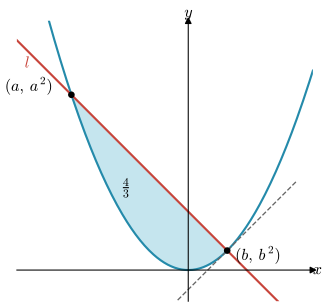
The parabola $y = x^2$ and the line $l$ meet at the points $(a, a^2)$ and $(b, b^2)$, with $a < b$.
- Let $S$ be the area of the region bounded by the parabola and the line $l$. Express $S$ in terms of $a$ and $b$.
- If $l$ is perpendicular to the tangent to the parabola at the point $(b, b^2)$, express $a$ in terms of $b$.
- Under these conditions, find the minimum $m$ of $S$ and the value of $b$ at which it occurs.
Solution
1. The area. The line $l$ lies above the parabola between $a$ and $b$, and the difference is $-(x - a)(x - b)$. So
$$S = \int_a^b -(x - a)(x - b)\,dx = \frac{(b - a)^3}{6}.$$2. The normal line. The slope of $l$ is $\frac{b^2 - a^2}{b - a} = a + b$, and that of the tangent at $b$ is $2b$. Perpendicularity: $(a + b)\cdot2b = -1$, so
$$a = -b - \frac{1}{2b}.$$3. The minimum. $b - a = 2b + \frac{1}{2b}$. For $a < b$ we need $b > 0$. By AM–GM, $2b + \frac{1}{2b} \ge 2$, with equality when $2b = \frac{1}{2b}$, that is, $b = \frac12$. Hence
$$m = \frac{2^3}{6} = \frac43, \qquad b = \frac12.$$(In that case $a = -\frac32$, and the line is $y = -x + \frac34$.)
Answer
- $S = \frac{(b - a)^3}{6}$.
- $a = -b - \frac{1}{2b}$.
- ① $m = \frac43$; ② $b = \frac12$.
Question 3: the intersection of two cylinders
Statement
Consider the solid $B$ formed by the intersection of the cylinders $x^2 + z^2 \le r^2$ and $y^2 + z^2 \le r^2$ ($r > 0$) in $xyz$-space.
- Express the area of the cross-section of $B$ by the plane $z = t$ ($-r \le t \le r$) in terms of $r$ and $t$.
- Express the volume of $B$ in terms of $r$.
Solution
1. The cross-section. In the plane $z = t$, the conditions become $x^2 \le r^2 - t^2$ and $y^2 \le r^2 - t^2$, that is, $|x| \le \sqrt{r^2 - t^2}$ and $|y| \le \sqrt{r^2 - t^2}$. It is a square of side $2\sqrt{r^2 - t^2}$, with area $4(r^2 - t^2)$.
2. The volume. By Cavalieri’s principle,
$$V = \int_{-r}^{r}4(r^2 - t^2)\,dt = 4\left(2r^3 - \frac{2r^3}{3}\right) = \frac{16}{3}r^3.$$This solid is the Steinmetz bicylinder. Archimedes already knew the result: the sphere inscribed in the bicylinder has circular cross-sections inscribed in the squares, and the ratio of the areas is always $\frac{\pi}{4}$. The volume of the sphere, $\frac43\pi r^3$, is exactly $\frac\pi4$ of $\frac{16}{3}r^3$.
Answer
- $4(r^2 - t^2)$.
- $\frac{16}{3}r^3$.