
Euler's Eyes
2022-08-17
Potentiation of integers
Parentheses change the base
Compare (−2)² with −2². Then change the exponent to 3. Does the minus sign belong to the base in both cases?
Em telas pequenas, deslize o gráfico na horizontal para ler os detalhes.
Why might the results be different?
- (−2)² has base −2: (−2) × (−2) = 4.
- −2² indicates the opposite of 2².
- First 2 × 2 = 4; then we take its opposite, −4.
- Therefore, (−2)² = 4 and −2² = −4.
Hippocrates of Chios around 470 BC was the first to mention potentiation, for application in geometry, which served as motivation for the creation of Euclid’s book Elements. In his collections he called the theme “dynamis”, which simply means power.
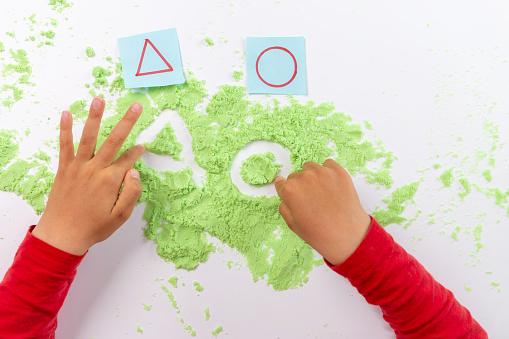
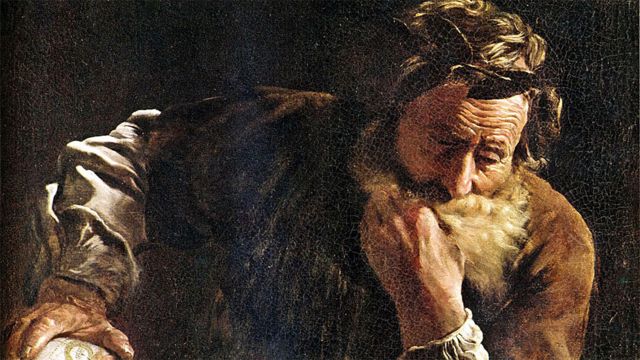
The most significant calculations using dynamis were made by Archimedes of Syracuse around 287 BC. Its applications were in the area of physics, which were used in engineering at the time.
Preliminary notions of potentiation
In the history of mathematics, scholars were known as (exacuo). Other terms also known at the time were nature (phýsis) and evolution (logos). In this way, we obtain the derivations of the terms:
- Exactum is equivalent to Invention
- Exactus is equivalent to Perfect
To understand the evolution of mathematics we have to observe the main historical topics of mathematics.
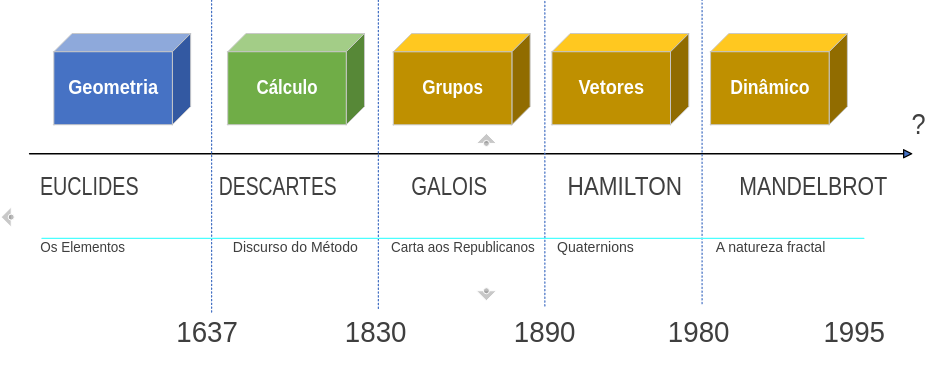
- Years 0 to 1637 - Drawing nature;
- Years 1637 to 1830 - Decode nature;
- Years 1830 to 1890 - Imitate and engineer nature;
- Years 1890 to 1980 - Control nature;
- Years 1980 to today - Create nature.
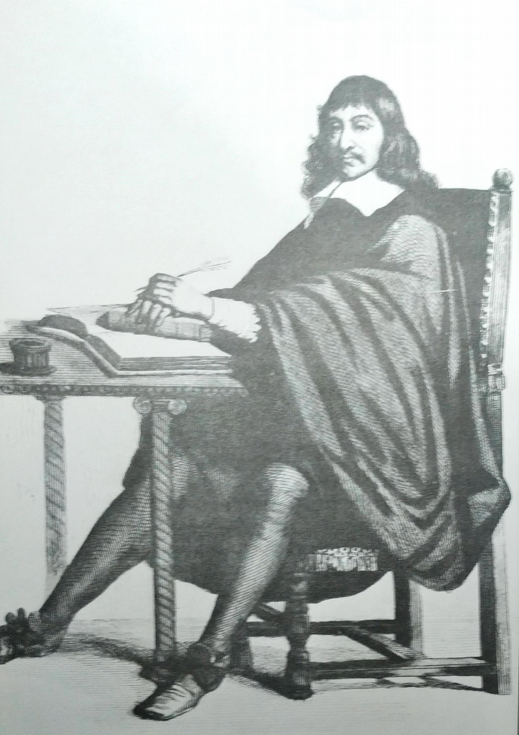
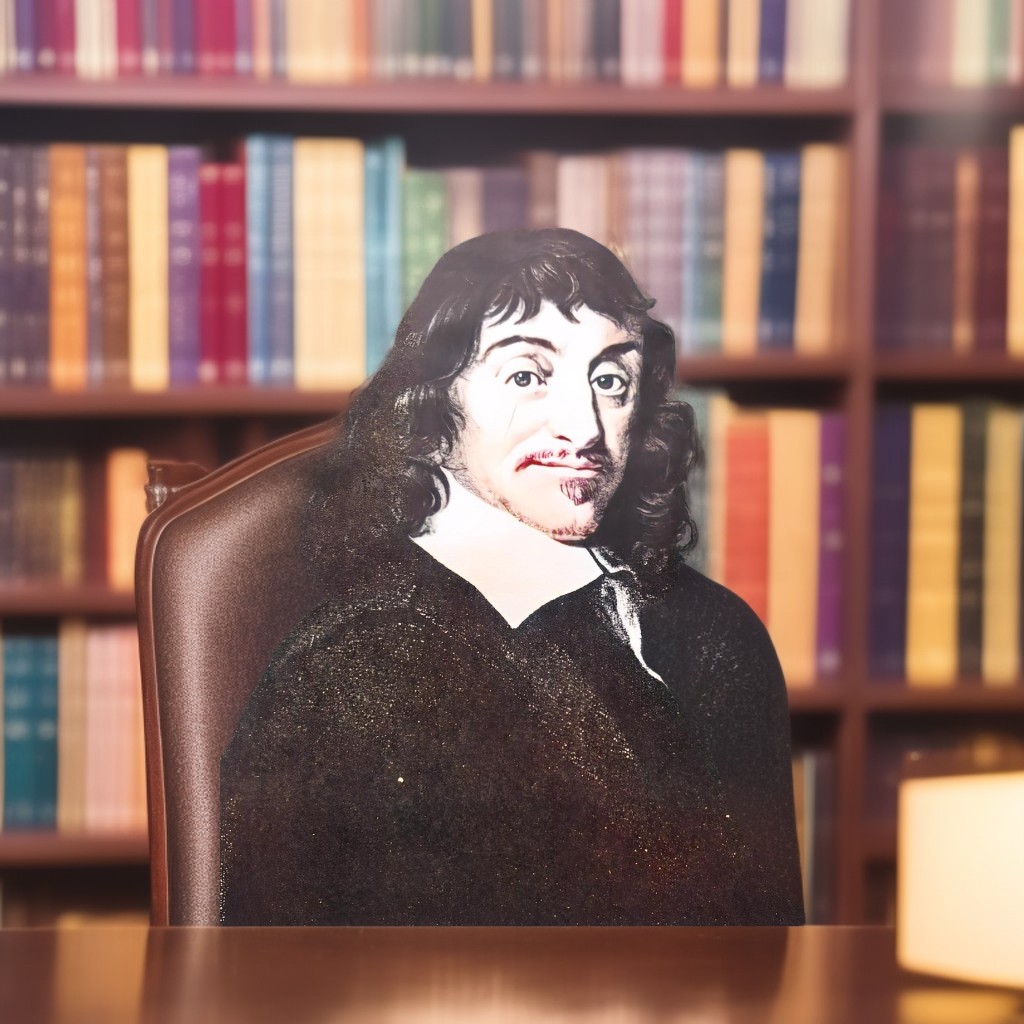
| Rene | Descartes |
|---|---|
|
|
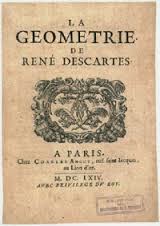
Already in the Middle Ages, these concepts of potentiation were solidified with the philosopher René Descartes around 1596, with his work Geometrie in 1637.
Exponents
The concept of exponent, as said, began with Archimedes, who, when studying volumes, obtained a very, very large number. From this, it began to represent this type of number with a power of 10.

Definition: The number that is presented above the base is called the exponent.
The main study designed by Archimedes for this representation was Sand Grains Counter.
Example: the base of the grains of sand counter is 10.

Ampliar figura para ler os detalhes
The base of the power can be any number, but in this post we will use integers:
$$\mathbb{Z} = \\{\dots, -10, -9, -8, -7, -6, -5, -4, -3, -2, -1, 0 , 1 , 2, 3, 4, 5, 6, 7, 8, 9, 10, \dots\\}$$Power of 10
For example, let’s enter numbers in powers of 10.
| Power of 10 | Equal | Multiple representation of 10 |
|---|---|---|
| $10^1$ | $=$ | 10 |
| $10^2$ | $=$ | 100 |
| $10^3$ | $=$ | 1000 |
| $10^4$ | $=$ | 10000 |
| $10^5$ | $=$ | 100000 |
| $10^6$ | $=$ | 1000000 |
| $10^7$ | $=$ | 10000000 |
| $10^8$ | $=$ | 100000000 |
| $10^9$ | $=$ | 1000000000 |
| $10^{10}$ | $=$ | 10000000000 |
| $10^{11}$ | $=$ | 100000000000 |
| $10^{12}$ | $=$ | 1000000000000 |
The main motivation for using potentiation was used by Archimedes. For this representation, Archimedes called the Counter of Grains of Sand.
How did he come to this conclusion?

Sand Grains Counter: the grains of sand needed to fill a sphere with a radius equal to the distance between the Earth and the Sun is on the order of $10^{51}$ (good idea) 😂😂😂. These numbers were written in the order up to 10000 called the myriad.

In Archimedes’ numbering system, numbers up to a myriad ($10000 = 10^4$).
- Numbering system up to a myriad of myriads ($10000^2 = 10^8$).
Therefore, for the sand grain counter, he needed a numbering system that was greater than $10^8$. So, we checked the idea.
- A myriad of myriad
- $10000 ~.~ 10000 = 10^8$
- Sand Grain Counter
- $10^3 ~.~ 10^8 ~.~ 10^8 ~.~ 10^8 ~.~ 10^8 ~.~ 10^8 ~.~ 10^8 = 10^{51}$
So, how did you expand this rule?
We observe below:
| Power of 10 | Equal | Multiple representation of 10 |
|---|---|---|
| $10$ | $=$ | $10$ |
| $10^2$ | $=$ | $10 ~.~10 = 10^{1+1} = 10^2$ |
| $10^3$ | $=$ | $10 ~.~10 ~.~10 = 10^{1+1+1} = 10^3$ |
| $ \vdots $ | $=$ | $ \vdots $ |
| $10^n$ | $=$ | $10 ~.~\dots~.~10 = 10^n$ |
In general:
Power of 2
With a power concept of 10, we can now talk about the base power 2.

| Power of 2 | Equal | Multiple representation of 2 | $=$ | Exponent | Result |
|---|---|---|---|---|---|
| $2^1$ | $=$ | $2$ | $=$ | $2^1$ | $2$ |
| $2^2$ | $=$ | $2~.~2$ | $=$ | $2^{1+1} =2^1~.~2^1$ | $4$ |
| $2^3$ | $=$ | $2~.~2 ~.~2$ | $=$ | $2^{1+1+1} = 2^2~.~2$ | $8$ |
| $2^4$ | $=$ | $2~.~2 ~.~2~.~2$ | $=$ | $2^{1+1+1+1}= 2^2~.~2^2=4~.~4$ | $16$ |
| $2^5$ | $=$ | $2~.~2 ~.~2~.~2~.~2$ | $=$ | $2^{1+1+1+1+1}= 2^4~.~2$ | $32$ |
| $2^6$ | $=$ | $2~.~2 ~.~2~.~2~.~2~.~2$ | $=$ | $2^{1+1+1+1+1+1} = 2^3~.~2^3 = 8~.~8$ | $64$ |
| $2^7$ | $=$ | $2~.~2 ~.~2~.~2~.~2~.~2~.~2$ | $=$ | $2^{1+1+1+1+1+1+1} = 2^6~.~2$ | $128$ |
| $2^8$ | $=$ | $2~.~2 ~.~2~.~2~.~2~.~2~.~2~.~2$ | $=$ | $2^{1+1+1+1+1+1+1+1}= 2^4~.~2^4 = 16 ~.~16$ | $256$ |
| $2^9$ | $=$ | $2~.~2 ~.~2~.~2~.~2~.~2~.~2~.~2~.~2$ | $=$ | $2^{1+1+1+1+1+1+1+1+1} = 2^8~.~2$ | $512$ |
| $2^{10}$ | $=$ | $2~.~2 ~.~2~.~2~.~2~.~2~.~2~.~2~.~2~.~2$ | $=$ | $2^{1+1+1+1+1+1+1+1+1+1}=2^5~.~2^5 = 32~.~32$ | $1024$ |
Power of 3
With a power concept of 10, we can now talk about the base power 3.
| Power of 3 | Equal | Multiple representation of 3 | $=$ | Exponent | Result |
|---|---|---|---|---|---|
| $3^1$ | $=$ | $3$ | $=$ | $3^1$ | $3$ |
| $3^3$ | $=$ | $3~.~3$ | $=$ | $3^{1+1} =3^1~.~3^1$ | $9$ |
| $3^3$ | $=$ | $3~.~3 ~.~3$ | $=$ | $3^{1+1+1} = 3^2~.~3$ | $27$ |
| $3^4$ | $=$ | $3~.~3 ~.~3~.~3$ | $=$ | $3^{1+1+1+1}= 3^2~.~3^2=9~.~9$ | $81$ |
| $3^5$ | $=$ | $3~.~3 ~.~3~.~3~.~3$ | $=$ | $3^{1+1+1+1+1}= 3^4~.~3$ | $243$ |
| $3^6$ | $=$ | $3~.~3 ~.~3~.~3~.~3~.~3$ | $=$ | $3^{1+1+1+1+1+1} = 3^3~.~3^3 = 27~.~27$ | $729$ |
| $3^7$ | $=$ | $3~.~3 ~.~3~.~3~.~3~.~3~.~3$ | $=$ | $3^{1+1+1+1+1+1+1} = 3^6~.~3$ | $2187$ |
| $3^8$ | $=$ | $3~.~3 ~.~3~.~3~.~3~.~3~.~3~.~3$ | $=$ | $3^{1+1+1+1+1+1+1+1}= 3^4~.~3^4 = 81 ~.~81$ | $6561$ |
| $3^9$ | $=$ | $3~.~3 ~.~3~.~3~.~3~.~3~.~3~.~3~.~3$ | $=$ | $3^{1+1+1+1+1+1+1+1+1} = 3^8~.~3$ | $19683$ |
| $3^{10}$ | $=$ | $3~.~3 ~.~3~.~3~.~3~.~3~.~3~.~3~.~3~.~3$ | $=$ | $3^{1+1+1+1+1+1+1+1+1+1}=3^5~.~3^5=243~.~243$ | $59049$ |
General case
With some cases given in the previous sections, we can extend to the case. Seka $k$ an integer $(k \in \mathbb{Z})$ and $n$ an exponent with a natural number $(n\in \mathbb{N})$.
| Power of $k$ | Number groups |
|---|---|
| $k^n$ | $k \in \mathbb{Z}, \quad n\in \mathbb{N}$ |
Examples
To establish the concepts, we take $k\in \mathbb{Z}$ an integer and $n\in \mathbb{N}$ a natural number.
| $k\in \mathbb{Z}$ integer | Power sets |
|---|---|
| $-6$ | $(-6)^n=\\{(-6)^1, (-6)^2, (-6)^3, (-6)^4, \dots\\} $ |
| $-5$ | $(-5)^n=\\{(-5)^1, (-5)^2, (-5)^3, (-5)^4, \dots\\} $ |
| $-4$ | $(-4)^n=\\{(-4)^1, (-4)^2, (-4)^3, (-4)^4, \dots\\} $ |
| $-3$ | $(-3)^n=\\{(-3)^1, (-3)^2, (-3)^3, (-3)^4, \dots\\} $ |
| $-2$ | $(-2)^n=\\{(-2)^1, (-2)^2, (-2)^3, (-2)^4, \dots\\} $ |
| $-1$ | $(-1)^n=\\{(-1)^1, (-1)^2, (-1)^3, (-1)^4, \dots\\} $ |
| $1$ | $1^n=\\{1^1, 1^2, 1^3, 1^4, \dots\\} $ |
| $2$ | $2^n=\\{2^1, 2^2, 2^3, 2^4, \dots\\} $ |
| $3$ | $3^n=\\{3^1, 3^2, 3^3, 3^4, \dots\\} $ |
| $4$ | $4^n=\\{4^1, 4^2, 4^3, 4^4, \dots\\} $ |
| $5$ | $5^n=\\{5^1, 5^2, 5^3, 5^4, \dots\\} $ |
| $6$ | $6^n=\\{6^1, 6^2, 6^3, 6^4, \dots\\} $ |
There are some properties for powers. However, we will leave it for later, as we first need the sign rule.